Cassia Raúl, Nocioni Macarena, Correa-Aragunde Natalia, Lamattina Lorenzo
Instituto de Investigaciones Biológicas, Facultad de Ciencias Exactas y Naturales, Universidad Nacional de Mar del Plata-Consejo Nacional de Investigaciones Científicas y Técnicas, Mar del Plata, Argentina.
Front Plant Sci. 2018 Mar 1;9:273. doi: 10.3389/fpls.2018.00273. eCollection 2018.
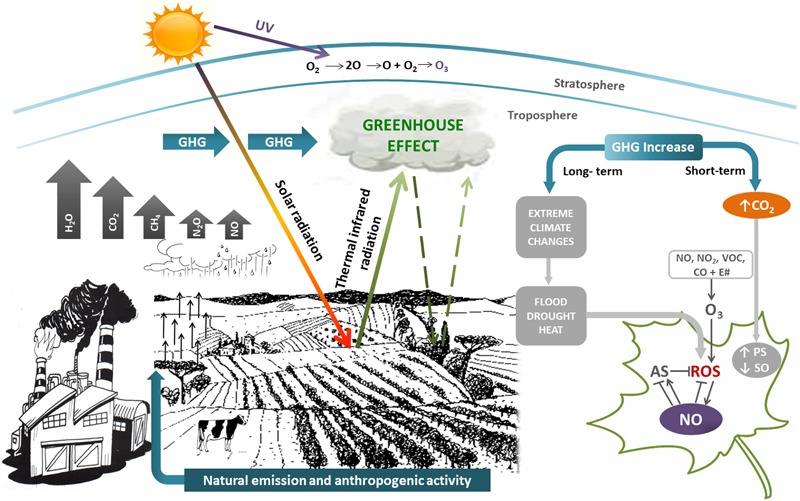
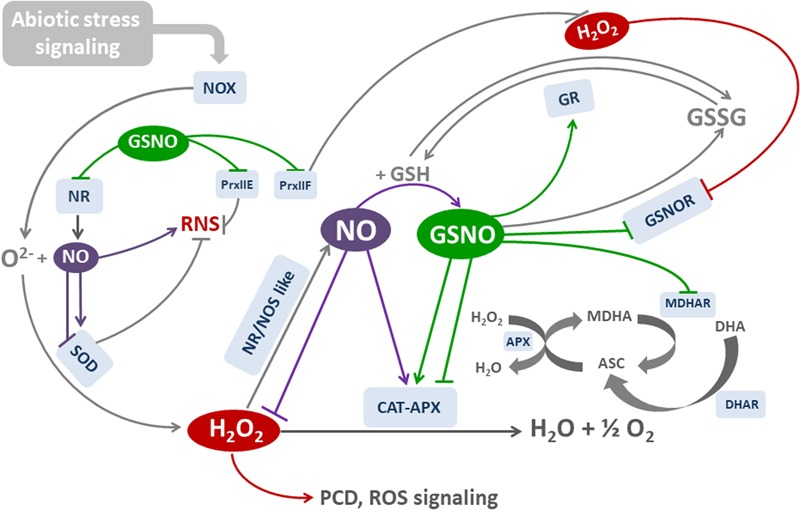
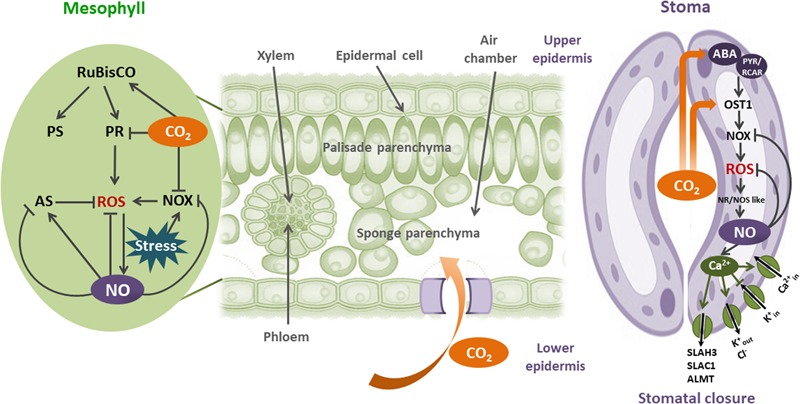
Here, we review information on how plants face redox imbalance caused by climate change, and focus on the role of nitric oxide (NO) in this response. Life on Earth is possible thanks to greenhouse effect. Without it, temperature on Earth's surface would be around -19°C, instead of the current average of 14°C. Greenhouse effect is produced by greenhouse gasses (GHG) like water vapor, carbon dioxide (CO), methane (CH), nitrous oxides (NO) and ozone (O). GHG have natural and anthropogenic origin. However, increasing GHG provokes extreme climate changes such as floods, droughts and heat, which induce reactive oxygen species (ROS) and oxidative stress in plants. The main sources of ROS in stress conditions are: augmented photorespiration, NADPH oxidase (NOX) activity, β-oxidation of fatty acids and disorders in the electron transport chains of mitochondria and chloroplasts. Plants have developed an antioxidant machinery that includes the activity of ROS detoxifying enzymes [e.g., superoxide dismutase (SOD), ascorbate peroxidase (APX), catalase (CAT), glutathione peroxidase (GPX), and peroxiredoxin (PRX)], as well as antioxidant molecules such as ascorbic acid (ASC) and glutathione (GSH) that are present in almost all subcellular compartments. CO and NO help to maintain the redox equilibrium. Higher CO concentrations increase the photosynthesis through the CO-unsaturated Rubisco activity. But Rubisco photorespiration and NOX activities could also augment ROS production. NO regulate the ROS concentration preserving balance among ROS, GSH, GSNO, and ASC. When ROS are in huge concentration, NO induces transcription and activity of SOD, APX, and CAT. However, when ROS are necessary (e.g., for pathogen resistance), NO may inhibit APX, CAT, and NOX activity by the S-nitrosylation of cysteine residues, favoring cell death. NO also regulates GSH concentration in several ways. NO may react with GSH to form GSNO, the NO cell reservoir and main source of S-nitrosylation. GSNO could be decomposed by the GSNO reductase (GSNOR) to GSSG which, in turn, is reduced to GSH by glutathione reductase (GR). GSNOR may be also inhibited by S-nitrosylation and GR activated by NO. In conclusion, NO plays a central role in the tolerance of plants to climate change.
在此,我们回顾了有关植物如何应对气候变化引起的氧化还原失衡的信息,并着重探讨了一氧化氮(NO)在这一反应中的作用。由于温室效应,地球上才有生命存在。没有温室效应,地球表面温度将约为-19°C,而非目前的平均14°C。温室效应由水蒸气、二氧化碳(CO₂)、甲烷(CH₄)、氧化亚氮(N₂O)和臭氧(O₃)等温室气体(GHG)产生。温室气体有自然和人为来源。然而,温室气体增加引发了洪水、干旱和高温等极端气候变化,这些变化会在植物中诱导活性氧(ROS)和氧化应激。应激条件下ROS的主要来源包括:光呼吸增强、NADPH氧化酶(NOX)活性、脂肪酸的β-氧化以及线粒体和叶绿体电子传递链紊乱。植物已形成一种抗氧化机制,其中包括ROS解毒酶[如超氧化物歧化酶(SOD)、抗坏血酸过氧化物酶(APX)、过氧化氢酶(CAT)、谷胱甘肽过氧化物酶(GPX)和过氧化物还原酶(PRX)]的活性,以及几乎存在于所有亚细胞区室中的抗氧化分子,如抗坏血酸(ASC)和谷胱甘肽(GSH)。CO₂和NO有助于维持氧化还原平衡。较高的CO₂浓度通过CO₂不饱和的核酮糖-1,5-二磷酸羧化酶/加氧酶(Rubisco)活性增加光合作用。但Rubisco光呼吸和NOX活性也可能增加ROS的产生。NO调节ROS浓度,维持ROS、GSH、GSNO和ASC之间的平衡。当ROS浓度过高时,NO诱导SOD、APX和CAT的转录和活性。然而,当ROS有必要时(如用于抗病),NO可能通过半胱氨酸残基的S-亚硝基化抑制APX、CAT和NOX活性,促进细胞死亡。NO还通过多种方式调节GSH浓度。NO可能与GSH反应形成GSNO,即NO细胞储存库和S-亚硝基化的主要来源。GSNO可被GSNO还原酶(GSNOR)分解为氧化型谷胱甘肽(GSSG),而GSSG又可被谷胱甘肽还原酶(GR)还原为GSH。GSNOR也可能被S-亚硝基化抑制,而GR被NO激活。总之,NO在植物对气候变化的耐受性中起着核心作用。