a Department of Pharmaceutics and Industrial Pharmacy, Faculty of Pharmacy , Cairo University , Cairo , Egypt.
b Department of Pharmaceutics and Industrial Pharmacy, Faculty of Pharmacy , October 6 University , Giza , Egypt.
Drug Deliv. 2018 Nov;25(1):815-826. doi: 10.1080/10717544.2018.1451572.
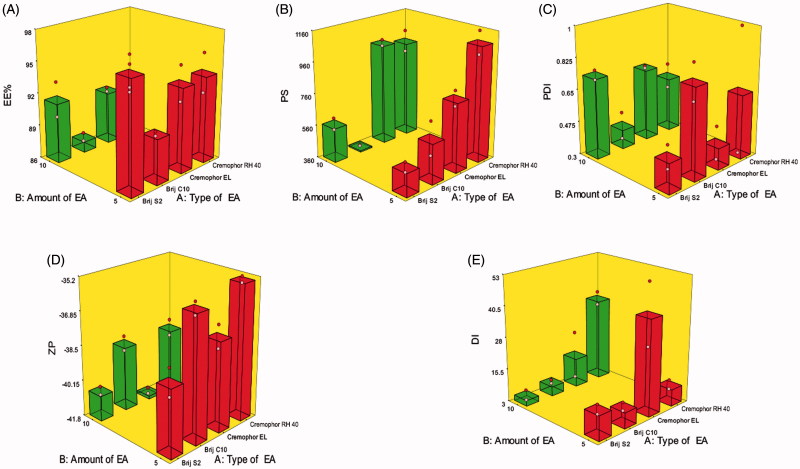
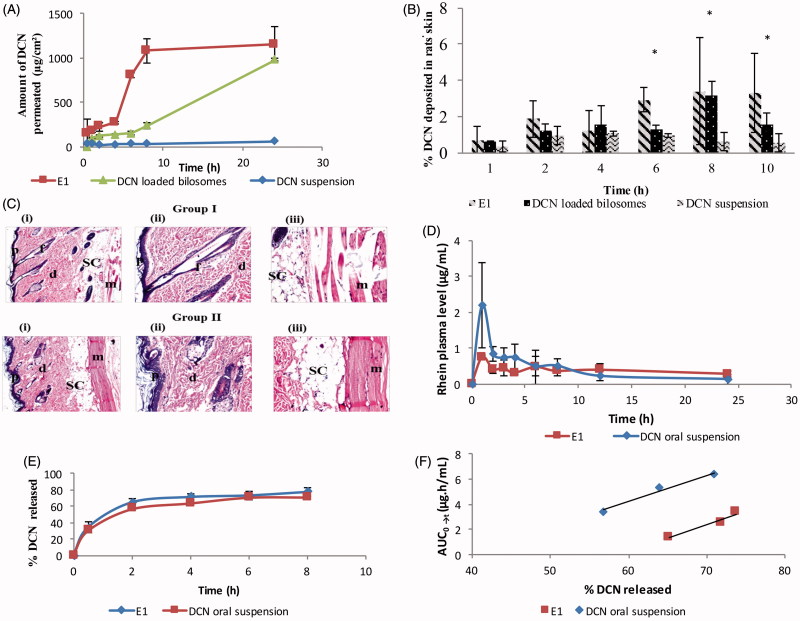
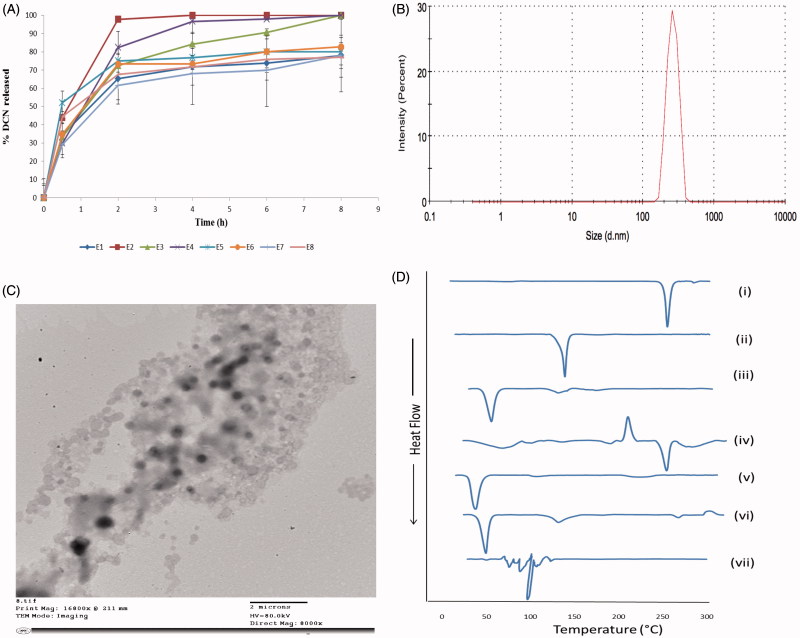
Diacerein (DCN) is a hydrophobic osteoarthritis (OA) drug with short half-life and low oral bioavailability. Furthermore, DCN oral administration is associated with diarrhea which represents obstacle against its oral use. Hence, this article aimed at developing elastosomes (edge activator (EA)-based vesicular nanocarriers) as a novel transdermal system for delivering DCN efficiently and avoiding its oral problems. For achieving this goal, elastosomes were prepared according to 4.2 full factorial design using different EAs in varying amounts. The prepared formulae were characterized regarding their entrapment efficiency percentage (EE%), particle size (PS), polydispersity index (PDI), zeta potential (ZP) and deformability index (DI). Desirability function was employed using Design-Expert software to select the optimal elastosomes (E1) which showed EE% of 96.25 ± 2.19%, PS of 506.35 ± 44.61 nm, PDI of 0.46 ± 0.09, ZP of -38.65 ± 0.91 mV, and DI of 12.74 ± 2.63 g. In addition, E1 was compared to DCN-loaded bilosomes and both vesicles exhibited superior skin permeation potential and retention capacity compared to drug suspension. In-vivo histopathological study was performed which ensured the safety of E1 for topical application. Furthermore, the pharmacokinetic study conducted in albino rabbits demonstrated that there was no significant difference in the rate and extent of DCN absorption from topically applied E1 compared to oral suspension. Multiple level C in-vitro in-vivo correlation showed good correlation between in-vitro release and in-vivo drug performance for E1 and DCN oral suspension. Overall, results confirmed the admirable potential of E1 to be utilized as novel carrier for transdermal delivery of DCN and bypassing its oral side effects.
双醋瑞因(DCN)是一种疏水性骨关节炎(OA)药物,半衰期短,口服生物利用度低。此外,DCN 口服给药与腹泻有关,这是其口服应用的障碍。因此,本文旨在开发弹性体(基于边缘激活剂(EA)的囊泡纳米载体)作为一种新型透皮系统,高效递送 DCN 并避免其口服问题。为了实现这一目标,根据 4.2 全因子设计,使用不同量的 EA 制备弹性体。对制备的配方进行了包封效率百分比(EE%)、粒径(PS)、多分散指数(PDI)、Zeta 电位(ZP)和变形指数(DI)的特征描述。使用 Design-Expert 软件中的期望函数选择最佳弹性体(E1),其 EE%为 96.25±2.19%,PS 为 506.35±44.61nm,PDI 为 0.46±0.09,ZP 为-38.65±0.91mV,DI 为 12.74±2.63g。此外,将 E1 与载有 DCN 的双脂质体进行比较,两种囊泡均表现出优于药物混悬剂的皮肤渗透潜力和保留能力。进行了体内组织病理学研究,确保了 E1 局部应用的安全性。此外,在白化兔中进行的药代动力学研究表明,与口服混悬剂相比,E1 局部应用时 DCN 的吸收速度和程度没有显著差异。体外-体内多水平 C 相关研究表明,E1 和 DCN 口服混悬剂的体外释放与体内药物性能之间具有良好的相关性。总体而言,结果证实了 E1 作为 DCN 透皮递送新型载体的令人钦佩的潜力,并可避免其口服副作用。