Gholami Mehrdad, Haghshenas Mohammadreza, Moshiri Mona, Razavi Shabnam, Pournajaf Abazar, Irajian Gholamreza, Heidary Mohsen
Dept. of Microbiology, Faculty of Medicine, Iran University of Medical Sciences, Tehran, Iran.
Microbial Biotechnology Research Center, Iran University of Medical Sciences, Tehran, Iran.
Iran J Pathol. 2017 Fall;12(4):329-338. Epub 2017 Oct 1.
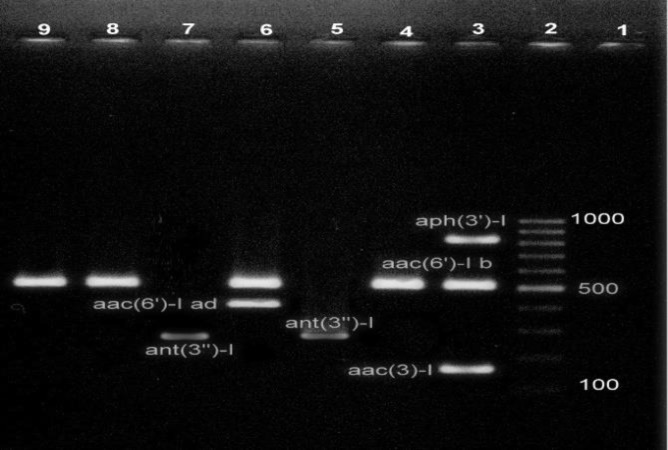
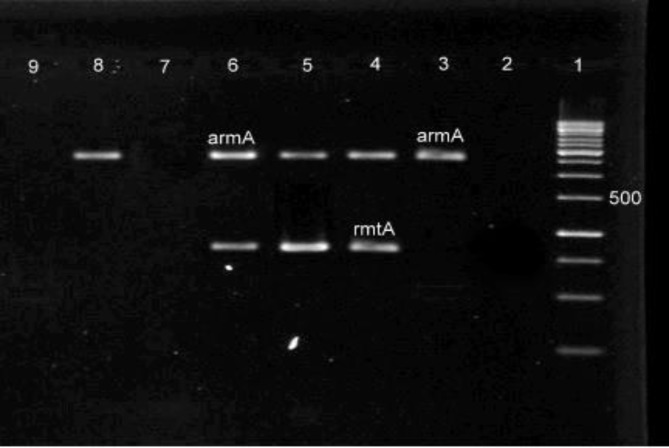
BACKGROUND & OBJECTIVE: Multidrug-resistant (MDR-AB) is an important nosocomial pathogen which is associated with significant morbidity and mortality, particularly in high-risk populations. Aminoglycoside-modifying enzymes (AMEs) and 16S ribosomal RNA (16S rRNA) methylation are two important mechanisms of resistance to aminoglycosides. The aim of this study was to determine the prevalence of 16S rRNA methylase (, , , , and ), and the AME genes [, , , and ], among clinical isolates of in Tehran, Iran.
Between November 2015 to July 2016, a total of 110 clinical strains of were isolated from patients in two teaching hospitals in Tehran, Iran. Antimicrobial susceptibility testing was performed according to Clinical and Laboratory Standards Institute guidelines. The presence of genes encoding the AMEs and 16S rRNA methylases responsible for resistance was investigated by multiplex polymerase chain reaction.
The results showed that colistin was an effective antibiotic and could be used as a last-resort treatment of infections caused by MDR-AB The resistance rate to aminoglycosides were 100%, 96.36% and 90.9% for tobramycin, gentamicin and amikacin, respectively. In this study, AME genes of , and were most prevalent among the isolated strains.
Markedly high resistance to tobramycin, gentamicin and amikacin was noted in current study. Our results suggested that modifying enzyme genes in conjunction with methylation of 16S rRNA might contribute to aminoglycoside resistance induced in vivo in . Further studies are required to determine the prevalence of the aminoglycoside resistance genes in other hospitals of Iran.
多重耐药鲍曼不动杆菌(MDR-AB)是一种重要的医院病原体,与显著的发病率和死亡率相关,尤其是在高危人群中。氨基糖苷类修饰酶(AMEs)和16S核糖体RNA(16S rRNA)甲基化是对氨基糖苷类耐药的两个重要机制。本研究的目的是确定伊朗德黑兰临床分离的鲍曼不动杆菌中16S rRNA甲基化酶(armA、rmtA、rmtB、rmtC和npmA)以及AME基因(aac(6')-Ib-cr、ant(3")-Ia、aph(3')-IIIa、aadA1和aac(3)-IIa)的流行情况。
2015年11月至2016年7月期间,从伊朗德黑兰的两家教学医院的患者中总共分离出110株鲍曼不动杆菌临床菌株。根据临床和实验室标准协会指南进行抗菌药物敏感性测试。通过多重聚合酶链反应研究负责耐药的AMEs和16S rRNA甲基化酶编码基因的存在情况。
结果表明,黏菌素是一种有效的抗生素,可作为MDR-AB引起的感染的最后手段治疗药物。对庆大霉素、妥布霉素和阿米卡星的耐药率分别为100%、96.36%和90.9%。在本研究中,aac(6')-Ib-cr、ant(3")-Ia和aph(3')-IIIa的AME基因在分离菌株中最为普遍。
在当前研究中,观察到对妥布霉素、庆大霉素和阿米卡星的耐药性明显很高。我们的结果表明,修饰酶基因与16S rRNA甲基化可能共同导致鲍曼不动杆菌体内诱导的氨基糖苷类耐药。需要进一步研究以确定伊朗其他医院中氨基糖苷类耐药基因的流行情况。