Clinical Research Directorate/Clinical Monitoring Research Program, Leidos Biomedical Research, Inc., NCI Campus at Frederick, Frederick, MD, United States of America.
Evidera Evidence, Value & Access by PPD, Seattle, WA, United States of America.
PLoS One. 2018 Mar 22;13(3):e0194180. doi: 10.1371/journal.pone.0194180. eCollection 2018.
The inFLUenza Patient Reported Outcome (FLU-PRO) measure is a daily diary assessing signs/symptoms of influenza across six body systems: Nose, Throat, Eyes, Chest/Respiratory, Gastrointestinal, Body/Systemic, developed and tested in adults with influenza.
This study tested the reliability, validity, and responsiveness of FLU-PRO scores in adults with influenza-like illness (ILI).
Data from the prospective, observational study used to develop and test the FLU-PRO in influenza virus positive patients were analyzed. Adults (≥18 years) presenting with influenza symptoms in outpatient settings in the US, UK, Mexico, and South America were enrolled, tested for influenza virus, and asked to complete the 37-item draft FLU-PRO daily for up to 14-days. Analyses were performed on data from patients testing negative. Reliability of the final, 32-item FLU-PRO was estimated using Cronbach's alpha (α; Day 1) and intraclass correlation coefficients (ICC; 2-day reproducibility). Convergent and known-groups validity were assessed using patient global assessments of influenza severity (PGA). Patient report of return to usual health was used to assess responsiveness (Day 1-7).
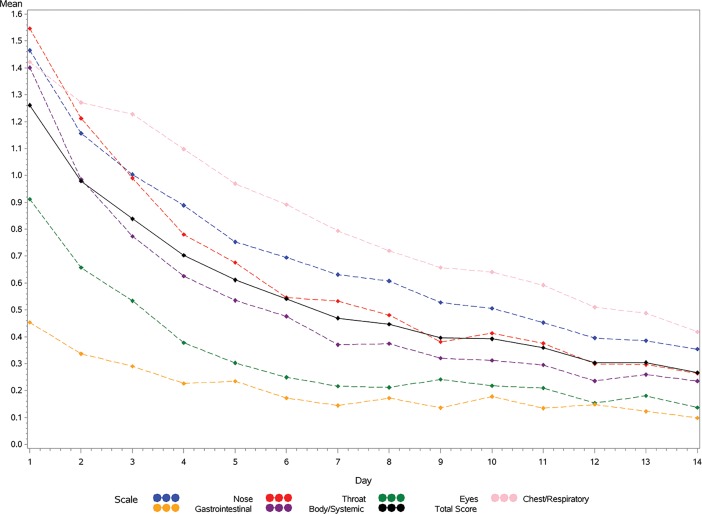
The analytical sample included 220 ILI patients (mean age = 39.3, 64.1% female, 88.6% white). Sixty-one (28%) were hospitalized at some point in their illness. Internal consistency reliability (α) of FLU-PRO Total score was 0.90 and ranged from 0.72-0.86 for domain scores. Reproducibility (Day 1-2) was 0.64 for Total, ranging from 0.46-0.78 for domain scores. Day 1 FLU-PRO scores correlated (≥0.30) with the PGA (except Gastrointestinal) and were significantly different across PGA severity groups (Total: F = 81.7, p<0.001; subscales: F = 6.9-62.2; p<0.01). Mean score improvements Day 1-7 were significantly greater in patients reporting return to usual health compared with those who did not (p<0.05, Total and subscales, except Gastrointestinal and Eyes).
Results suggest FLU-PRO scores are reliable, valid, and responsive in adults with influenza-like illness.
流感患者报告结局(FLU-PRO)量表是一种日常日记,评估六种身体系统的流感体征/症状:鼻子、喉咙、眼睛、胸部/呼吸、胃肠道、全身/系统,在患有流感的成年人中开发和测试。
本研究测试了流感样疾病(ILI)成年人中 FLU-PRO 评分的可靠性、有效性和反应性。
使用前瞻性、观察性研究的数据进行分析,该研究用于开发和测试流感病毒阳性患者的 FLU-PRO。在美国、英国、墨西哥和南美洲的门诊环境中出现流感症状的成年人(≥18 岁)入组,检测流感病毒,并要求他们每天最多填写 37 项草稿 FLU-PRO 14 天。对检测为阴性的患者的数据进行分析。使用 Cronbach's alpha(α;第 1 天)和组内相关系数(ICC;2 天可重复性)评估最终 32 项 FLU-PRO 的可靠性。使用患者对流感严重程度的总体评估(PGA)评估聚合和已知组的有效性。使用患者恢复到正常健康的报告来评估反应性(第 1-7 天)。
分析样本包括 220 例 ILI 患者(平均年龄=39.3,64.1%女性,88.6%白人)。61 例(28%)在疾病过程中的某个时间点住院。FLU-PRO 总分的内部一致性可靠性(α)为 0.90,范围为 0.72-0.86。(Day 1-2)的可重复性为 0.64,范围为 0.46-0.78。第 1 天的 FLU-PRO 评分与 PGA(除胃肠道外)相关(≥0.30),并且在 PGA 严重程度组之间存在显着差异(总分:F=81.7,p<0.001;子量表:F=6.9-62.2;p<0.01)。与未报告恢复正常健康的患者相比,报告恢复正常健康的患者在第 1-7 天的平均评分改善显着更大(p<0.05,总分和子量表,除胃肠道和眼睛外)。
结果表明,FLU-PRO 评分在患有流感样疾病的成年人中具有可靠性、有效性和反应性。