West China Hospital Emergency Department (WCHED), State Key Laboratory of Biotherapy and Cancer Center, West China Hospital, Sichuan University, and Collaborative Innovation Center of Biotherapy, Chengdu, Sichuan, 610041, China.
CAS Key Laboratory of Pathogenic Microbiology and Immunology, Institute of Microbiology, Chinese Academy of Sciences, 100101, Beijing, China.
Nat Commun. 2018 Mar 22;9(1):1196. doi: 10.1038/s41467-018-03625-x.
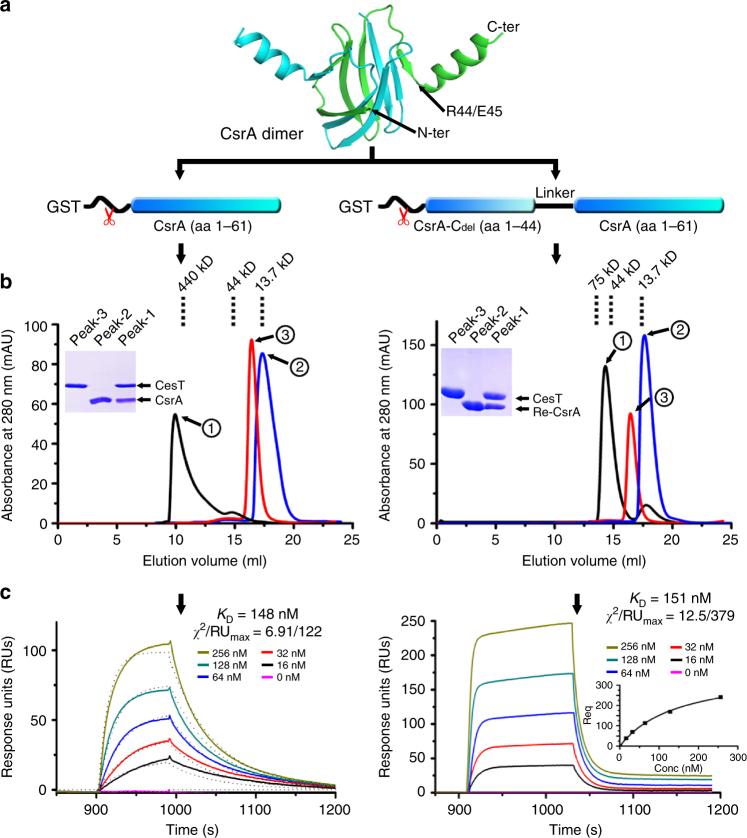
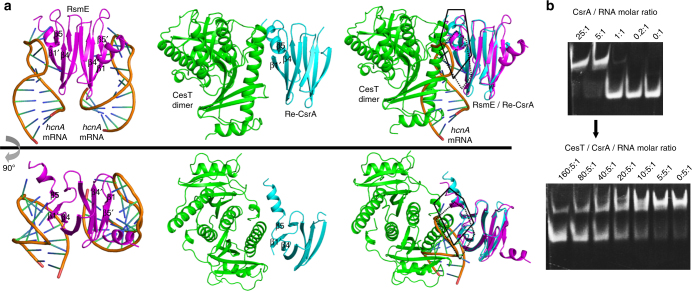
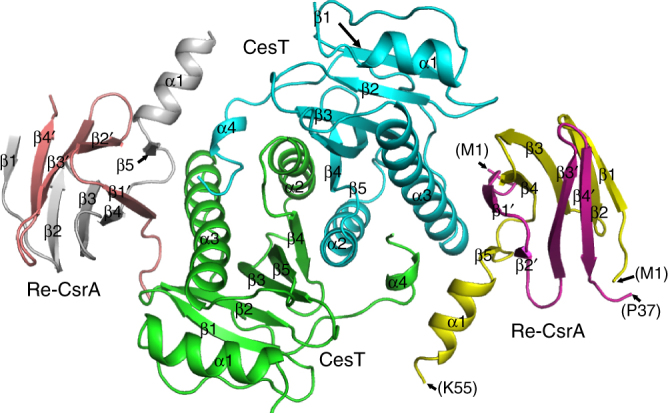
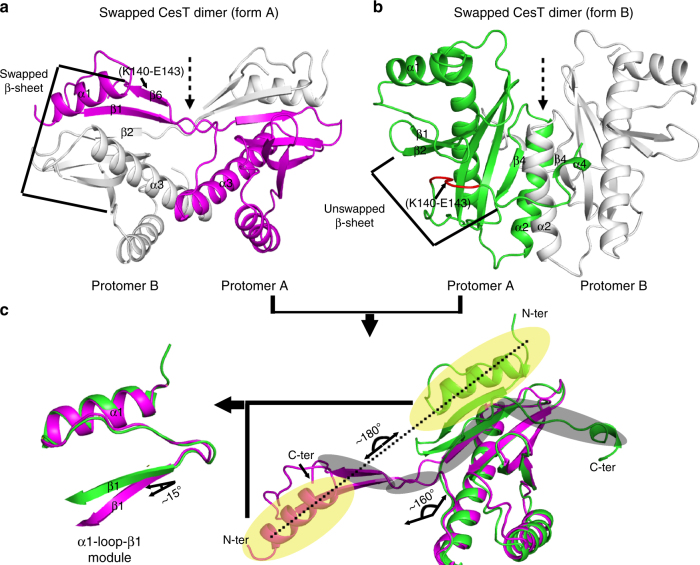
The T3SS chaperone CesT is recently shown to interact with the post-transcriptional regulator CsrA to modulate post-attachment signaling in enteropathogenic and enterohemorrhagic Escherichia coli. The molecular basis of the CesT/CsrA binding, however, remains elusive. Here, we show that CesT and CsrA both created two ligand binding sites in their homodimers, forming irregular multimeric complexes in solution. Through construction of a recombinant CsrA-dimer (Re-CsrA) that contains a single CesT binding site, the atomic binding features between CesT and CsrA are delineated via the structure of the CesT/Re-CsrA complex. In contrast to a previously reported N-terminally swapped dimer-form, CesT adopts a dimeric architecture with a swapped C-terminal helix for CsrA engagement. In CsrA, CesT binds to a surface patch that extensively overlaps with its mRNA binding site. The binding mode therefore justifies a mechanism of CsrA-modulation by CesT via competitive inhibition of the CsrA/mRNA interactions.
T3SS 伴侣蛋白 CesT 最近被证明与转录后调节剂 CsrA 相互作用,从而调节肠致病性和肠出血性大肠杆菌中的附着后信号。然而,CesT/CsrA 结合的分子基础仍然难以捉摸。在这里,我们表明 CesT 和 CsrA 在它们的同源二聚体中都创建了两个配体结合位点,在溶液中形成不规则的多聚体复合物。通过构建包含单个 CesT 结合位点的重组 CsrA-二聚体(Re-CsrA),通过 CesT/Re-CsrA 复合物的结构描绘了 CesT 和 CsrA 之间的原子结合特征。与之前报道的 N 端交换二聚体形式相反,CesT 采用了一种二聚体结构,其 C 端螺旋发生了交换,用于与 CsrA 结合。在 CsrA 中,CesT 结合到一个表面斑块上,该斑块与它的 mRNA 结合位点广泛重叠。因此,这种结合模式证明了 CesT 通过竞争性抑制 CsrA/mRNA 相互作用来调节 CsrA 的机制。