Tamura Yuya, Kanomata Kyohei, Kitaoka Takuya
Department of Agro-Environmental Sciences, Graduate School of Bioresource and Bioenvironmental Sciences, Kyushu University, 6-10-1 Hakozaki, Higashi-ku, Fukuoka, 812-8581, Japan.
Sci Rep. 2018 Mar 22;8(1):5021. doi: 10.1038/s41598-018-23381-8.
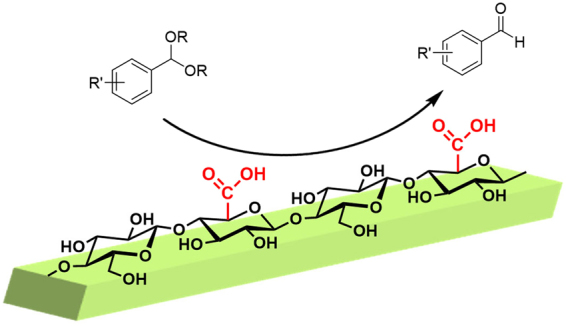
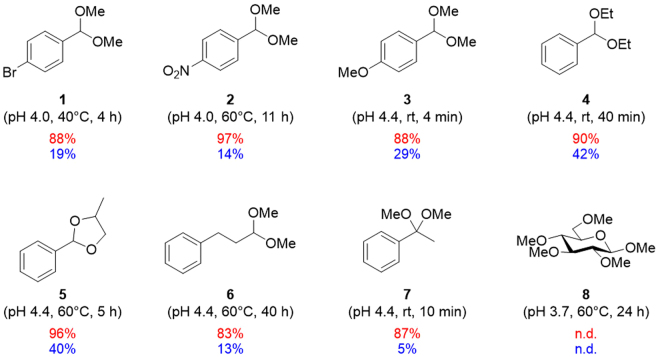
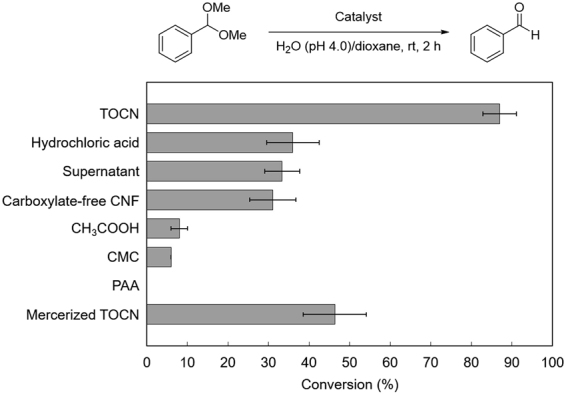
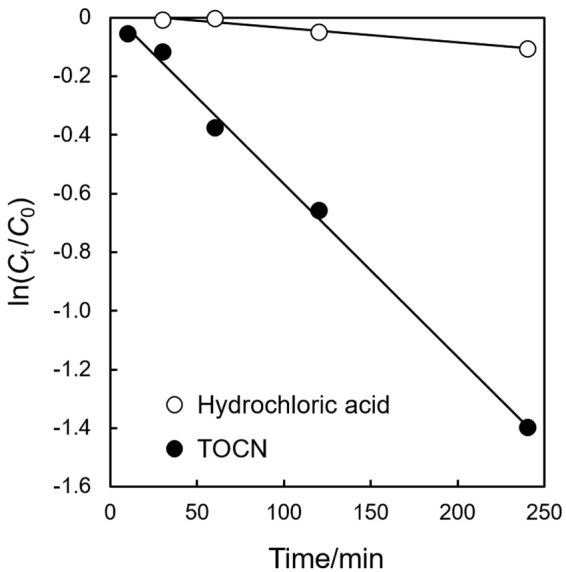
2,2,6,6-Tetramethylpiperidine-1-oxyl (TEMPO)-oxidized cellulose nanofibers (TOCNs), which have a high-density of exposed carboxylic acid groups on their crystalline surfaces, effectively act as acid catalysts in acetal hydrolysis. Carboxy-free cellulose nanofibers, polymeric carboxylic acids, and homogeneous acetic acid do not show significant catalytic activity under the same reaction conditions. Mercerized TOCNs differing from the original TOCNs in a crystalline structure were also ineffective, which suggests that the unique nanoarchitectural features of TOCNs, such as regularly aligned carboxylic acid groups, large specific surface areas, and structural rigidity, must be major factors in the acceleration of acetal hydrolysis. Kinetic analysis suggested that substrates and/or acid catalyst species were concentrated on the TOCN crystalline surfaces, which significantly enhanced the catalytic activity.
2,2,6,6-四甲基哌啶-1-氧基(TEMPO)氧化纤维素纳米纤维(TOCNs)在其晶体表面具有高密度的暴露羧酸基团,在缩醛水解中有效地充当酸催化剂。无羧基纤维素纳米纤维、聚合羧酸和均相乙酸在相同反应条件下没有显示出显著的催化活性。与原始TOCNs晶体结构不同的丝光处理TOCNs也没有效果,这表明TOCNs独特的纳米结构特征,如规则排列的羧酸基团、大比表面积和结构刚性,一定是加速缩醛水解的主要因素。动力学分析表明,底物和/或酸催化剂物种集中在TOCN晶体表面,这显著提高了催化活性。