1National Institute for Health Research Health Protection Research Unit in Healthcare Associated Infections and Antimicrobial Resistance, Imperial College London, Hammersmith Campus, Du Cane Road, London, W12 0NN UK.
2Imperial College Healthcare NHS Trust, Du Cane Road, London, W12 0HS UK.
Antimicrob Resist Infect Control. 2018 Mar 20;7:43. doi: 10.1186/s13756-018-0333-1. eCollection 2018.
We developed a personalised antimicrobial information module co-designed with patients. This study aimed to evaluate the potential impact of this patient-centred intervention on short-term knowledge and understanding of antimicrobial therapy in secondary care.
Thirty previous patients who had received antibiotics in hospital within 12 months were recruited to co-design an intervention to promote patient engagement with infection management. Two workshops, containing five focus-groups were held. These were audio-recorded. Data were analysed using a thematic framework developed deductively based on previous work. Line-by-line coding was performed with new themes added to the framework by two researchers. This was used to inform the development of a patient information module, embedded within an electronic decision support tool (CDSS).The intervention was piloted over a four-week period at Imperial College Healthcare NHS Trust on 30 in-patients. Pre- and post-intervention questionnaires were developed and implemented to assess short term changes in patient knowledge and understanding and provide feedback on the intervention. Data were analysed using SPSS and NVIVO software.
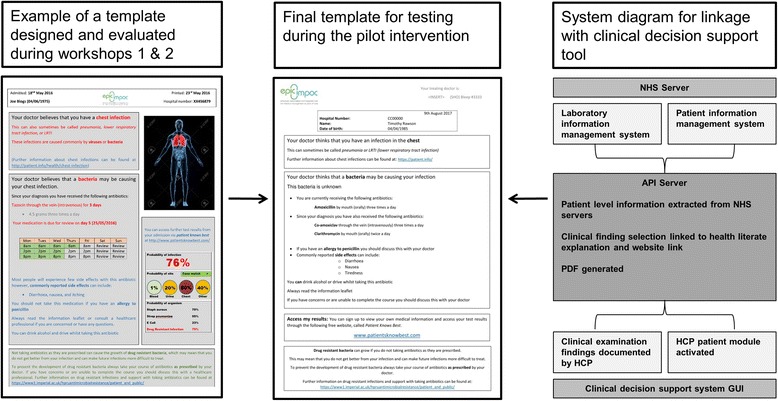
Within the workshops, there was consistency in identified themes. The participants agreed upon and co-designed a personalised PDF document that could be integrated into an electronic CDSS to be used by healthcare professionals at the point-of-care. Their aim for the tool was to provide individualised practical information, signpost to reputable information sources, and enhance communication between patients and healthcare professionals.Eighteen out of thirty in-patients consented to participant in the pilot evaluation with 15/18(83%) completing the study. Median (range) age was 66(22-85) years. The majority were male (10/15;66%). Pre-intervention, patients reported desiring further information regarding their infections and antibiotic therapy, including side effects of treatment. Deployment of the intervention improved short term knowledge and understanding of individuals infections and antibiotic management with median (IQR) scores improving from 3(2-5)/13 to 10(6-11)/13. 13/15(87%) reported that they would use the intervention again.
A personalised, patient-centred intervention improved understanding and short-term knowledge of infections and antibiotic therapy in participating patients'. Long term impact on attitudes and behaviours post discharge will be further investigated.
我们与患者合作开发了一个个性化的抗菌信息模块。本研究旨在评估这种以患者为中心的干预措施对短期了解和理解二级保健中抗菌治疗的潜在影响。
在过去 12 个月内,我们招募了 30 名在医院接受过抗生素治疗的既往患者,共同设计了一项促进患者参与感染管理的干预措施。举办了两个包含五个焦点小组的研讨会。对这些研讨会进行了录音。根据先前的工作,使用一种从理论上推导出来的主题框架对数据进行了分析。通过两位研究人员向框架中添加新主题,对数据进行了逐行编码。这用于为嵌入电子决策支持工具(CDSS)中的患者信息模块的开发提供信息。在 Imperial College Healthcare NHS Trust 对 30 名住院患者进行了为期四周的干预试验。在干预之前和之后开发并实施了问卷调查,以评估患者知识和理解方面的短期变化,并提供对干预措施的反馈。使用 SPSS 和 NVIVO 软件分析数据。
在研讨会中,主题一致。参与者一致同意并共同设计了一个个性化的 PDF 文档,可以集成到电子 CDSS 中,供医护人员在护理点使用。他们希望该工具能够提供个性化的实用信息,为可靠的信息来源提供指示,并增强患者与医护人员之间的沟通。在 30 名住院患者中,有 18 名同意参加试点评估,其中 15 名(83%)完成了研究。中位数(范围)年龄为 66(22-85)岁。大多数是男性(10/15;66%)。在干预前,患者报告说希望进一步了解他们的感染和抗生素治疗,包括治疗的副作用。该干预措施的部署提高了个人感染和抗生素管理的短期知识和理解,中位数(IQR)评分从 3(2-5)/13 提高到 10(6-11)/13。15 名(87%)患者表示他们会再次使用该干预措施。
个性化、以患者为中心的干预措施提高了参与患者对感染和抗生素治疗的理解和短期知识。将进一步调查出院后对态度和行为的长期影响。