Department of Neonatal Intensive Care Unit The First People's Hospital of Shangqiu Shangqiu Henan China.
Brain Behav. 2017 Dec 30;8(1):e00835. doi: 10.1002/brb3.835. eCollection 2018 Jan.
Hypoxic-ischemic encephalopathy (HIE) is a disorder featured by hypoxic and ischemic damages during the perinatal period and its high mortality (i.e., 15%-20%) could be partly attributed to late diagnosis. Therefore, miR-210 and miR-374a were investigated to find if they could improve the diagnostic values of S100B protein and neuron-specific enolase (NSE) for HIE.
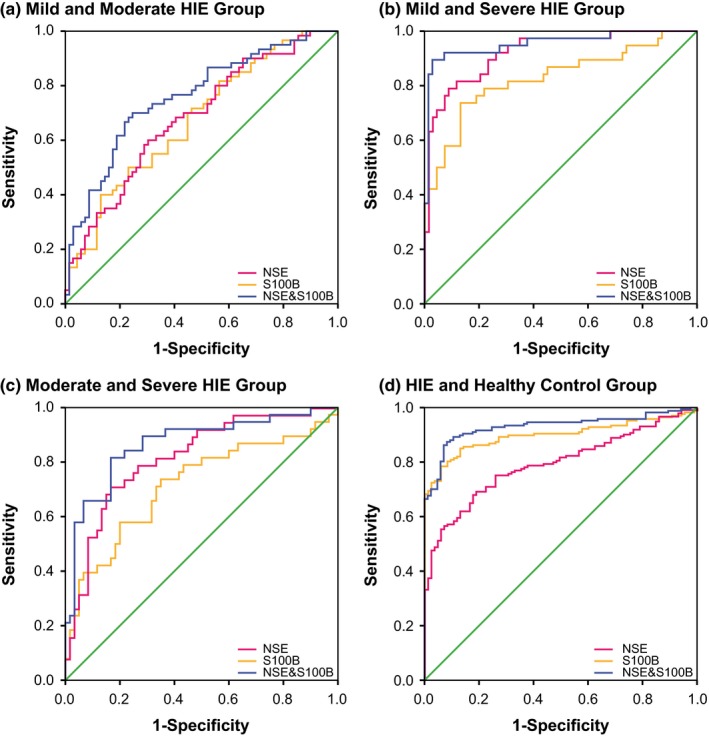
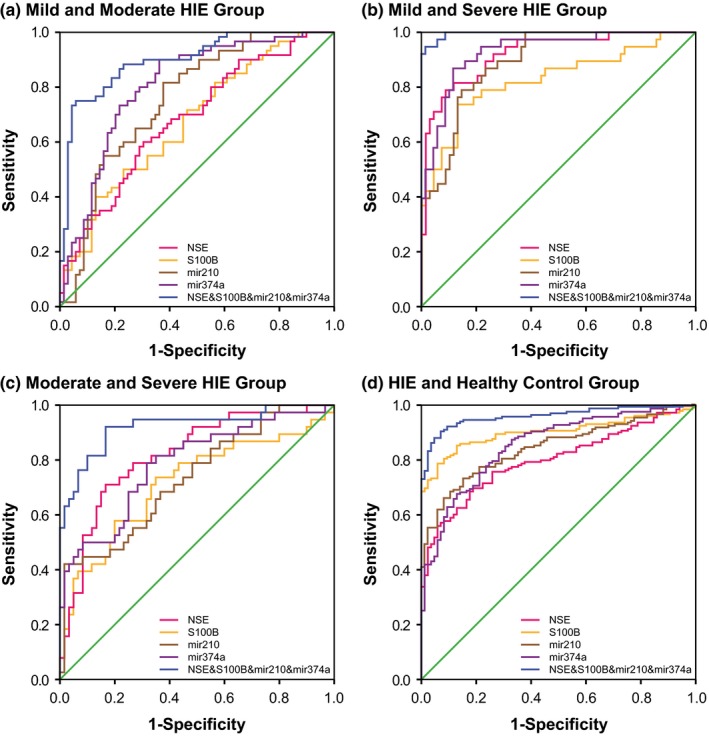
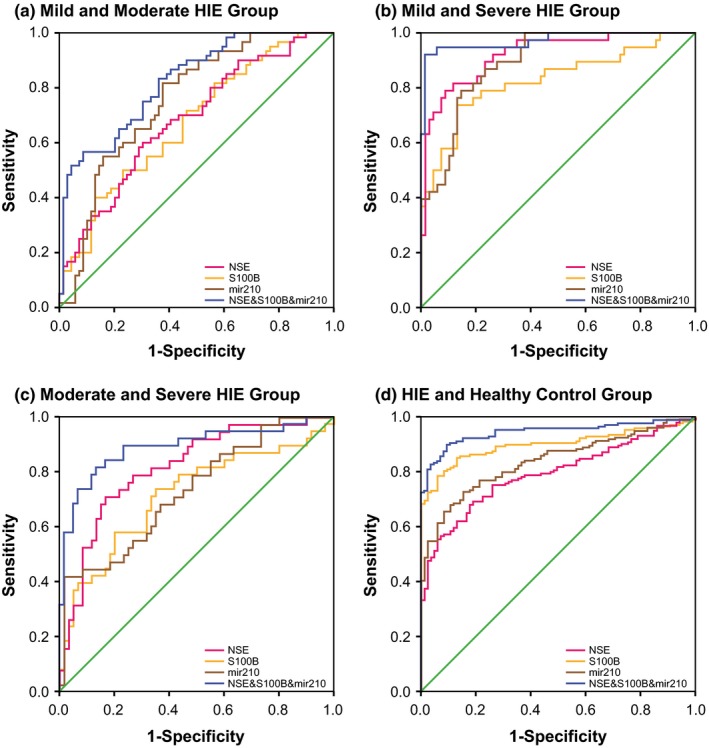
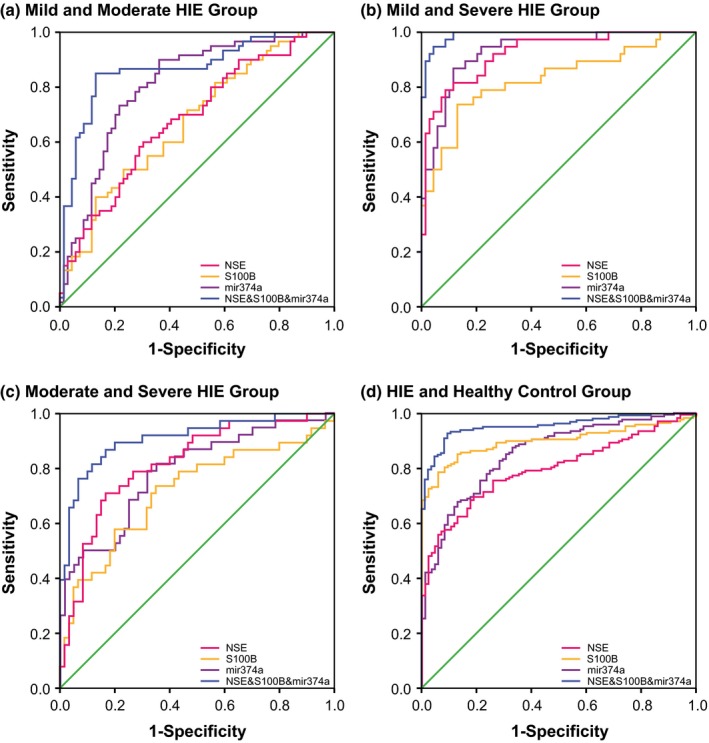
Altogether 167 HIE newborns and 82 healthy newborns were recruited, and their blood were sampled for determining the levels of biomarkers. Specifically, S100B protein and NSE levels were detected based on the enzyme-linked immunosorbent assay (ELISA) kit, while the expressions of miR-210 and miR-374a were quantified by quantitative reverse transcription-polymerase chain reaction (qRT-PCR). Moreover, the receiver operating characteristic (ROC) curves were established to assess the diagnostic values of the above biomarkers for HIE. Finally, the correlation analysis between miR-210/miR-374 and Neonatal Behavioral Neurological Assessment (NBNA) scoring or Gesell intellectual development were also conducted.
The levels of miR-210, miR-374a, S100B protein, and NSE were significantly distinct between HIE patients and healthy newborns (<.05). Besides, miR-210 ( = .573), miR-374a ( = .651), NSE level ( = -.622), and S100B level ( = -.55) were all, respectively, correlated with NBNA scoring with statistical significance (<.05). Furthermore, it was revealed that the combined diagnosis of miR-210, miR-374a, S100B protein, and NSE could obtain the highest accuracy regarding pairs of mild HIE versus moderate HIE (AUC = 0.898), moderate HIE versus severe HIE (AUC = 0.922), mild HIE versus severe HIE (AUC = 0.996), and HIE versus control (AUC = 0.960). More than that, the four molecules were also remarkably associated with Gesell intellectual development (<.05).
MiR-210 and miR-374a could help to elevate the diagnostic value and prognostic prediction of S100B protein and NSE for HIE.
缺氧缺血性脑病(HIE)是一种在围产期出现缺氧和缺血损伤的疾病,其死亡率较高(即 15%-20%),部分原因是诊断较晚。因此,研究了 miR-210 和 miR-374a,以探讨它们是否能提高 S100B 蛋白和神经元特异性烯醇化酶(NSE)对 HIE 的诊断价值。
共纳入 167 例 HIE 新生儿和 82 例健康新生儿,采集血液样本检测生物标志物水平。具体而言,采用酶联免疫吸附试验(ELISA)试剂盒检测 S100B 蛋白和 NSE 水平,采用定量逆转录聚合酶链反应(qRT-PCR)定量检测 miR-210 和 miR-374a 的表达。此外,还建立了受试者工作特征(ROC)曲线,以评估上述生物标志物对 HIE 的诊断价值。最后,还进行了 miR-210/miR-374 与新生儿行为神经评估(NBNA)评分或盖塞尔智力发育的相关性分析。
HIE 患者与健康新生儿的 miR-210、miR-374a、S100B 蛋白和 NSE 水平差异有统计学意义(<.05)。此外,miR-210(=0.573)、miR-374a(=0.651)、NSE 水平(=-.622)和 S100B 水平(=-.55)与 NBNA 评分均有统计学意义(<.05)。此外,还发现 miR-210、miR-374a、S100B 蛋白和 NSE 的联合诊断对轻度 HIE 与中度 HIE(AUC=0.898)、中度 HIE 与重度 HIE(AUC=0.922)、轻度 HIE 与重度 HIE(AUC=0.996)以及 HIE 与对照组(AUC=0.960)的诊断准确性最高。此外,这四个分子与盖塞尔智力发育也有显著相关性(<.05)。
miR-210 和 miR-374a 可提高 S100B 蛋白和 NSE 对 HIE 的诊断价值和预后预测。