Desvignes Thomas, Carey Andrew, Postlethwait John H
Institute of Neuroscience, University of Oregon, Eugene, Oregon.
Dev Dyn. 2018 Jun;247(6):832-853. doi: 10.1002/dvdy.24630. Epub 2018 Apr 16.
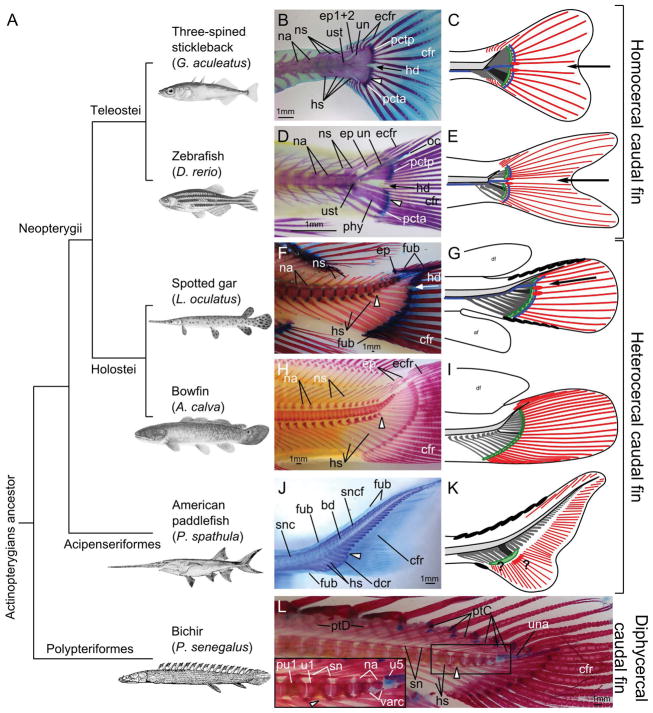
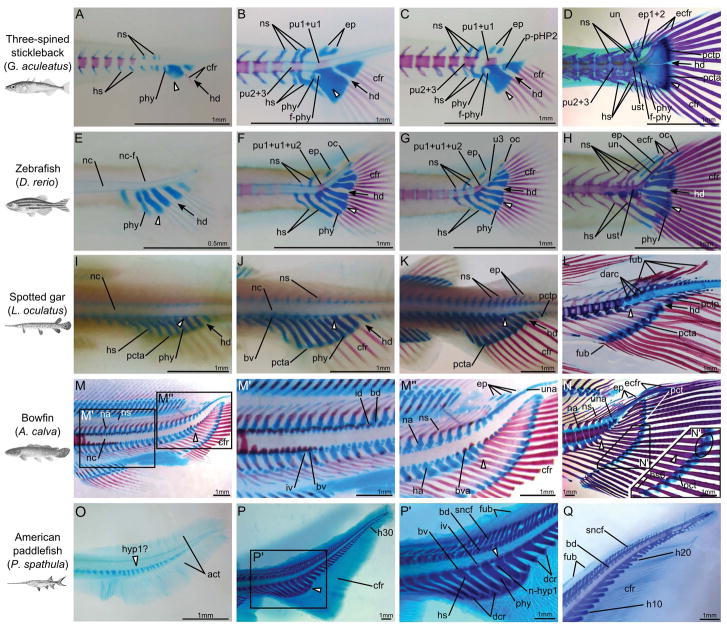
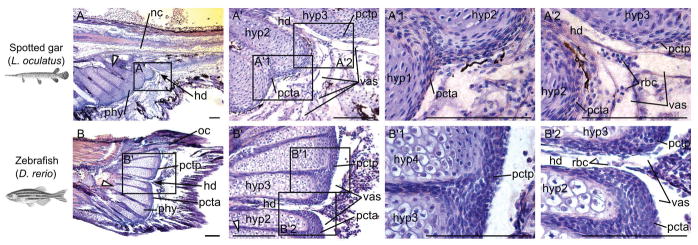
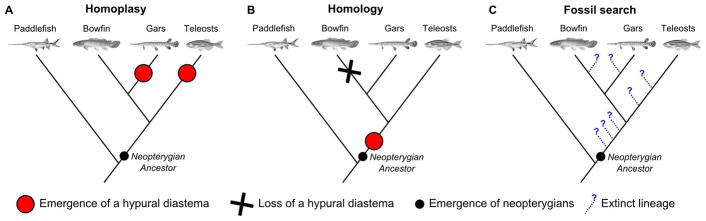
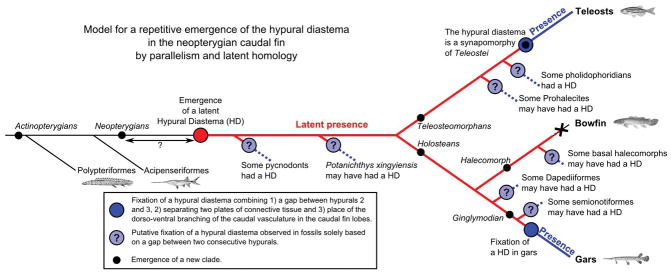
The caudal fin of actinopterygians transitioned from a heterocercal dorsoventrally asymmetrical fin to a homocercal externally symmetrical fin in teleosts through poorly understood evolutionary developmental mechanisms. We studied the caudal skeleton of major living actinopterygian lineages, including polypteriformes, acipenseriformes, Holostei (gars and bowfin), and teleosts, compared with reports of extinct neopterygians and basal teleosteans. We focused on the hypural diastema complex, which includes (1) a gap between hypurals 2 and 3, that (2) separates two plates of connective tissue at (3) the branching of caudal vasculature; these features had been considered as a shared, derived trait of teleosts, a synapomorphy.
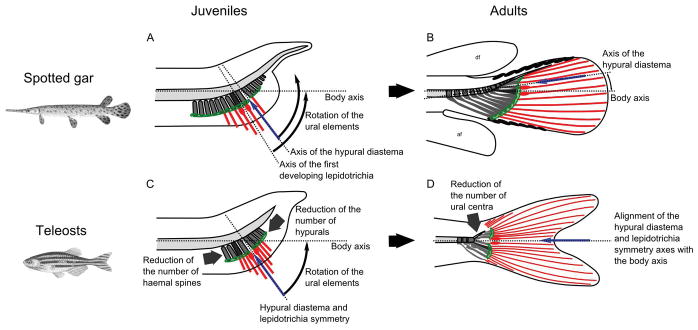
These studies revealed that gars and teleosts share all three features of the hypural diastema complex. Absence of a complex with these features from bowfin, fossil Holostei, and stem Teleostei argues in favor of repetitive, independent emergence in several neopterygian and basal Teleostei lineages, or less likely, many independent losses. We further observed that, in gars and teleosts, the earliest developing lepidotrichia align with the horizontal adult body axis, thus participating in external symmetry.
These results suggest that the hypural diastema complex in teleosts and gars represents a homoplasy among neopterygians and that it emerged repeatedly by parallel evolution due to shared inherited underlying genetic and developmental programs (latent homology). Because the hypural diastema complex exists in gars with heterocercal tails, this complex is independent of homocercality. Developmental Dynamics 247:832-853, 2018. © 2018 Wiley Periodicals, Inc.
硬骨鱼的尾鳍通过进化发育机制从不太为人所知的方式,从硬骨鱼纲中背腹不对称的歪尾鳍转变为真骨鱼类中外在对称的正尾鳍。我们研究了现存主要硬骨鱼谱系的尾骨骼,包括多鳍鱼目、鲟形目、全骨鱼类(雀鳝和弓鳍鱼)和真骨鱼类,并与已灭绝的新鳍鱼类和基部真骨鱼类的报道进行了比较。我们重点研究了尾下骨间隙复合体,该复合体包括:(1)尾下骨2和3之间的间隙,(2)在尾血管分支处将两块结缔组织板分开;这些特征曾被认为是真骨鱼类共有的衍生特征,即共有衍征。
这些研究表明,雀鳝和真骨鱼类具有尾下骨间隙复合体的所有三个特征。弓鳍鱼、化石全骨鱼类和基部真骨鱼类中不存在具有这些特征的复合体,这表明在几个新鳍鱼类和基部真骨鱼类谱系中存在重复、独立的出现,或者可能性较小的是,存在许多独立的缺失情况。我们进一步观察到,在雀鳝和真骨鱼类中,最早发育的鳞质鳍条与成年鱼的水平体轴对齐,从而参与外在对称。
这些结果表明,真骨鱼类和雀鳝中的尾下骨间隙复合体代表新鳍鱼类中的趋同现象,并且由于共享的遗传和发育程序(潜在同源性),它通过平行进化反复出现。由于具有歪尾的雀鳝中存在尾下骨间隙复合体,因此该复合体与正尾无关。《发育动力学》2018年第247卷:832 - 853页。© 2018威利期刊公司。