Wang Yu, Wang Ziyi, Yu Wenyang, Sheng Xia, Zhang Haolin, Han Yingying, Yuan Zhengrong, Weng Qiang
Beijing Forestry University, College of Biological Science and Technology.
Eur J Histochem. 2018 Feb 7;62(1):2889. doi: 10.4081/ejh.2018.2889.
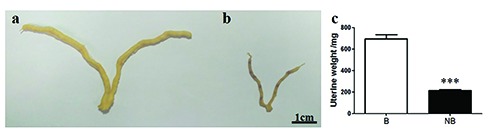
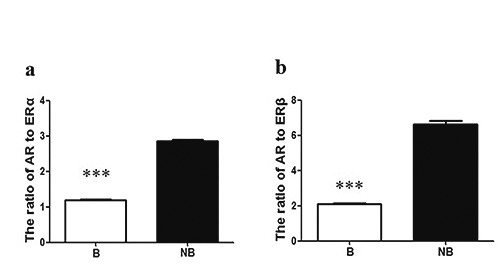
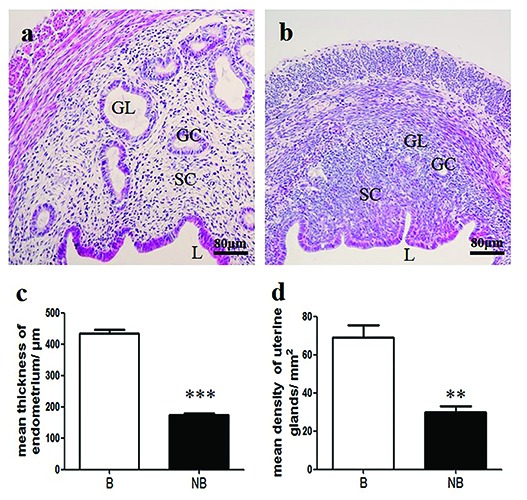
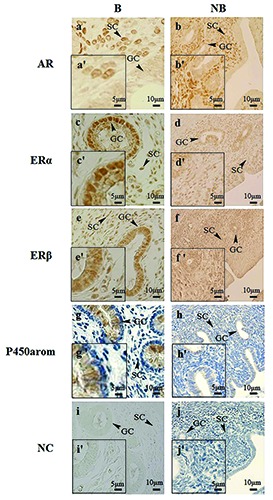
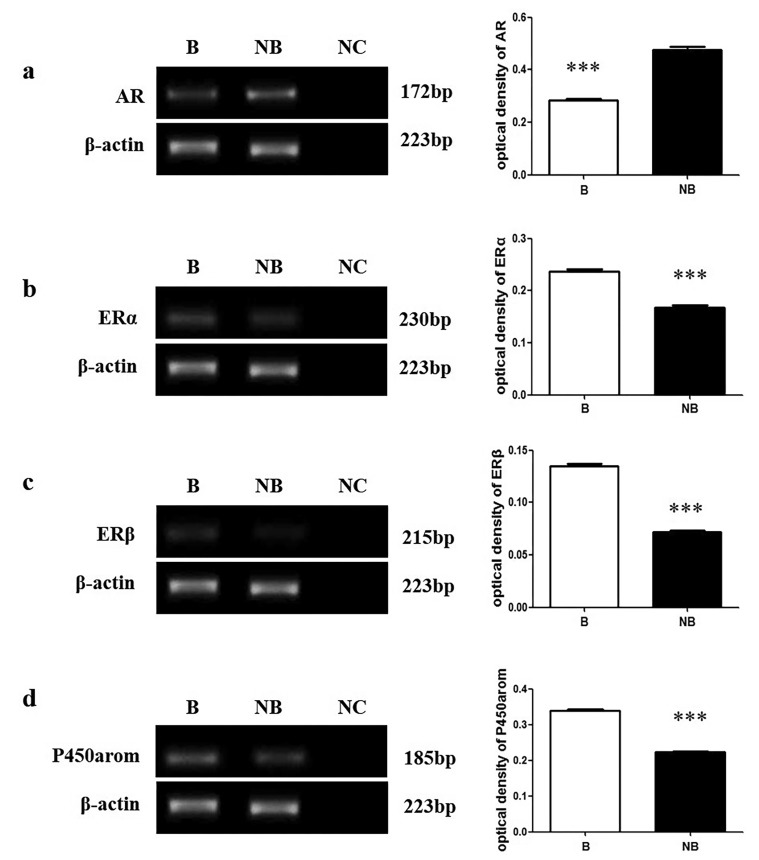
The reproductive tissues including the uterus undergo dramatic changes in seasonal breeders from the breeding to non-breeding seasons. Classically, sex steroid hormones play important roles in the uterine morphology and functions. To clarify the relationship between sex steroid hormones and seasonal changes in the uterine morphology and functions, the wild Daurian ground squirrels (Spermophilus dauricus) were used as seasonal breeder model. And the immunolocalizations and expression levels of androgen receptor (AR), estrogen receptors α and β (ERα and ERβ) and cytochrome P450 aromatase (P450arom) were investigated in the uteri of the wild Daurian ground squirrels in the breeding (April) and the non-breeding (June) seasons via immunohistochemistry, Western blot and RT-PCR. Histologically, the uterine weight, the thickness of endometrium and the glandular density were significantly higher in the uteri of the breeding season than those of the non-breeding season. In both seasons, the immunostaining of AR was only presented in stromal cells of the uteri; the positive staining of ERα and ERβ were localized in stromal cells and glandular cells; P450arom was merely immunolocalized in glandular cells. The protein and mRNA expression levels of ERα, ERβ and P450arom were higher in the uteri of the breeding season than those of the non-breeding season; conversely, the expressions of AR were higher in the uteri of the non-breeding season comparing with those of the breeding season in both protein and mRNA levels. The AR: ER ratio in the uteri of the non-breeding season exceeded the AR: ER ratio in the uteri of the breeding season in the wild Daurian ground squirrels. These results suggested that seasonal changes in the expression levels of AR, ERs and P450arom might be correlated with the uterine morphology and histology changes, and estrogen may play an important autocrine/paracrine role in regulating the uterine functions of the wild Daurian ground squirrels.
包括子宫在内的生殖组织在季节性繁殖动物从繁殖季节到非繁殖季节的过程中会发生显著变化。传统上,性类固醇激素在子宫形态和功能中发挥重要作用。为了阐明性类固醇激素与子宫形态和功能的季节性变化之间的关系,将野生达乌尔黄鼠(达乌尔黄鼠)作为季节性繁殖动物模型。通过免疫组织化学、蛋白质印迹法和逆转录-聚合酶链反应,研究了野生达乌尔黄鼠在繁殖季节(4月)和非繁殖季节(6月)子宫中雄激素受体(AR)、雌激素受体α和β(ERα和ERβ)以及细胞色素P450芳香化酶(P450arom)的免疫定位和表达水平。组织学上,繁殖季节子宫的重量、子宫内膜厚度和腺体密度显著高于非繁殖季节。在两个季节中,AR的免疫染色仅出现在子宫的基质细胞中;ERα和ERβ的阳性染色定位于基质细胞和腺细胞中;P450arom仅在腺细胞中免疫定位。ERα、ERβ和P450arom的蛋白质和mRNA表达水平在繁殖季节子宫中高于非繁殖季节;相反,在蛋白质和mRNA水平上,非繁殖季节子宫中AR的表达高于繁殖季节。野生达乌尔黄鼠非繁殖季节子宫中的AR:ER比值超过了繁殖季节子宫中的AR:ER比值。这些结果表明,AR、ERs和P450arom表达水平的季节性变化可能与子宫形态和组织学变化相关,雌激素可能在调节野生达乌尔黄鼠子宫功能中发挥重要的自分泌/旁分泌作用。