Odhagen Erik, Sunnergren Ola, Söderman Anne-Charlotte Hessén, Thor Johan, Stalfors Joacim
Department of Otorhinolaryngology, Södra Älvsborgs Hospital, Brämhultsvägen 53, 501 82, Borås, Sweden.
Institute of Clinical Sciences, Sahlgrenska Academy at the University of Gothenburg, Gothenburg, Sweden.
Eur Arch Otorhinolaryngol. 2018 Jun;275(6):1631-1639. doi: 10.1007/s00405-018-4942-3. Epub 2018 Mar 24.
Tonsillectomy (TE) is one of the most frequently performed ENT surgical procedures. Post-tonsillectomy haemorrhage (PTH) is a potentially life-threatening complication of TE. The National Tonsil Surgery Register in Sweden (NTSRS) has revealed wide variations in PTH rates among Swedish ENT centres. In 2013, the steering committee of the NTSRS, therefore, initiated a quality improvement project (QIP) to decrease the PTH incidence. The aim of the present study was to describe and evaluate the multicentre QIP initiated to decrease PTH rates.
Six ENT centres, all with PTH rates above the Swedish average, participated in the 7-month quality improvement project. Each centre developed improvement plans describing the intended changes in clinical practice. The project's primary outcome variable was the PTH rate. Process indicators, such as surgical technique, were also documented. Data from the QIP centres were compared with a control group of 15 surgical centres in Sweden with similarly high PTH rates. Data from both groups for the 12 months prior to the start of the QIP were compared with data for the 12 months after the QIP.
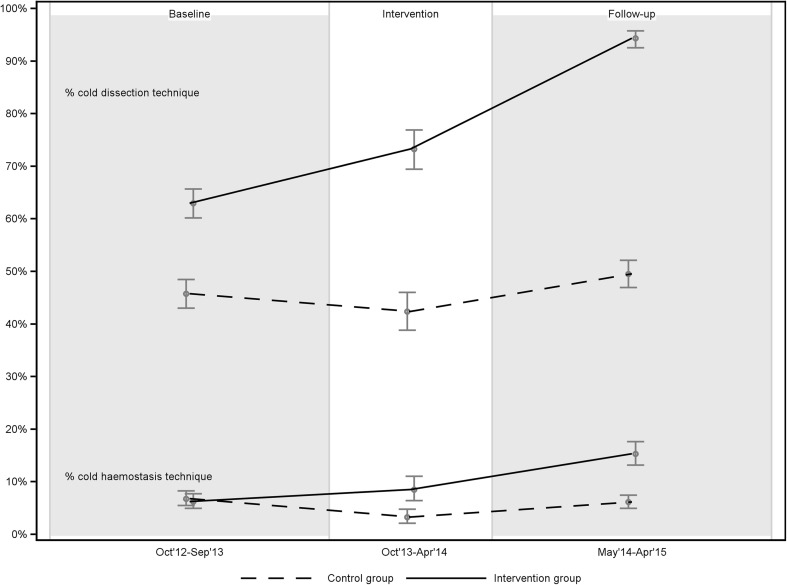
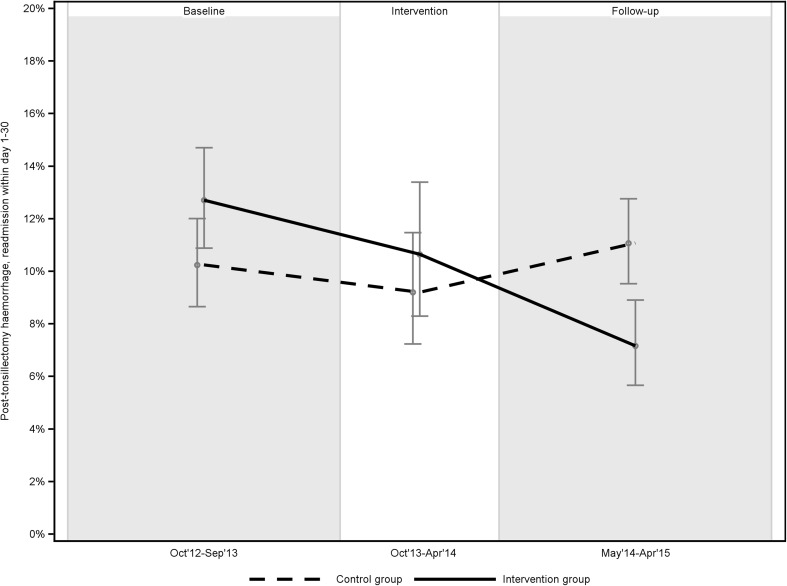
The QIP centres reduced the PTH rate from 12.7 to 7.1% from pre-QIP to follow-up; in the control group, the PTH rate remained unchanged. The QIP centres also exhibited positive changes in related key process indicators, i.e., increasing the use of cold techniques for dissection and haemostasis.
The rates of PTH can be reduced with a QIP. A national quality register can be used not only to identify areas for improvement but also to evaluate the impact of subsequent improvement efforts and thereby guide professional development and enhance patient outcomes.
扁桃体切除术(TE)是耳鼻喉科最常开展的外科手术之一。扁桃体切除术后出血(PTH)是TE潜在的危及生命的并发症。瑞典国家扁桃体手术登记处(NTSRS)显示,瑞典各耳鼻喉科中心的PTH发生率差异很大。因此,2013年,NTSRS指导委员会启动了一项质量改进项目(QIP),以降低PTH发生率。本研究的目的是描述和评估为降低PTH发生率而启动的多中心QIP。
六个PTH发生率均高于瑞典平均水平的耳鼻喉科中心参与了为期7个月的质量改进项目。每个中心都制定了改进计划,描述临床实践中预期的变化。该项目的主要结果变量是PTH发生率。还记录了手术技术等过程指标。将QIP中心的数据与瑞典15个PTH发生率同样高的手术中心组成的对照组进行比较。将QIP开始前12个月两组的数据与QIP后12个月的数据进行比较。
QIP中心的PTH发生率从QIP前的12.7%降至随访时的7.1%;对照组的PTH发生率保持不变。QIP中心在相关关键过程指标方面也呈现出积极变化,即增加了冷分离和止血技术的使用。
通过QIP可以降低PTH发生率。国家质量登记册不仅可用于确定改进领域,还可用于评估后续改进措施的影响,从而指导专业发展并改善患者预后。