Kotler Jennifer, Haig David
Harvard University, Department of Organismic & Evolutionary Biology.
Evol Anthropol. 2018 Mar;27(2):80-91. doi: 10.1002/evan.21579. Epub 2018 Mar 25.
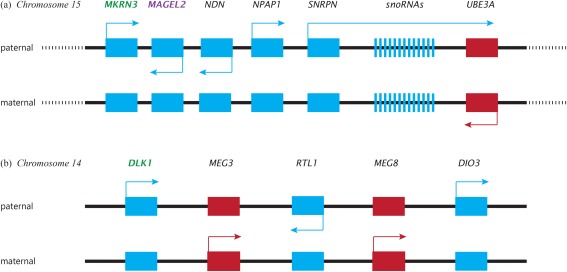
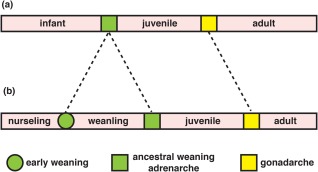
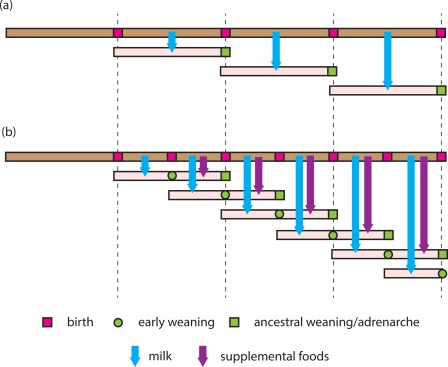
Relative to the life history of other great apes, that of humans is characterized by early weaning and short interbirth intervals (IBIs). We propose that in modern humans, birth until adrenarche, or the rise in adrenal androgens, developmentally corresponds to the period from birth until weaning in great apes and ancestral hominins. According to this hypothesis, humans achieved short IBIs by subdividing ancestral infancy into a nurseling phase, during which offspring fed at the breast, and a weanling phase, during which offspring fed specially prepared foods. Imprinted genes influence the timing of human weaning and adrenarche, with paternally expressed genes promoting delays in childhood maturation and maternally expressed genes promoting accelerated maturation. These observations suggest that the tempo of human development has been shaped by consequences for the fitness of kin, with faster development increasing maternal fitness at a cost to child fitness. The effects of imprinted genes suggest that the duration of the juvenile period (adrenarche until puberty) has also been shaped by evolutionary conflicts within the family.
相对于其他大型猿类的生命历程,人类的生命历程特点是断奶早且生育间隔期(IBIs)短。我们提出,在现代人类中,从出生到肾上腺初现(即肾上腺雄激素水平升高)这一阶段,在发育上相当于大型猿类和人类祖先从出生到断奶的时期。根据这一假说,人类通过将祖先的婴儿期细分为哺乳阶段(在此期间后代以母乳喂养)和断奶期(在此期间后代食用特制食物)来实现较短的生育间隔期。印记基因影响人类断奶和肾上腺初现的时间,父系表达的基因会促使儿童期成熟延迟,而母系表达的基因则会促使成熟加速。这些观察结果表明,人类发育的节奏是由对亲属适应性的影响所塑造的,发育速度加快会提高母亲的适应性,但以牺牲儿童的适应性为代价。印记基因的作用表明,青少年期(从肾上腺初现到青春期)的时长也受到家庭内部进化冲突的影响。