Okinawa Institute of Science and Technology Graduate University, Okinawa, Japan.
Elife. 2018 Mar 26;7:e32510. doi: 10.7554/eLife.32510.
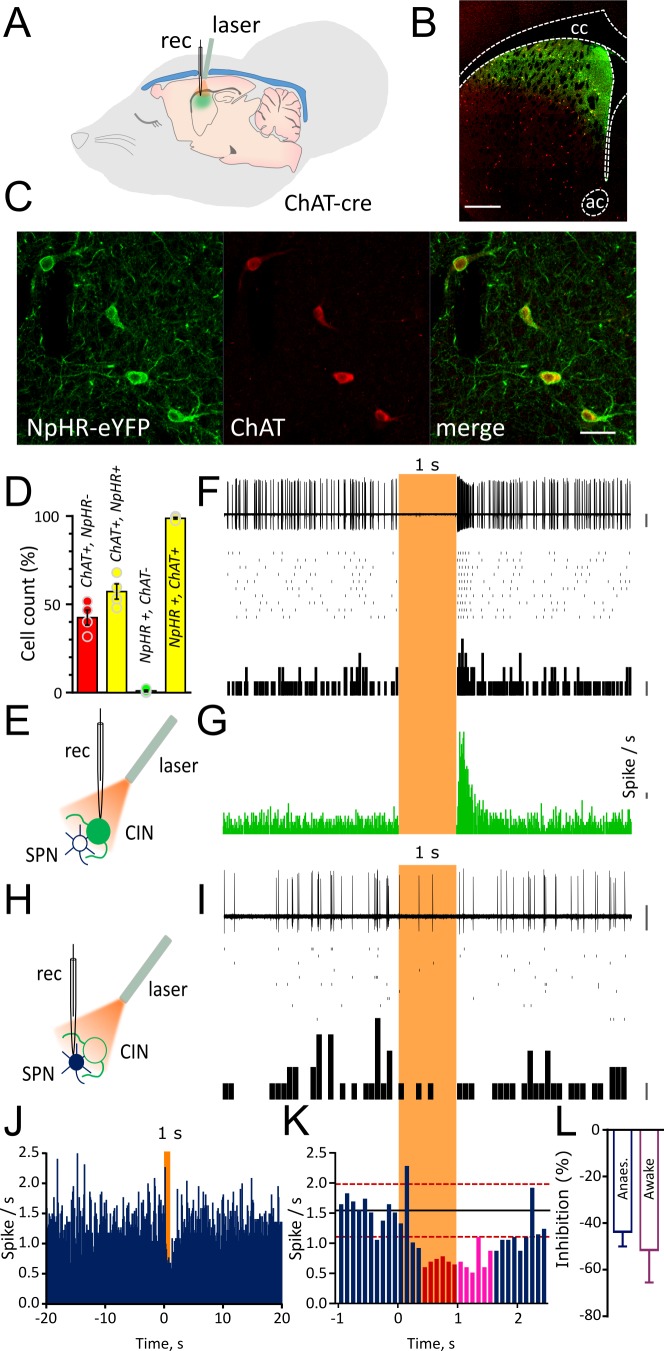
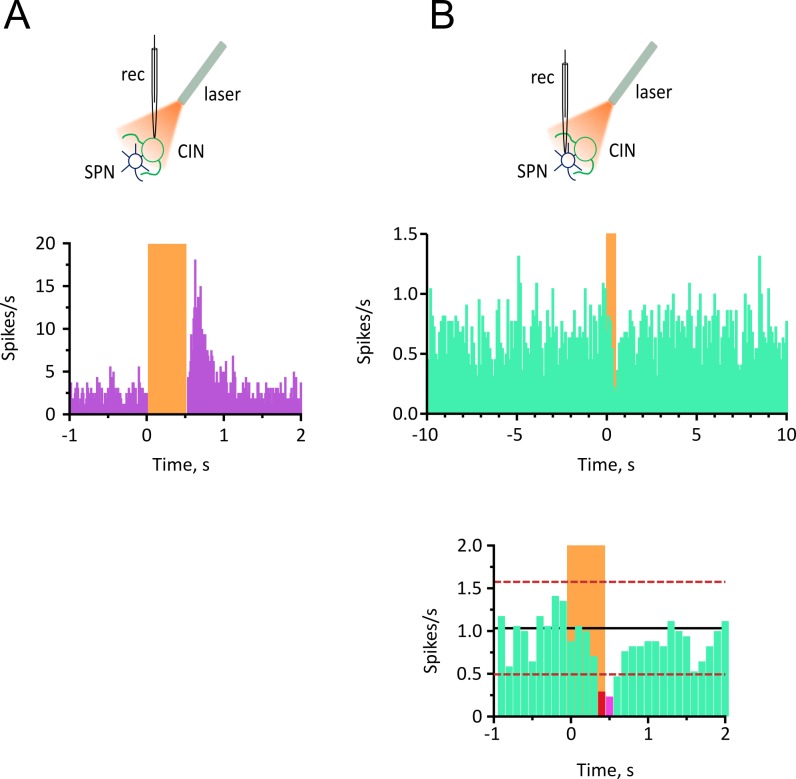
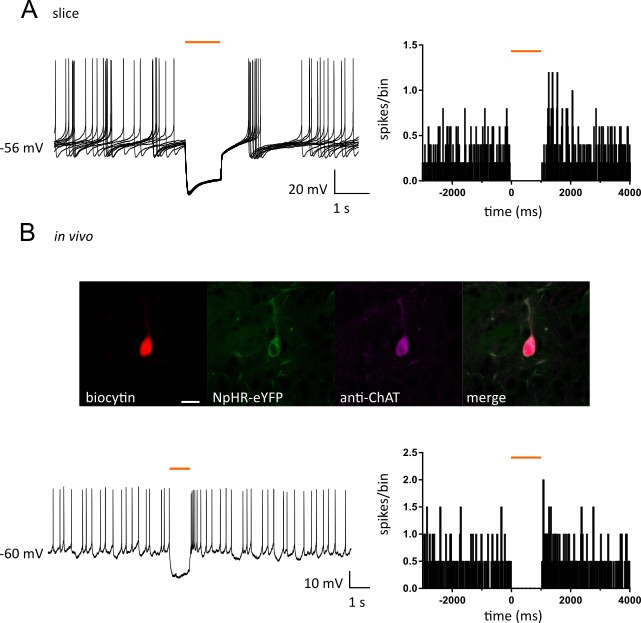
The cholinergic interneurons (CINs) of the striatum are crucial for normal motor and behavioral functions of the basal ganglia. Striatal CINs exhibit tonic firing punctuated by distinct pauses. Pauses occur in response to motivationally significant events, but their function is unknown. Here we investigated the effects of pauses in CIN firing on spiny projection neurons (SPNs) - the output neurons of the striatum - using in vivo whole cell and juxtacellular recordings in mice. We found that optogenetically-induced pauses in CIN firing inhibited subthreshold membrane potential activity and decreased firing of SPNs. During pauses, SPN membrane potential fluctuations became more hyperpolarized and UP state durations became shorter. In addition, short-term plasticity of corticostriatal inputs was decreased during pauses. Our results indicate that, in vivo, the net effect of the pause in CIN firing on SPNs activity is inhibition and provide a novel mechanism for cholinergic control of striatal output.
纹状体中的胆碱能中间神经元(CINs)对于基底神经节的正常运动和行为功能至关重要。纹状体中的 CIN 表现出被明显停顿打断的紧张性放电。停顿是对动机重要事件的反应,但它们的功能尚不清楚。在这里,我们使用在体全细胞膜片钳和细胞外记录技术在小鼠中研究了 CIN 放电停顿对棘突投射神经元(SPNs)-纹状体的输出神经元的影响。我们发现,光遗传学诱导的 CIN 放电停顿抑制了 SPN 的亚阈膜电位活动和放电。在停顿期间,SPN 膜电位波动变得更加超极化,而 UP 状态持续时间变得更短。此外,皮质纹状体输入的短期可塑性在停顿期间降低。我们的结果表明,在体内,CIN 放电停顿对 SPN 活动的净效应是抑制,并为胆碱能控制纹状体输出提供了一种新的机制。