Pediatric Endocrinology and Diabetes Unit, Dana-Dwek Children's Hospital, Tel Aviv Sourasky Medical Center, Tel Aviv, Israel.
Sackler Faculty of Medicine, Tel Aviv University, Tel Aviv, Israel.
PLoS One. 2018 Mar 27;13(3):e0195046. doi: 10.1371/journal.pone.0195046. eCollection 2018.
Variations in the degree of hirsutism among women of different ethnic backgrounds may stem from multiple etiologies. Shorter length of the polymorphic CAG repeats of the androgen receptor (AR) gene may be associated with increased activity of the receptor leading to hirsutism. We hypothesized that there are ethnic differences in the degree of hirsutism that is unrelated to androgen levels among Israeli women, and that the CAG repeats length may contribute to these differences. Anti-androgenic therapies, such as spironolactone, could be suggested if a shorter CAG repeats length is found to affect the difference in the degree of hirsutism between the ethnic groups.
Healthy Israeli Jewish women aged 18-45 years of Ashkenazi and non-Ashkenazi origin were invited to participate. Hirsutism was assessed using the simplified Ferriman-Gallwey (sFG) score, and serum total testosterone levels were measured as well. The CAG repeats length was determined by PCR. Methylation-sensitive methods were used to detect the fractional activity of each allele, and the weighted mean was calculated for the CAG repeats length.
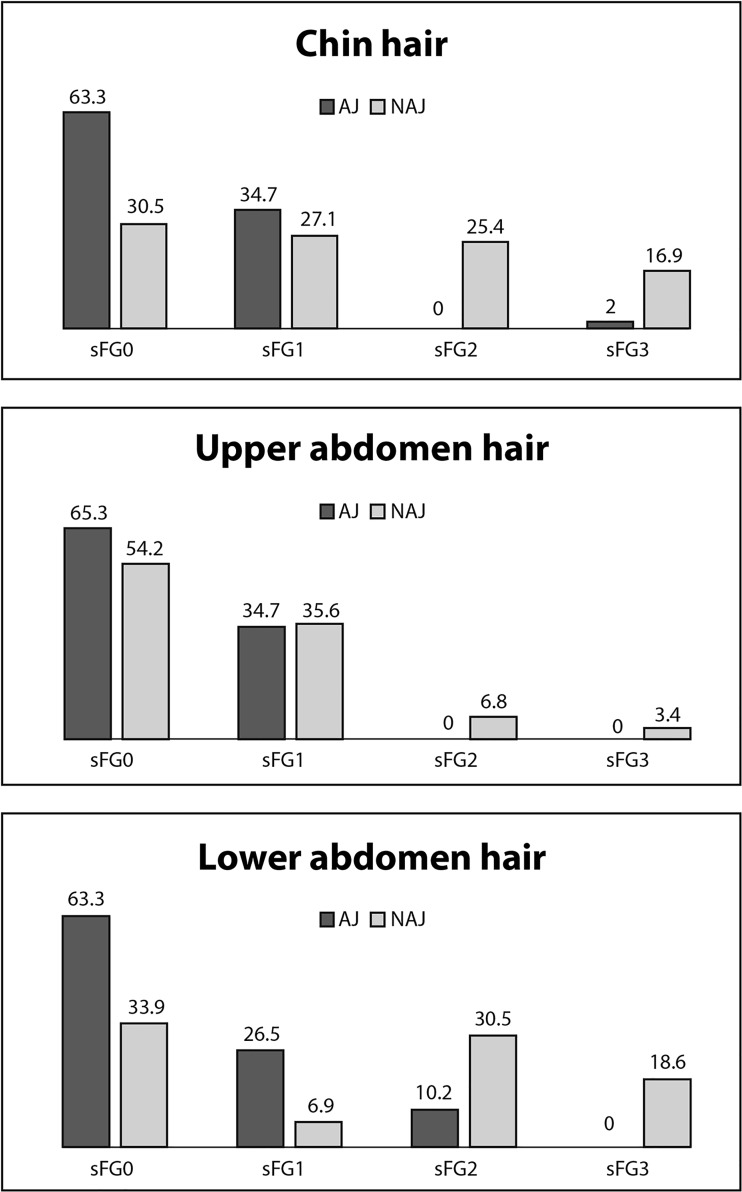
One-hundred and eight women were recruited (49 Ashkenazi and 59 non-Ashkenazi). The Ashkenazi women had a significantly lower degree of hirsutism (P<0.01), lower mean BMI (P = 0.003), total testosterone levels (P = 0.017), and longer weighted bi-allelic CAG repeats mean (P = 0.015) compared to non-Ashkenazi women. For the group as a whole, there was a significant negative correlation between the number of CAG repeats in the AR gene and the sFG score, while the number of repeats was not related to testosterone levels. Stepwise logistic regression revealed that ethnic origin and the CAG repeats length were the strongest factors affecting hirsutism (P<0.001, P = 0.03, respectively).
There is a significant difference in the degree of hirsutism between Ashkenazi and non-Ashkenazi women in Israel that is partially explained by CAG repeats length.
不同种族背景的女性多毛症程度的差异可能源于多种病因。雄激素受体(AR)基因的多态性 CAG 重复序列较短,可能与受体活性增加导致多毛症有关。我们假设以色列女性的多毛症程度存在与雄激素水平无关的种族差异,CAG 重复序列长度可能导致这些差异。如果发现较短的 CAG 重复序列长度会影响不同种族之间多毛症程度的差异,可以建议使用抗雄激素治疗,如螺内酯。
邀请年龄在 18-45 岁的阿什肯纳兹和非阿什肯纳兹血统的健康以色列犹太女性参与。使用简化的 Ferriman-Gallwey(sFG)评分评估多毛症,同时测量血清总睾酮水平。通过 PCR 确定 CAG 重复序列长度。使用甲基化敏感方法检测每个等位基因的分数活性,并计算 CAG 重复序列长度的加权平均值。
共招募了 108 名女性(49 名阿什肯纳兹人和 59 名非阿什肯纳兹人)。阿什肯纳兹女性的多毛症程度明显较低(P<0.01),平均 BMI 较低(P=0.003),总睾酮水平较低(P=0.017),加权双等位基因 CAG 重复序列平均值较长(P=0.015)。与非阿什肯纳兹女性相比。对于整个组,AR 基因中的 CAG 重复次数与 sFG 评分之间存在显著负相关,而重复次数与睾酮水平无关。逐步逻辑回归显示,种族起源和 CAG 重复长度是影响多毛症的最强因素(P<0.001,P=0.03)。
以色列的阿什肯纳兹和非阿什肯纳兹女性之间的多毛症程度存在显著差异,部分原因是 CAG 重复长度不同。