Surgical Outcomes Research Centre (SOuRCe), Sydney Local Health District and University of Sydney, Sydney, NSW, Australia.
Institute of Academic Surgery, Royal Prince Alfred Hospital and University of Sydney, Sydney, NSW, Australia.
BMC Cancer. 2018 Mar 27;18(1):339. doi: 10.1186/s12885-018-4297-6.
The incidence and survival rates for colorectal cancer in Australia are among the highest in the world. With population growth and ageing there are increasing numbers of colorectal cancer survivors in the community, yet little is known of their ongoing follow up and survivorship care experiences. This study investigated patterns and predictors of follow up and survivorship care received and recommended for adults with colorectal cancer in New South Wales (NSW), Australia.
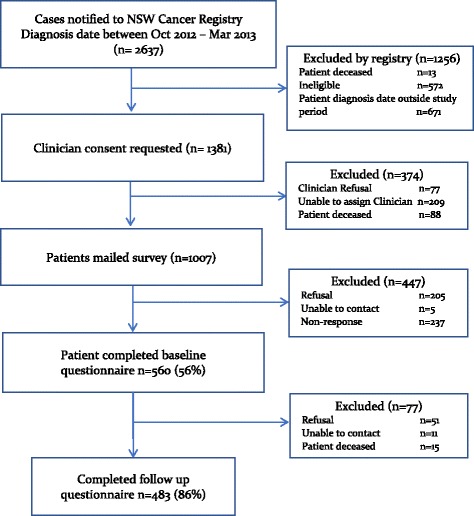
Cross-sectional analysis within the NSW Bowel Cancer Care Survey, a population-based cohort of adults diagnosed with colorectal cancer between April 2012 and May 2013 in NSW. One year after diagnosis, participants completed a study specific questionnaire about their follow up and survivorship care experience and plans. Logistic regression was used to identify independent predictors of guideline-recommended care.
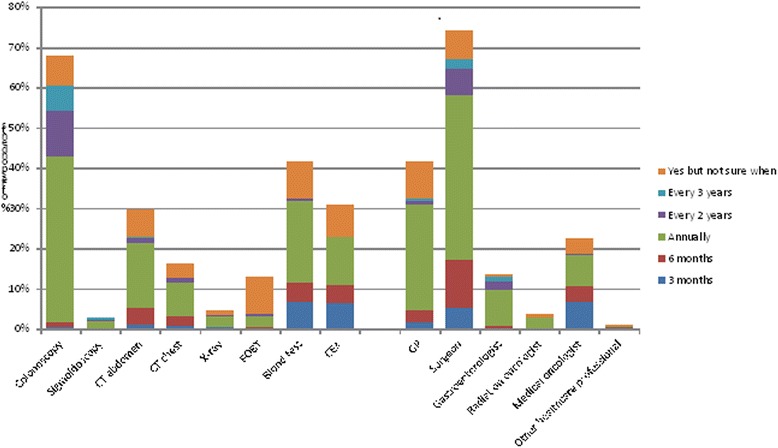
Of 1007 eligible people, 560 (56%) participated in the NSW Bowel Cancer Care Survey with 483 (86% of study participants, 48% of invited sample) completing the survivorship survey. Among these 483 participants, only 110 (23%, 95% Confidence Interval CI 19-27%) had received a written follow up plan, with this more common among migrants, non-urban dwellers and those with little experience of the health system. Of 379 (78%) people treated with curative intent, most were receiving ongoing colorectal cancer follow up from multiple providers with 28% (23-32%) attending three or more different doctors. However, less than half had received guideline-recommended follow-up colonoscopy (46%, CI 41-51%) or carcino-embryonic antigen assay (35%, CI 30-40%). Socio-economic advantage was associated with receipt of guideline-recommended care. While participants reported high interest in improving general health and lifestyle since their cancer diagnosis, few had received advice about screening for other cancers (24%, CI 19-28%) or assistance with lifestyle modification (30%, CI 26-34%). Less than half (47%, CI 43-52%) had discussed their family's risk of cancer with a doctor since their diagnosis.
Survivorship care was highly variable, with evident socioeconomic disparities and missed opportunities for health promotion.
澳大利亚的结直肠癌发病率和存活率均处于世界较高水平。随着人口增长和老龄化,社区中结直肠癌幸存者的数量不断增加,但人们对他们的后续随访和生存护理体验知之甚少。本研究调查了澳大利亚新南威尔士州(NSW)成年人接受结直肠癌随访和生存护理的模式和预测因素,并为其提供了建议。
这是一项基于人群的队列研究,对 2012 年 4 月至 2013 年 5 月期间在新南威尔士州被诊断为结直肠癌的成年人进行横断面分析。在诊断一年后,参与者完成了一项关于他们的随访和生存护理体验及计划的特定研究问卷。采用逻辑回归来确定指南推荐护理的独立预测因素。
在 1007 名合格人群中,有 560 人(56%)参与了新南威尔士州结直肠癌护理调查,其中 483 人(研究参与者的 86%,受邀样本的 48%)完成了生存调查。在这 483 名参与者中,仅有 110 人(23%,95%置信区间 CI 19-27%)收到了书面随访计划,而移民、非城市居民和对卫生系统经验较少的人更常收到该计划。在 379 名(78%)接受根治性治疗的患者中,大多数人正在接受来自多个提供者的持续结直肠癌随访,其中 28%(23-32%)会看三位或以上不同的医生。然而,只有不到一半的人接受了指南推荐的结肠镜检查(46%,CI 41-51%)或癌胚抗原检测(35%,CI 30-40%)。社会经济优势与接受指南推荐的护理有关。尽管参与者报告说自癌症诊断以来,他们对改善一般健康和生活方式非常感兴趣,但很少有人接受过其他癌症筛查(24%,CI 19-28%)或生活方式改变(30%,CI 26-34%)的建议。不到一半(47%,CI 43-52%)的人自诊断以来曾与医生讨论过他们家庭的癌症风险。
生存护理差异很大,存在明显的社会经济差异和错失促进健康的机会。