Department of Dermatology and Radiotherapy, Botucatu Medical School, Universidade Estadual Paulista, UNESP, São Paulo, Brazil.
BMC Cancer. 2018 Mar 27;18(1):340. doi: 10.1186/s12885-018-4288-7.
The primary clinical manifestation of skin field cancerization is the presence of actinic keratoses (AKs). Current treatments for AKs related to skin field cancerization include photodynamic therapy (PDT) and colchicine. The objective of this study is to evaluate the efficacy and safety of 0.5% colchicine cream versus PDT with methyl aminolevulinate (MAL-PDT) in the treatment of skin field cancerization.
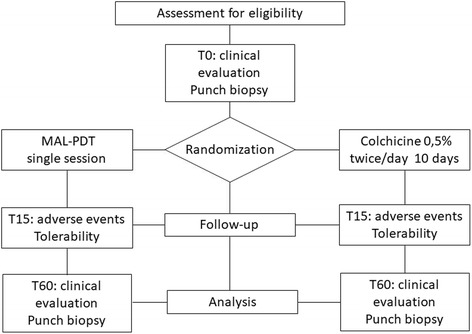
In a randomized controlled and open clinical trial with a blind histopathological and immunohistochemical analysis, 36 patients with up to 10 AKs on their forearms will be included from the outpatient clinic. The forearms will be randomized into two groups, clinically evaluated and biopsied for histopathology and immunohistochemistry (p53 and Ki67). One forearm will be treated with 0.5% colchicine cream for 10 days, and the other forearm will receive one session of MAL-PDT; the forearms will subsequently be reassessed clinically and histologically after 60 days (T60) of treatment. The primary endpoint will be the point of complete clearance of AKs in T60. The sample size will enable a detection in the reduction of over 10% in AK counts between the groups with power of 0.9 and an alpha of 0.05, accounting for an estimated dropout rate of 10%, resulting in 36 patients (72 forearms). All participants included in the randomized study will be part of the analysis, and the final outcomes of any dropouts will be the value of their last visit (LOCF). The statistical analysis will be performed using SPSS 22.0, and a p value < 5% will be considered to be significant.
It is expected that colchicine will be superior to MAL-PDT in reducing AKs and in the skin field cancerization, and there will be good tolerability in both groups. Colchicine intervention is novel in that it provides a new alternative to MAL-PDT. Moreover, this drug is inexpensive that may be a potential treatment of skin field cancerization that can be prescribed in public health systems with good results.
The trial is registered in Brazilian Registry for Clinical Trials (Registration number: RBR-8y3sj9 , date assigned May 4, 2016, retrospectively registered).
皮肤野癌化的主要临床表现为光化性角化病(AK)的存在。目前针对皮肤野癌化相关 AK 的治疗方法包括光动力疗法(PDT)和秋水仙碱。本研究旨在评估 0.5%秋水仙碱乳膏与甲氨基酮戊酸(MAL-PDT)治疗皮肤野癌化的疗效和安全性。
在一项随机对照、开放性临床试验中,我们对门诊的 36 例前臂最多有 10 个 AK 的患者进行了研究。前臂随机分为两组,进行临床评估,并进行组织病理学和免疫组织化学(p53 和 Ki67)活检。其中一只前臂接受 0.5%秋水仙碱乳膏治疗 10 天,另一只前臂接受一次 MAL-PDT 治疗;治疗 60 天后(T60)再次进行临床和组织学评估。主要终点为 T60 时 AK 完全清除的点数。样本量将能够检测出两组间 AK 计数减少超过 10%,具有 0.9 的功效和 0.05 的α,估计失访率为 10%,最终将纳入 36 例患者(72 只前臂)。所有纳入随机研究的参与者都将参与分析,任何失访者的最终结果将是他们最后一次就诊的值(LOCF)。统计分析将使用 SPSS 22.0 进行,p 值<0.05 被认为具有统计学意义。
预计秋水仙碱在减少 AK 和皮肤野癌化方面将优于 MAL-PDT,且两组的耐受性都较好。秋水仙碱的干预是新颖的,它为 MAL-PDT 提供了一种新的替代方案。此外,这种药物价格低廉,可能是一种可在公共卫生系统中开具、效果良好的皮肤野癌化潜在治疗药物。
该试验在巴西临床试验注册中心注册(注册号:RBR-8y3sj9,注册日期为 2016 年 5 月 4 日,回溯性注册)。