Medical Educational Development Center, Gifu University, Gifu, Japan.
College of Nursing, Aichi Medical University, Nagakute, Japan.
BMC Med Educ. 2018 Mar 27;18(1):47. doi: 10.1186/s12909-018-1165-7.
It is known that empathic communication is important for physicians to achieve higher patient satisfaction and health outcomes. Emotional intelligence (EI), empathy and personality in medical students predict students' individual disposition and their emotional and empathic perceptions. This study aimed to investigate: 1) The association between empathy, EI and personality, and 2) Gender differences in the association between empathy, EI and personality.
Participants were 357 1st year medical students from 2008 to 2011 at one medical school in Japan. Students completed self-report questionnaires comprising three validated instruments measuring EI: Trait Emotional Intelligence Questionnaire-Short Form (TEIQue-SF), empathy: Jefferson Scale of Physician Empathy- student version (JSPE) and personality: NEO-Five-Factor Inventory (NEO-FFI), which explores 5 dimensions of personality Neuroticism (N), Extraversion (E), Openness to experience (O), Agreeableness (A), and Conscientiousness (C).
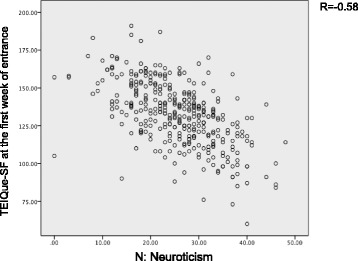
Pearson Correlations showed weak association between TEIQue-SF and JSPE. TEIQue-SF and NEO-FFI showed positive correlation for E and C, and strong negative correlation for N and weak positive correlation for A and O. Weak positive correlation between JSPE and the NEO-FFI were observed for E and A. Although effect sizes were small, N, A and empathy were significantly higher in females (unpaired t-test). However, hierarchical multiple-regression analysis when controlling for gender and personality showed no association between EI, empathy and gender. A, TEIQue-SF and N were found to make small contributions in respect of predictions for JSPE. Personality contributed significantly to the prediction of TEIQue-SF. N had the largest independent negative contribution (β = - 0,38).
In our study population of 1st year medical students, females had significantly higher N, A and empathy scores than males. Medical students' N score was strongly negatively associated with EI. Empathy was weakly associated with EI and A. However, when controlling gender and personality in regression analysis, gender did not affect EI and empathy, rather personality is the most important factor. Our findings indicate that N is a major factor that negatively affects EI. It is important to mitigate N using thoughtful training, taking into account students' personalities, to reduce N. In future studies, we will assess how communication trainings for students might enhance EI.
众所周知,同理心沟通对于医生提高患者满意度和改善健康结果至关重要。医学生的情商(EI)、同理心和个性可以预测他们的个人倾向以及他们的情感和同理心感知。本研究旨在调查:1)同理心、EI 和个性之间的关系,2)同理心、EI 和个性之间关联的性别差异。
参与者为 2008 年至 2011 年期间日本一所医学院的 357 名一年级医学生。学生完成了自我报告问卷,其中包括三个经过验证的工具,用于测量 EI:特质情绪智力问卷-短版(TEIQue-SF)、同理心:医师同理心量表-学生版(JSPE)和个性:大五人格量表(NEO-FFI),它探索了个性的五个维度:神经质(N)、外向性(E)、开放性(O)、宜人性(A)和尽责性(C)。
皮尔逊相关显示 TEIQue-SF 与 JSPE 之间存在弱关联。TEIQue-SF 和 NEO-FFI 与 E 和 C 呈正相关,与 N 呈强负相关,与 A 和 O 呈弱正相关。JSPE 与 NEO-FFI 之间存在微弱的正相关,与 E 和 A 相关。尽管效应大小较小,但女性的 N、A 和同理心得分明显更高(未配对 t 检验)。然而,当控制性别和个性时,层次多重回归分析显示 EI、同理心与性别之间没有关联。A、TEIQue-SF 和 N 对预测 JSPE 有较小的贡献。个性对 TEIQue-SF 的预测有显著贡献。N 具有最大的独立负向贡献(β=−0.38)。
在我们的一年级医学生研究人群中,女性的 N、A 和同理心得分明显高于男性。医学生的 N 分数与 EI 呈强烈负相关。同理心与 EI 和 A 呈弱相关。然而,在回归分析中控制性别和个性时,性别并不影响 EI 和同理心,而是个性是最重要的因素。我们的研究结果表明,N 是一个主要的负向因素,影响 EI。通过考虑学生的个性,使用深思熟虑的培训来减轻 N 非常重要。在未来的研究中,我们将评估针对学生的沟通培训如何提高 EI。