Dai Liang, Kang Xiaozheng, Yan Wanpu, Yang Yongbo, Zhao Peiliang, Fu Hao, Zhou Haitao, Liang Zhen, Xiong Hongchao, Lin Yao, Chen Keneng
Key Laboratory of Carcinogenesis and Translational Research (Ministry of Education), the First Department of Thoracic Surgery, Peking University Cancer Hospital and Institute, Peking University School of Oncology, Beijing 100142, China.
Zhongguo Fei Ai Za Zhi. 2018 Mar 20;21(3):223-229. doi: 10.3779/j.issn.1009-3419.2018.03.23.
Thoracoscopic surgery has gradually become the major procedure for lung cancer surgery in our department. Its characteristics are minimal trauma and quick recovery, which make approximately 90% of patients discharge from the hospital after surgery. However, the postoperative complications still happen now and then. We analyzed the patients who had been hospitalized for longer than 7 days after thoracoscopic lung cancer surgery, aiming to summarize the types and risk factors of complications, and improve postoperative safety of patients.
The data were come from the prospective database of Thoracic Surgery Unit One in Peking Cancer Hospital, and patients that underwent thoracoscopic pulmonary surgery between Jan. 2010 and Dec. 2014 with length of stay more than 7 days were included in the study. The classifications of the complications were investigated and graded as mild or severe complications according to modified Claviengrading, the relationship between clinical factors and degrees of complications was also analyzed.
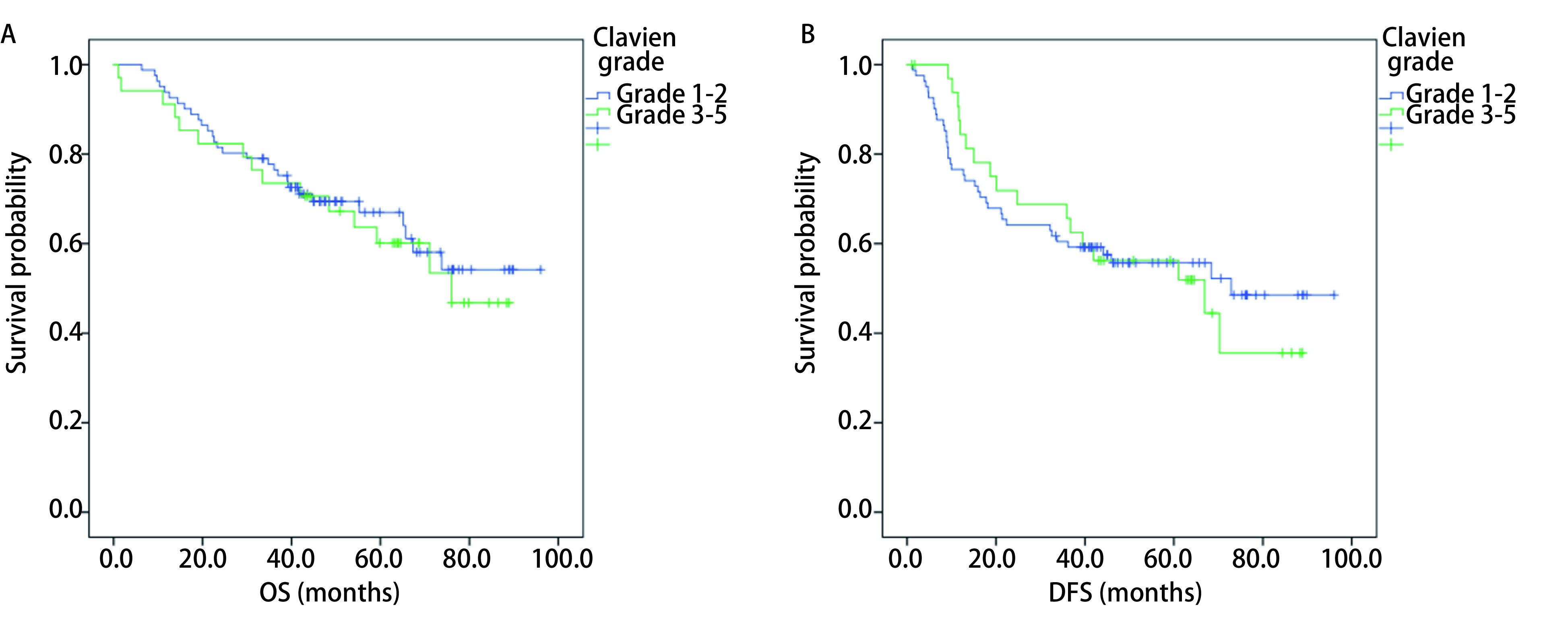
The hospitalization of 115 cases were longer than 7 days after surgery, accounting for 10.3% (115/1,112) of the whole patients that underwent surgery during the same period. Eighty-one cases had mild complications, accounting for 7.3% (81/1,112) of the whole cases that underwent surgery during the same period and 70.4% (81/115) of the cases with prolonged length of stay; the proportions of severe complications in both groups were 3.1% (34/1,112) and 29.6% (34/115), respectively; and the proportions of complications that caused perioperative deaths were 0.18% (2/1112) and 1.7% (2/115), respectively. Among all the postoperative complications, the most common was air leakage for more than 5 days after surgery, with a total of 20 cases (1.8% and 17.4%). The other common complications were: atelectasis (19 cases, 1.7% and 16.5%), pulmonary infection (18 cases, 1.6% and 15.7%), etc. The less common complications was bronchopleural fistula (4 cases, 0.36% and 3.5%) with very high risk, and 2 cases died perioperatively due to the combination of acute respiratory distresssyndrome (ARDS). In the clinical factors, only preoperative low pulmonary function (FEV1%<70%) was the potential risk factor for postoperative severe complications (45.8% vs 23.6%, P=0.038). There was no significant difference either regarding the 5 year disease free survival or the 5 year overall survival between mild complication group and severe complication group, with 5 year DFS being 52.2% and 51.9%, respectively (P=0.894) , and 5 year overall survival being 64.0% and 53.5%, respectively (P=0.673).
Continuous postoperative air leakage, atelectasis and pulmonary infections were the major causes for prolonged hospitalization after thoracoscopic surgery for lung cancer, and bronchopleural fistula was the most perilous complications. Patients with low preoperative pulmonary function were more likely to have severe postoperative complication, however, this would not influence the long term survival of the patients.
胸腔镜手术已逐渐成为我科肺癌手术的主要术式。其特点是创伤小、恢复快,约90%的患者术后可出院。然而,术后并发症仍时有发生。我们对胸腔镜肺癌手术后住院时间超过7天的患者进行分析,旨在总结并发症的类型及危险因素,提高患者术后安全性。
数据来自北京肿瘤医院胸外科一病区前瞻性数据库,纳入2010年1月至2014年12月期间行胸腔镜肺手术且住院时间超过7天的患者。调查并发症分类,并根据改良Clavien分级将其分为轻度或重度并发症,同时分析临床因素与并发症程度之间的关系。
115例患者术后住院时间超过7天,占同期手术患者总数的10.3%(115/1112)。81例发生轻度并发症,占同期手术患者总数的7.3%(81/1112),占住院时间延长患者的70.4%(81/115);两组重度并发症的比例分别为3.1%(34/1112)和29.6%(34/115);导致围手术期死亡的并发症比例分别为0.18%(2/1112)和1.7%(2/115)。在所有术后并发症中,最常见的是术后漏气超过5天,共20例(1.8%和17.4%)。其他常见并发症有:肺不张(19例,1.7%和16.5%)、肺部感染(18例,1.6%和15.7%)等。较少见但风险极高的并发症是支气管胸膜瘘(4例,0.36%和3.5%),2例因合并急性呼吸窘迫综合征(ARDS)围手术期死亡。在临床因素中,仅术前肺功能低下(FEV1%<70%)是术后发生严重并发症的潜在危险因素(45.8%对23.6%,P=0.038)。轻度并发症组与重度并发症组之间5年无病生存率及5年总生存率差异均无统计学意义,5年无病生存率分别为52.2%和51.9%(P=0.894),5年总生存率分别为64.0%和53.5%(P=0.673)。
持续的术后漏气、肺不张和肺部感染是胸腔镜肺癌手术后住院时间延长的主要原因,支气管胸膜瘘是最危险的并发症。术前肺功能低下的患者术后更易发生严重并发症,然而,这并不影响患者的长期生存。