Dobesberger Judith, Höfler Julia, Leitinger Markus, Kuchukhidze Giorgi, Zimmermann Georg, Thomschewski Aljoscha, Unterberger Iris, Walser Gerald, Kalss Gudrun, Rohracher Alexandra, Neuray Caroline, Kobulashvili Teia, Höller Yvonne, Trinka Eugen
Department of Neurology Centre for Cognitive Neuroscience Paracelsus Medical University Salzburg Austria.
Department of Neurology Medical Innsbruck University Innsbruck Austria.
Epilepsia Open. 2017 Sep 18;2(4):400-414. doi: 10.1002/epi4.12078. eCollection 2017 Dec.
Safety in epilepsy monitoring units (EMUs) has become an increasing concern because adverse events occur in up to 10% of patients undergoing long-term video EEG in EMUs. The aim of this study was to assess the effectiveness of a specific safety protocol in an EMU.
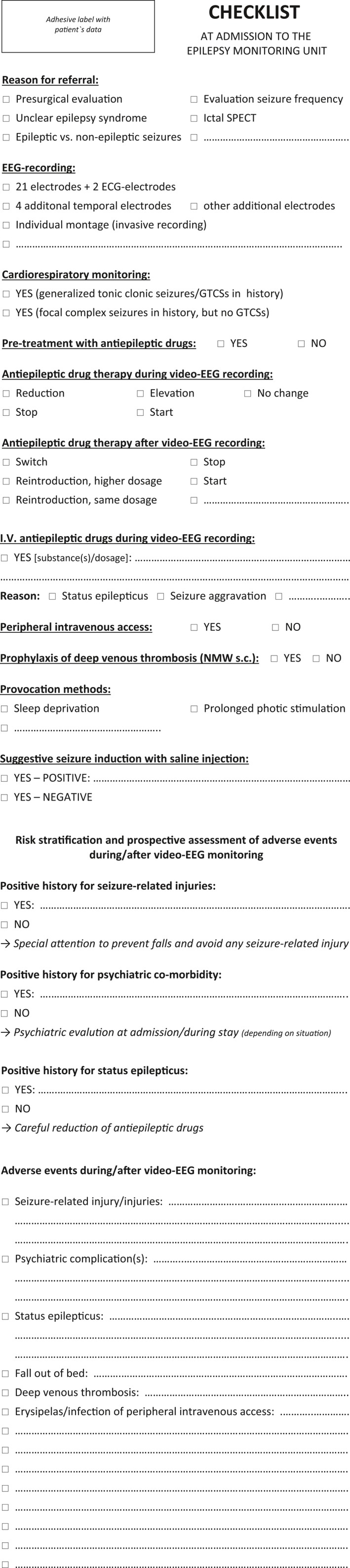
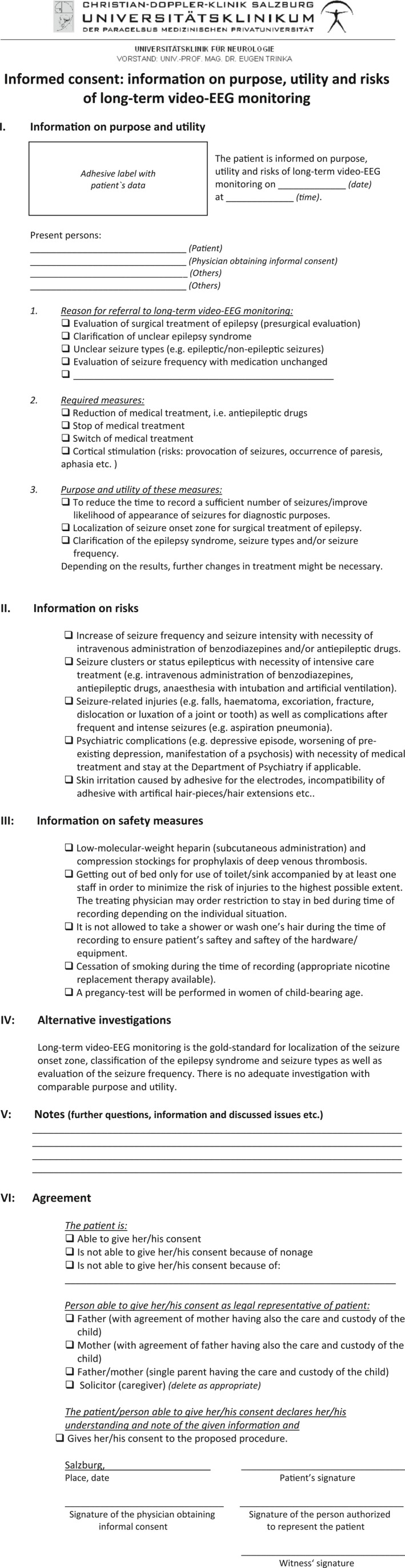
We retrospectively assessed the adverse event rates in a group without (group 1, 84-month period, Innsbruck, Austria) and a group with (group 2, 33-month period, Salzburg, Austria) personalized safety measures utilizing a standardized protocol for long-term epilepsy monitoring in high-risk patients. Differences in adverse event rates during and after long-term video EEG between the two groups were calculated and compared.
In group 1, 44/507 (9%, 95% confidence interval [CI] 6.5-11.5%) patients experienced 53 adverse events: 20/507 (4%, 95% CI 2.6-6.0%) patients had psychiatric events, 15/507 (3%, 95% CI 1.8-4.8%) patients sustained a total of 19 injuries during seizures, and 10/507 (2%, 95% CI 1.1-3.6%) patients had 13 episodes of status epilepticus; one adverse event was treatment-related (valproic acid-induced encephalopathy; 1/507, 0.2%, 95% CI 0.0-1.1%). By using the new safety protocol in group 2, the adverse event rate was only 5% (95% CI 3.4-7.6%; 30 adverse events in 26/491; 45% reduction; p = 0.036), in contrast. These events included 13 psychiatric complications in 13/491 (2%, 95% CI 1.6-4.5%, p = 0.252) patients, 12 seizure-related injuries in 9/491 (2%, 95% CI 1.0-3.4%, p = 0.250) patients, and 5 episodes of status epilepticus in 4/491 (1%, 95% CI 0.3-2.1%, p = 0.120) patients.
Implementation of personalized safety measures in high-risk patients resulted in a clinically relevant reduction of adverse events in the EMU. Safety protocols are a valid tool to reduce the occurrence of adverse events in EMUs.
癫痫监测单元(EMU)的安全性已日益受到关注,因为在接受EMU长期视频脑电图监测的患者中,高达10%会发生不良事件。本研究的目的是评估EMU中一种特定安全方案的有效性。
我们回顾性评估了两组患者的不良事件发生率,一组未采用(第1组,奥地利因斯布鲁克,为期84个月),另一组采用了个性化安全措施(第2组,奥地利萨尔茨堡,为期33个月),采用标准化方案对高危患者进行长期癫痫监测。计算并比较两组在长期视频脑电图监测期间及之后不良事件发生率的差异。
在第1组中,44/507例(9%,95%置信区间[CI]6.5 - 11.5%)患者发生了53起不良事件:20/507例(4%,95%CI 2.6 - 6.0%)患者出现精神事件,15/507例(3%,95%CI 1.8 - 4.8%)患者在癫痫发作期间共遭受19次伤害,10/507例(2%,95%CI 1.1 - 3.6%)患者发生13次癫痫持续状态发作;1起不良事件与治疗相关(丙戊酸诱导的脑病;1/507,0.2%,95%CI 0.0 - 1.1%)。相比之下,在第2组中使用新的安全方案后,不良事件发生率仅为5%(95%CI 3.4 - 7.6%;26/491例患者发生30起不良事件;降低了45%;p = 0.036)。这些事件包括13/491例(2%,95%CI 1.6 - 4.5%,p = 0.252)患者出现13例精神并发症,9/491例(2%,95%CI 1.0 - 3.4%,p = 0.250)患者发生12次与癫痫发作相关的伤害,4/491例(1%,95%CI 0.3 - 2.1%,p = 0.120)患者发生5次癫痫持续状态发作。
对高危患者实施个性化安全措施可使EMU中的不良事件在临床上显著减少。安全方案是减少EMU中不良事件发生的有效工具。