Azarakhsh Mahboobeh, Lebedeva Maria A, Lutova Lyudmila A
Department of Genetics and Biotechnology, Saint Petersburg State University, Saint Petersburg, Russia.
Front Plant Sci. 2018 Mar 9;9:304. doi: 10.3389/fpls.2018.00304. eCollection 2018.
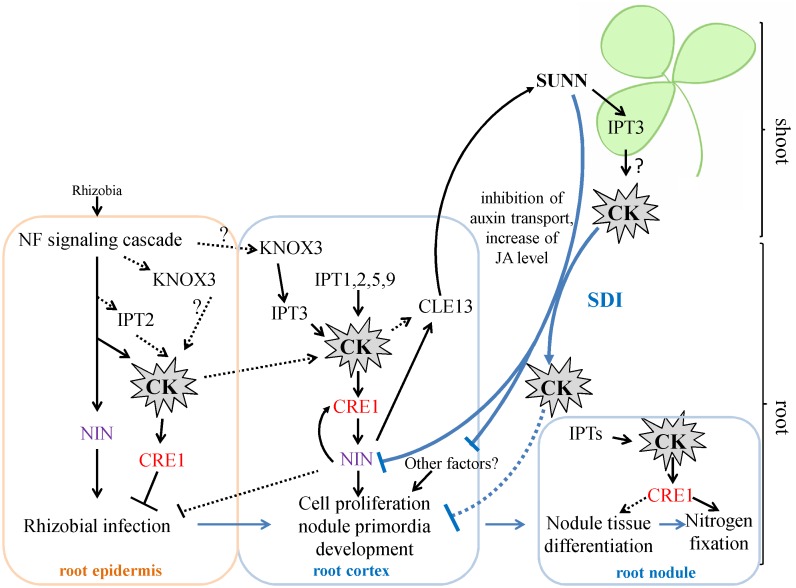
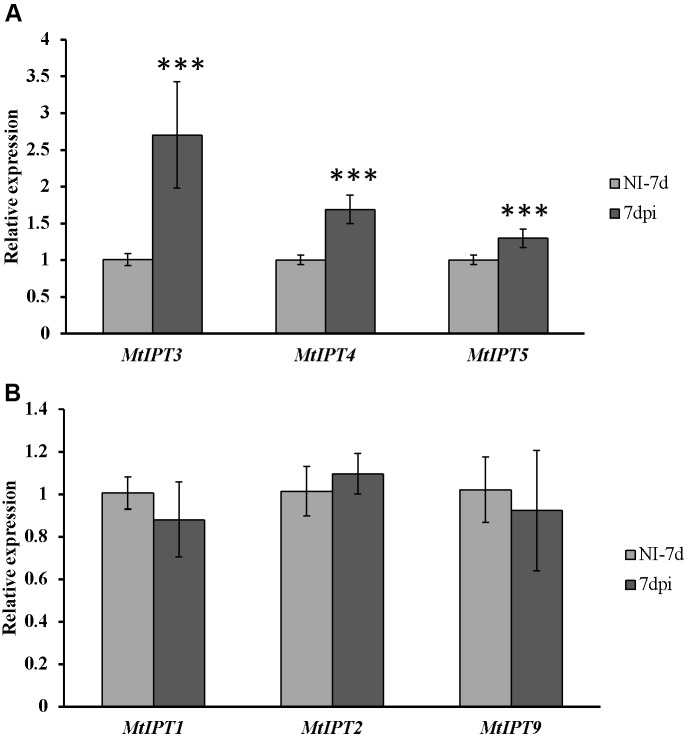
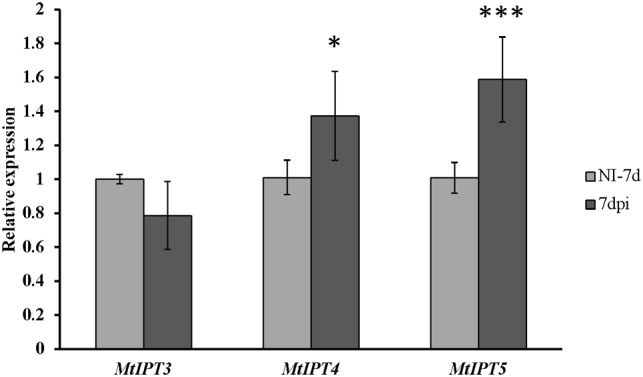
Cytokinins are essential for legume plants to establish a nitrogen-fixing symbiosis with rhizobia. Recently, the expression level of cytokinin biosynthesis s () genes was shown to be increased in response to rhizobial inoculation in and . In addition to its well-established positive role in nodule primordium initiation in root cortex, cytokinin negatively regulates infection processes in the epidermis. Moreover, it was reported that shoot-derived cytokinin inhibits the subsequent nodule formation through AON (autoregulation of nodulation) pathway. In gene was shown to be activated in the shoot phloem via the components of AON system, negatively affecting nodulation. However, in , the detailed analysis of s expression, both in roots and shoots, in response to nodulation has not been performed yet, and the link between s and AON has not been studied so far. In this study, we performed an extensive analysis of s expression levels in different organs, focusing on the possible role of s in nodule development. s expression dynamics in inoculated roots suggest that besides its early established role in the nodule primordia development, cytokinin may be also important for later stages of nodulation. According to expression analysis, , and are activated in the shoots in response to inoculation. Among these genes, is the only one the induction of which was not observed in leaves of the mutant defective in CLV1-like kinase, the key component of AON, suggesting that is activated in the shoots in an AON-dependent manner. Taken together, our findings suggest that s are involved in the nodule development at different stages, both locally in inoculated roots and systemically in shoots, where their expression can be activated in an AON-dependent manner.
细胞分裂素对于豆科植物与根瘤菌建立固氮共生关系至关重要。最近,在[具体植物1]和[具体植物2]中发现,根瘤菌接种后细胞分裂素生物合成基因([具体基因名称])的表达水平会升高。除了在根皮层结节原基起始中已确立的积极作用外,细胞分裂素还对表皮中的感染过程起负调控作用。此外,据报道,地上部来源的细胞分裂素通过自调控结瘤(AON)途径抑制后续的结瘤形成。在[具体研究1]中,[具体基因名称]被证明通过AON系统的组分在地上部韧皮部中被激活,对结瘤产生负面影响。然而,在[具体研究2]中,尚未对根和地上部中[具体基因名称]响应结瘤的表达进行详细分析,并且到目前为止尚未研究[具体基因名称]与AON之间的联系。在本研究中,我们对不同器官中[具体基因名称]的表达水平进行了广泛分析,重点关注[具体基因名称]在结节发育中的可能作用。接种根中[具体基因名称]的表达动态表明,除了其在结节原基发育中早期确立的作用外,细胞分裂素可能对结瘤的后期阶段也很重要。根据表达分析,[具体基因1]、[具体基因2]和[具体基因3]在接种后地上部中被激活。在这些基因中,[具体基因3]是唯一一个在AON关键组分CLV1样激酶缺陷的[具体突变体名称]突变体叶片中未观察到诱导的基因,这表明[具体基因3]在地上部中以AON依赖的方式被激活。综上所述,我们的研究结果表明,[具体基因名称]参与结瘤的不同阶段,在接种根中局部参与,在地上部中系统参与,其表达可通过AON依赖的方式被激活。