Nordic Bioscience A/S, Herlev, Denmark.
DTU Bioengineering, Department of Biotechnology and Biomedicine, Technical University of Denmark, Kgs. Lyngby, Denmark.
PLoS One. 2018 Mar 29;13(3):e0194458. doi: 10.1371/journal.pone.0194458. eCollection 2018.
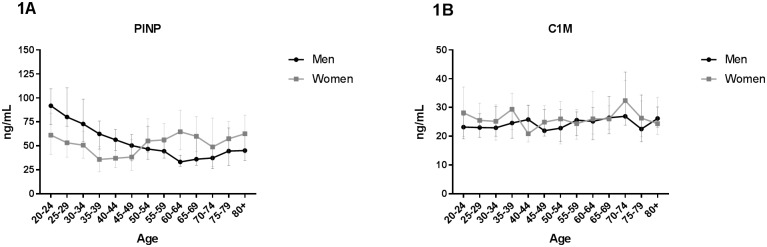
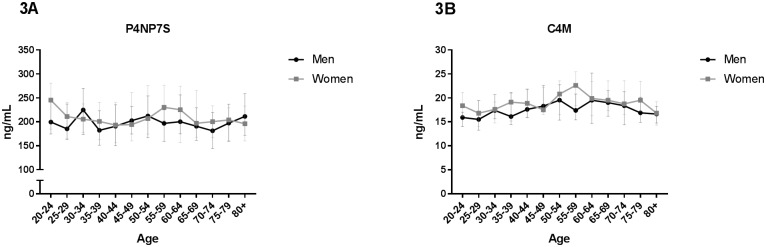
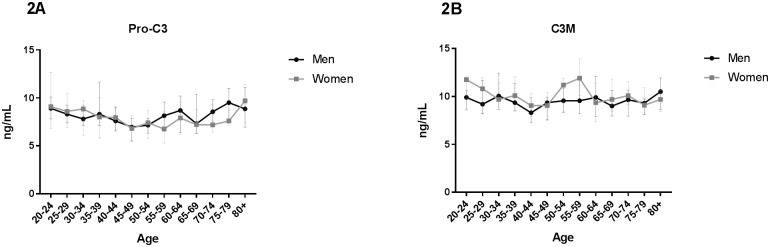
The extracellular matrix (ECM) plays a vital role in maintaining normal tissue function. Collagens are major components of the ECM and there is a tight equilibrium between degradation and formation of these proteins ensuring tissue health and homeostasis. As a consequence of tissue turnover, small collagen fragments are released into the circulation, which act as important biomarkers in the study of certain tissue-related remodeling factors in health and disease. The aim of this study was to establish an age-related collagen turnover profile of the main collagens of the interstitial matrix (type I and III collagen) and basement membrane (type IV collagen) in healthy men and women. By using well-characterized competitive ELISA-assays, we assessed specific fragments of degraded (C1M, C3M, C4M) and formed (PINP, Pro-C3, P4NP7S) type I, III and IV collagen in serum from 617 healthy men and women ranging in ages from 22 to 86. Subjects were divided into 5-year age groups according to their sex and age. Groups were compared using Kruskal-Wallis adjusted for Dunn's multiple comparisons test and Mann-Whitney t-test. Age-specific changes in collagen turnover was most profound for type I collagen. PINP levels decreased in men with advancing age, whereas in women, the level decreased in early adulthood followed by an increase around the age of menopause (age 40-60). Sex-specific changes in type I, III and IV collagen turnover was present at the age around menopause (age 40-60) with women having an increased turnover. In summary, collagen turnover is affected by age and sex with the interstitial matrix and the basement membrane being differently regulated. The observed changes needs to be accounted for when measuring ECM related biomarkers in clinical studies.
细胞外基质(ECM)在维持正常组织功能方面起着至关重要的作用。胶原蛋白是 ECM 的主要成分,这些蛋白质的降解和形成之间存在着紧密的平衡,以确保组织的健康和内稳态。由于组织更新,小的胶原蛋白片段被释放到循环中,这些片段在研究健康和疾病中某些与组织相关的重塑因素时,是重要的生物标志物。本研究的目的是建立一个与间质基质(I 型和 III 型胶原蛋白)和基底膜(IV 型胶原蛋白)主要胶原蛋白相关的年龄相关性胶原转换图谱,该图谱适用于健康男性和女性。通过使用经过充分表征的竞争性 ELISA 测定法,我们评估了血清中特定片段的降解(C1M、C3M、C4M)和形成(PINP、Pro-C3、P4NP7S)I 型、III 型和 IV 型胶原蛋白,研究对象为年龄在 22 至 86 岁之间的 617 名健康男性和女性。根据他们的性别和年龄,将受试者分为 5 岁一个年龄组。使用 Kruskal-Wallis 检验进行组间比较,并根据 Dunn 的多重比较检验和 Mann-Whitney t 检验进行调整。I 型胶原蛋白的胶原转换的年龄特异性变化最为显著。随着年龄的增长,男性的 PINP 水平下降,而女性的水平则在成年早期下降,随后在绝经前后(40-60 岁)增加。I 型、III 型和 IV 型胶原蛋白转换的性别特异性变化发生在绝经前后(40-60 岁),此时女性的胶原转换增加。总之,胶原转换受年龄和性别影响,间质基质和基底膜受到不同的调节。在临床研究中测量 ECM 相关生物标志物时,需要考虑到这些变化。