
2015年7月,埃博拉经历和风险认知对塞拉利昂心理健康的影响。
Impact of Ebola experiences and risk perceptions on mental health in Sierra Leone, July 2015.
作者信息
Jalloh Mohamed F, Li Wenshu, Bunnell Rebecca E, Ethier Kathleen A, O'Leary Ann, Hageman Kathy M, Sengeh Paul, Jalloh Mohammad B, Morgan Oliver, Hersey Sara, Marston Barbara J, Dafae Foday, Redd John T
机构信息
Division of Global Health Protection, Centers for Global Health, US Centers for Disease Control and Prevention (CDC), Atlanta, Georgia, USA.
National Center for HIV/AIDS, Viral Hepatitis, STD, and TB Prevention, US Centers for Disease Control and Prevention (CDC), Atlanta, Georgia, USA.
出版信息
BMJ Glob Health. 2018 Mar 17;3(2):e000471. doi: 10.1136/bmjgh-2017-000471. eCollection 2018.
BACKGROUND
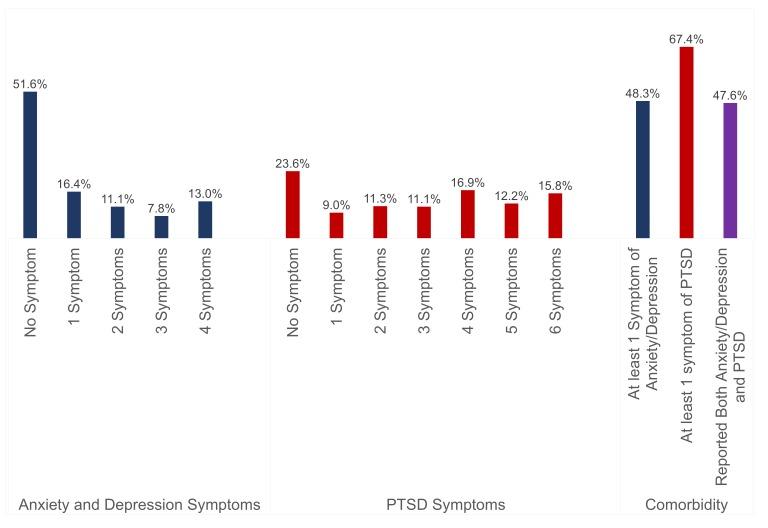
The mental health impact of the 2014-2016 Ebola epidemic has been described among survivors, family members and healthcare workers, but little is known about its impact on the general population of affected countries. We assessed symptoms of anxiety, depression and post-traumatic stress disorder (PTSD) in the general population in Sierra Leone after over a year of outbreak response.
METHODS
We administered a cross-sectional survey in July 2015 to a national sample of 3564 consenting participants selected through multistaged cluster sampling. Symptoms of anxiety and depression were measured by Patient Health Questionnaire-4. PTSD symptoms were measured by six items from the Impact of Events Scale-revised. Relationships among Ebola experience, perceived Ebola threat and mental health symptoms were examined through binary logistic regression.
RESULTS
Prevalence of any anxiety-depression symptom was 48% (95% CI 46.8% to 50.0%), and of any PTSD symptom 76% (95% CI 75.0% to 77.8%). In addition, 6% (95% CI 5.4% to 7.0%) met the clinical cut-off for anxiety-depression, 27% (95% CI 25.8% to 28.8%) met levels of clinical concern for PTSD and 16% (95% CI 14.7% to 17.1%) met levels of probable PTSD diagnosis. Factors associated with higher reporting of any symptoms in bivariate analysis included region of residence, experiences with Ebola and perceived Ebola threat. Knowing someone quarantined for Ebola was independently associated with anxiety-depression (adjusted OR (AOR) 2.3, 95% CI 1.7 to 2.9) and PTSD (AOR 2.095% CI 1.5 to 2.8) symptoms. Perceiving Ebola as a threat was independently associated with anxiety-depression (AOR 1.69 95% CI 1.44 to 1.98) and PTSD (AOR 1.86 95% CI 1.56 to 2.21) symptoms.
CONCLUSION
Symptoms of PTSD and anxiety-depression were common after one year of Ebola response; psychosocial support may be needed for people with Ebola-related experiences. Preventing, detecting, and responding to mental health conditions should be an important component of global health security efforts.
背景
2014 - 2016年埃博拉疫情对幸存者、家庭成员及医护人员的心理健康影响已有描述,但对受影响国家普通民众的影响却知之甚少。我们评估了在爆发应对一年多后,塞拉利昂普通民众中焦虑、抑郁及创伤后应激障碍(PTSD)的症状。
方法
2015年7月,我们对通过多阶段整群抽样选取的3564名同意参与的全国样本进行了横断面调查。焦虑和抑郁症状通过患者健康问卷 - 4进行测量。PTSD症状通过事件影响量表修订版中的六个项目进行测量。通过二元逻辑回归研究埃博拉经历、感知到的埃博拉威胁与心理健康症状之间的关系。
结果
任何焦虑 - 抑郁症状的患病率为48%(95%可信区间46.8%至50.0%),任何PTSD症状的患病率为76%(95%可信区间75.0%至77.8%)。此外,6%(95%可信区间5.4%至7.0%)达到焦虑 - 抑郁的临床临界值,27%(95%可信区间25.8%至28.8%)达到PTSD的临床关注水平,16%(95%可信区间14.7%至17.1%)达到可能的PTSD诊断水平。在双变量分析中,与任何症状报告率较高相关的因素包括居住地区、埃博拉经历及感知到的埃博拉威胁。认识因埃博拉被隔离的人独立与焦虑 - 抑郁(调整后比值比(AOR)2.3, 95%可信区间1.7至2.9)及PTSD(AOR 2.0, 95%可信区间1.5至2.8)症状相关。将埃博拉视为威胁独立与焦虑 - 抑郁(AOR 1.69, 95%可信区间1.44至1.98)及PTSD(AOR 1.86, 95%可信区间1.56至2.21)症状相关。
结论
埃博拉应对一年后,PTSD及焦虑 - 抑郁症状普遍存在;有埃博拉相关经历的人可能需要心理社会支持。预防、检测及应对心理健康状况应成为全球卫生安全努力的重要组成部分。
 Zotero 插件