Keita Mamady Mory, Taverne Bernard, Sy Savané Sékou, March Laura, Doukoure Morifodé, Sow Mamadou Saliou, Touré Abdoulaye, Etard Jean François, Barry Moumié, Delaporte Eric
Psychiatric Unit, Donka National Hospital, University Medical Center of Conakry, BP 925, Conakry, Guinea.
Institut de Recherche pour le Développement; IRD-UMI 233/INSERM U 1175, Montpellier University, Montpellier, 911, Avenue Agropolis, BP 64501, 34394, Montpellier CEDEX 5, France.
BMC Psychiatry. 2017 Apr 4;17(1):127. doi: 10.1186/s12888-017-1280-8.
The 2013-2016 West African Ebola outbreak infected 28,616 people and caused 11,310 deaths by 11 May 2016, across six countries. The outbreak has also resulted in the largest number of EVD survivors in history-over 17,000. Guinea was declared Ebola-free on 1 June 2016. Reports from the outbreak documented 3814 cases resulting in 2544 deaths and 1270 survivors. EVD survivors face various neuropsychological and psycho-affective alterations that have not been fully identified yet. This study aims to document the depressive symptoms among adult survivors in Guinea.
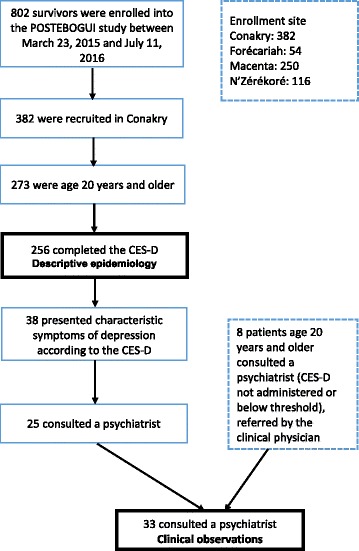
Depressive symptoms were investigated using the French version of the Center for Epidemiologic Studies-Depression Scale (CES-D) administered to all adult survivors (≥ 20 years) participating in the PostEboGui study and receiving care in Conakry. The study was combined with a clinical consultation by a psychiatrist at the Donka National Hospital in Conakry that ensured adapted care was provided when needed.
Overall, 256 adult participants receiving care in Conakry participated in this study: 55% were women, median age 31 years [IQR: 26-40]. The median time since the Ebola Treatment Center (ETC) discharge was 8.1 months [IQR: 4.1-11.7]. 15% had a score above the threshold values indicating psychological suffering (15% for men and 14% for women). 33 people (16 women and 17 men) met with the psychiatrist, which resulted in the diagnosis of 3 cases of post-traumatic stress disorder (PTSD), 3 cases of mild depression, 13 cases of moderate depression, and 11 cases of severe depression, including 1 with kinesthetic hallucinations and another with visual hallucinations, and 1 with suicidal ideation and 3 with attempted suicide. Severe depression was diagnosed between 1 and 19 months after ETC discharge. The various identified forms of depression responded favorably to conventional drug therapies and cognitive behavioral therapy.
Long-term follow-up for EVD survivors will be necessary to understand the evolution of these pathologies. In the current post-epidemic context, these cases underscore the need to strengthen mental health diagnostic systems and treatment on a national scale.
2013 - 2016年西非埃博拉疫情感染了28616人,截至2016年5月11日,在六个国家造成11310人死亡。此次疫情还造就了历史上数量最多的埃博拉病毒病幸存者——超过17000人。几内亚于2016年6月1日宣布摆脱埃博拉疫情。疫情报告记录了3814例病例,导致2544人死亡,1270人幸存。埃博拉病毒病幸存者面临各种尚未完全明确的神经心理和心理情感改变。本研究旨在记录几内亚成年幸存者中的抑郁症状。
使用流行病学研究中心抑郁量表(CES - D)的法语版本对所有参与PostEboGui研究并在科纳克里接受治疗的成年幸存者(≥20岁)进行抑郁症状调查。该研究还结合了科纳克里Donka国家医院精神科医生的临床会诊,以确保在需要时提供适当的护理。
总体而言,256名在科纳克里接受治疗的成年参与者参与了本研究:55%为女性,中位年龄31岁[四分位间距:26 - 40]。自埃博拉治疗中心出院后的中位时间为8.1个月[四分位间距:4.1 - 11.7]。15%的人得分高于表明心理痛苦的阈值(男性为15%,女性为14%)。33人(16名女性和17名男性)与精神科医生会面,结果诊断出3例创伤后应激障碍(PTSD)、3例轻度抑郁症、13例中度抑郁症和11例重度抑郁症,其中1例有运动性幻觉,另1例有视幻觉,1例有自杀意念,3例有自杀未遂。重度抑郁症在埃博拉治疗中心出院后1至19个月被诊断出来。各种已确定的抑郁症形式对传统药物治疗和认知行为疗法反应良好。
有必要对埃博拉病毒病幸存者进行长期随访,以了解这些病症的发展情况。在当前疫情后的背景下,这些病例凸显了在全国范围内加强心理健康诊断系统和治疗的必要性。