Chung Sochung, Yoo Jae-Ho, Choi Jin Ho, Rhie Young-Jun, Chae Hyun-Wook, Kim Jae Hyun, Hwang Il Tae, Shin Choong Ho, Kim Eun Young, Lee Kee-Hyoung
Department of Pediatrics, Konkuk University Medical Center, Konkuk University School of Medicine, Seoul, Korea.
Department of Pediatrics, Dong-A University College of Medicine, Busan, Korea.
Ann Pediatr Endocrinol Metab. 2018 Mar;23(1):43-50. doi: 10.6065/apem.2018.23.1.43. Epub 2018 Mar 22.
Regarding recombinant human growth hormone (rhGH) use in the pediatric population, no long-term follow-up data are available for Korean patients. To fill in the gap of knowledge, a registry study (LG Growth Study) was initiated to assess the safety and effectiveness of four types of rhGH products in real-life settings.
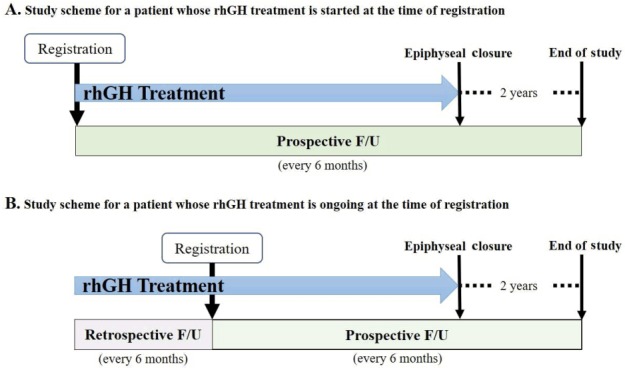
A total of 4,000 children will be registered and prospectively followed up at 6-month intervals until 2 years after epiphyseal closure to collect data on treatment and adverse events, with primary interest in malignancies and growth outcomes.
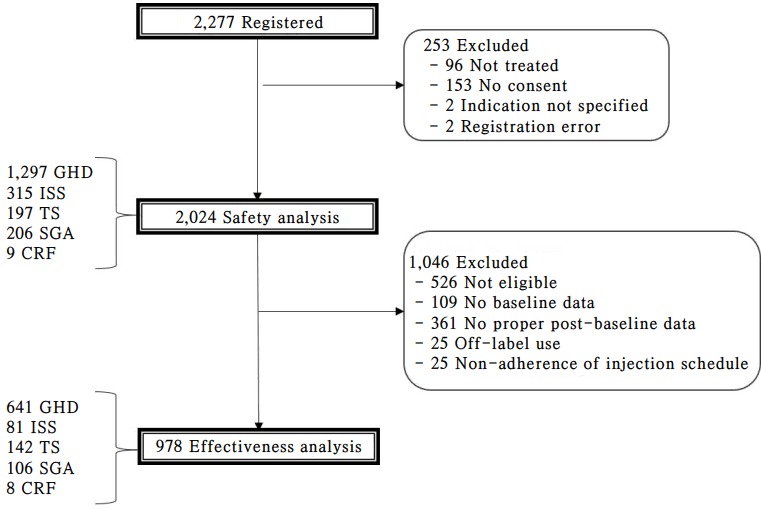
As of 22 March 2017, approximately 50% (2,024) of the target number of patients have been included in the analysis set: growth hormone deficiency, 1,297 (64.1%); idiopathic short stature, 315 (15.6%); small for gestational age, 206 (10.2%); Turner syndrome, 197 (9.7%); and chronic renal failure, 9 (0.4%). At baseline, median age (years) was 8 (interquartile range [IQR], 5-11); 52% (1,048) were boys; and the majority were at Tanner stage I (83% based on breast/external genitalia, 97% on pubic hair). Median height standard deviation score was -2.26 (IQR, -2.69 to -2.0), and median bone age delay (years) was -1.46 (IQR, -2.26 to -0.78).
This registry study will provide the opportunity to assess the risk of malignancies as well as the general safety data in Korean pediatric patients receiving rhGH. In addition, the long-term effectiveness of rhGH and comparative data between different disease entities will provide practical insight on the standard rhGH treatment.
关于重组人生长激素(rhGH)在儿科人群中的应用,韩国患者尚无长期随访数据。为填补这一知识空白,启动了一项注册研究(LG生长研究),以评估四种rhGH产品在实际应用中的安全性和有效性。
总共将登记4000名儿童,并每隔6个月进行前瞻性随访,直至骨骺闭合后2年,以收集治疗和不良事件数据,主要关注恶性肿瘤和生长结果。
截至2017年3月22日,约50%(2024名)的目标患者已纳入分析集:生长激素缺乏症患者1297名(64.1%);特发性矮小症患者315名(15.6%);小于胎龄儿患者206名(10.2%);特纳综合征患者197名(9.7%);慢性肾衰竭患者9名(0.4%)。基线时,中位年龄(岁)为8岁(四分位间距[IQR],5 - 11岁);52%(1048名)为男孩;大多数处于坦纳I期(根据乳房/外生殖器判断为83%,根据阴毛判断为97%)。中位身高标准差分数为 - 2.26(IQR, - 2.69至 - 2.0),中位骨龄延迟(岁)为 - 1.46(IQR, - 2.26至 - 0.78)。
这项注册研究将提供机会,评估接受rhGH治疗的韩国儿科患者发生恶性肿瘤的风险以及一般安全性数据。此外,rhGH的长期有效性以及不同疾病实体之间的比较数据将为标准rhGH治疗提供实际见解。