Denke Claudia, Balzer Felix, Menk Mario, Szur Sebastian, Brosinsky Georg, Tafelski Sascha, Wernecke Klaus-Dieter, Deja Maria
1 Department of Anesthesiology and Operative Intensive Care Medicine, Campus Virchow-Klinikum, Charité - Universitätsmedizin Berlin, corporate member of Freie Universität Berlin, Humboldt-Universität zu Berlin, and Berlin Institute of Health, Berlin, Germany.
2 SOSTANA GmbH, Berlin, Germany.
J Int Med Res. 2018 Jun;46(6):2265-2283. doi: 10.1177/0300060518762040. Epub 2018 Apr 2.
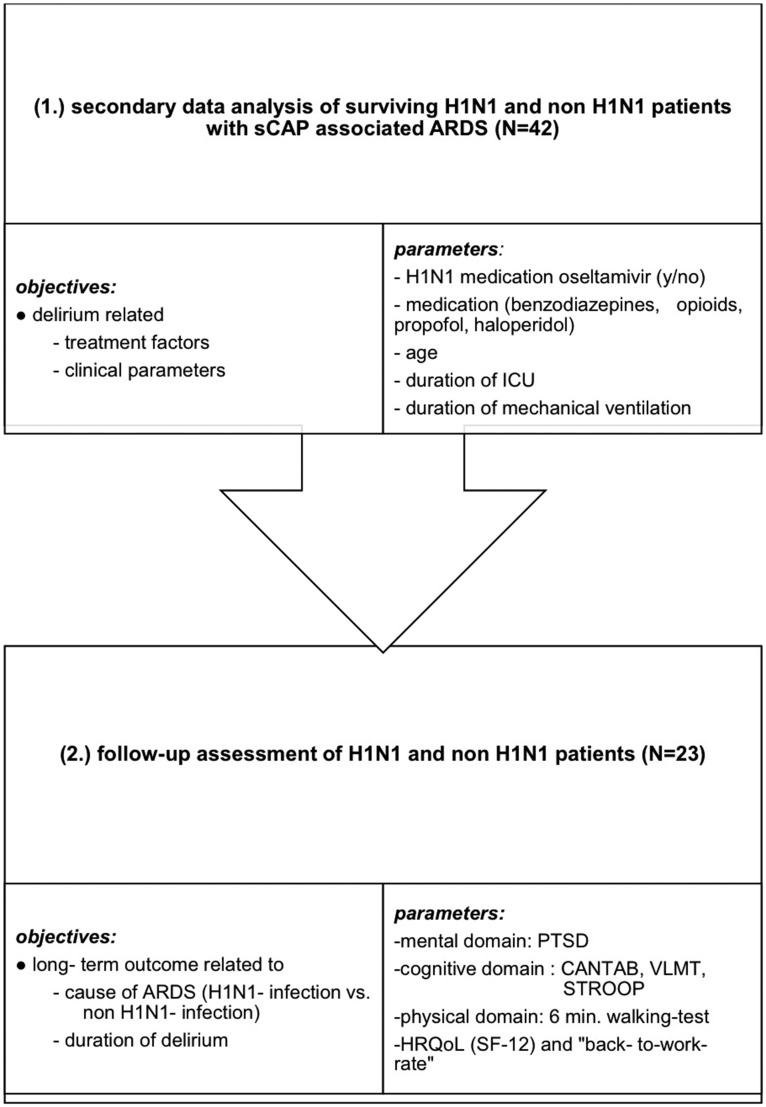
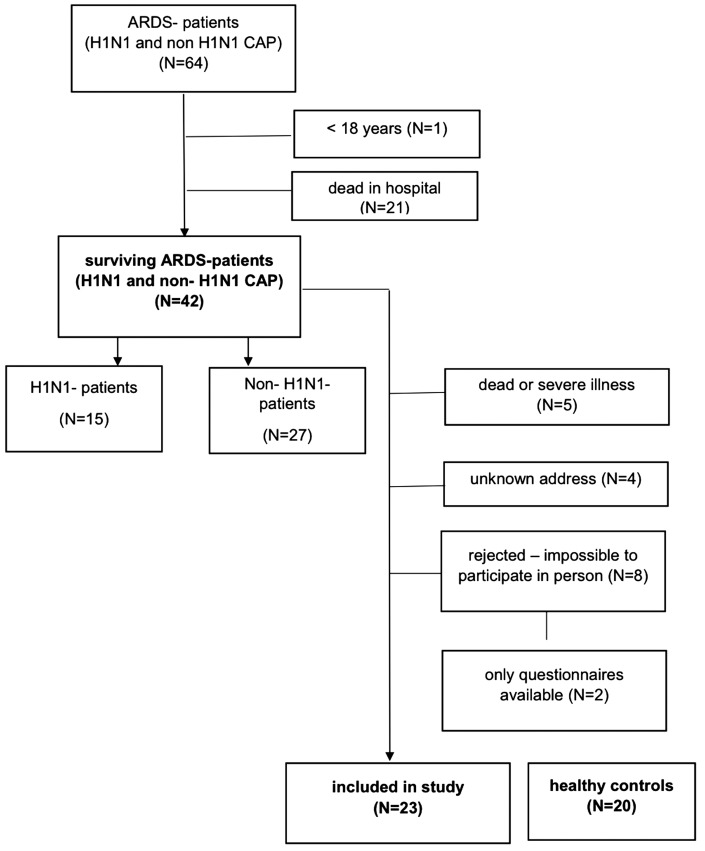
Objective Delirium in critically ill patients is considered a risk factor for various long-term consequences. We evaluated delirium and associated long-term outcomes in patients with acute respiratory distress syndrome with non-H1N1 and H1N1- associated severe community-acquired pneumonia (sCAP) who had been recommended to take antiviral drugs associated with delirious symptoms as adverse effects. Methods Of 64 patients, 42 survivors (H1N1, 15; non-H1N1, 27) were analyzed regarding the relationship between medication and the duration of delirium in the intensive care unit. During follow-up (n = 23), we assessed cognitive abilities, post-traumatic stress disorder (PTSD), physical capacity, and health-related quality of life (HRQoL). Results The incidence of delirium was 88%. There was no difference in the incidence and duration of delirium between patients with H1N1 and non-H1N1 infection. The haloperidol and opioid doses were associated with a longer delirium duration. The delirium duration was correlated with reduced cognitive performance in motor skills, memory function, and learning efficiency. Patients with PTSD (16%) had a significantly longer delirium duration and low mental HRQoL. Conclusions H1N1 infection and corresponding antiviral medication had no impact on delirium. The duration of delirium in these patients was associated with impairments in various outcome parameters, illustrating the burden of sCAP.
目的 重症患者的谵妄被认为是各种长期后果的危险因素。我们评估了患有急性呼吸窘迫综合征并伴有非H1N1和H1N1相关严重社区获得性肺炎(sCAP)的患者的谵妄及相关长期预后,这些患者被建议服用有谵妄症状不良反应的抗病毒药物。方法 对64例患者中的42例幸存者(H1N1感染组15例;非H1N1感染组27例)分析了药物治疗与重症监护病房谵妄持续时间之间的关系。在随访期间(n = 23),我们评估了认知能力、创伤后应激障碍(PTSD)、身体能力和健康相关生活质量(HRQoL)。结果 谵妄发生率为88%。H1N1感染患者和非H1N1感染患者的谵妄发生率和持续时间无差异。氟哌啶醇和阿片类药物剂量与谵妄持续时间延长有关。谵妄持续时间与运动技能、记忆功能和学习效率方面认知能力下降相关。患有创伤后应激障碍(16%)的患者谵妄持续时间显著延长且心理方面的健康相关生活质量较低。结论 H1N1感染及相应的抗病毒药物治疗对谵妄无影响。这些患者的谵妄持续时间与各种预后参数受损有关,说明了严重社区获得性肺炎的负担。