Kyung Sun Young, Kim Dae Young, Yoon Jin Young, Son Eun Suk, Kim Yu Jin, Park Jeong Woong, Jeong Sung Hwan
Department of Internal Medicine, Gachon University Gil Medical Center, 21 Namdong-daero 774, Namdong-gu, Incheon, 21565, Republic of Korea.
Department of Biological Science, College of Bio-nano Technology, Gachon University, Seongnam-daero 1342, Seongnam, South Korea.
BMC Pharmacol Toxicol. 2018 Apr 2;19(1):13. doi: 10.1186/s40360-018-0204-7.
Idiopathic pulmonary fibrosis (IPF) is a progressive and fatal disease with no effective treatment. The epithelial-mesenchymal transition (EMT) is a critical stage during the development of fibrosis. To assess the effect of sulforaphane (SFN) on the EMT and fibrosis using an in vitro transforming growth factor (TGF)-β1-induced model and an in vivo bleomycin (BLM)-induced model.
In vitro studies, cell viability, and cytotoxicity were measured using a Cell Counting Kit-8. The functional TGF-β1-induced EMT and fibrosis were assessed using western blotting and a quantitative real-time polymerase chain reaction. The lungs were analyzed histopathologically in vivo using hematoxylin and eosin and Masson's trichrome staining. The BLM-induced fibrosis was characterized by western blotting and immunohistochemical analyses for fibronectin, TGF-β1, E-cadherin (E-cad), and α-smooth muscle actin (SMA) in lung tissues.
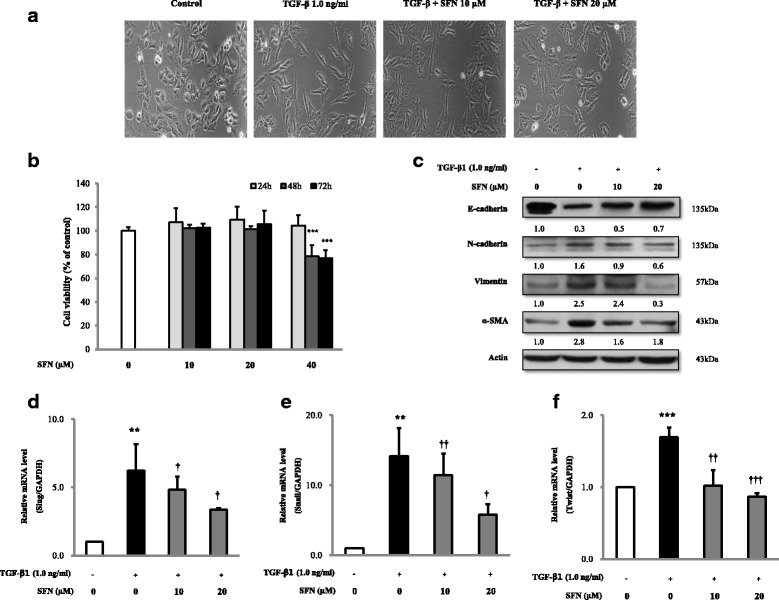
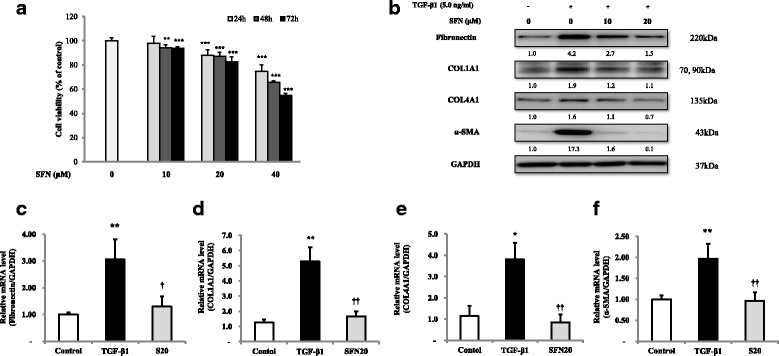
SFN reversed mesenchymal-like changes induced by TGF-β1 and restored cells to their epithelial-like morphology. The results confirmed that the expression of the epithelial marker, E-cadherin, increased after SFN treatment, while expression of the mesenchymal markers, N-cadherin, vimentin, and α-SMA decreased in A549 cells after SFN treatment. In addition, SFN inhibited TGF-β1-induced mRNA expression of the EMT-related transcription factors, Slug, Snail, and Twist. The SFN treatment attenuated TGF-β1-induced expression of fibrosis-related proteins, such as fibronection, collagen I, collagen IV, and α-SMA in MRC-5 cells. Furthermore, SFN reduced the TGF-β1-induced phosphorylation of SMAD2/3 protein in A549 cells and MRC-5 cells. BLM induced fibrosis in mouse lungs that was also attenuated by SFN treatment, and SFN treatment decreased BLM-induced fibronectin expression, TGF-β1 expression, and the levels of collagen I in the lungs of mice.
SFN showed a significant anti-fibrotic effect in TGF-β-treated cell lines and BLM-induced fibrosis in mice. These findings showed that SFN has anti-fibrotic activity that may be considered in the treatment of IPF.
特发性肺纤维化(IPF)是一种进行性致命疾病,尚无有效治疗方法。上皮-间质转化(EMT)是纤维化发展过程中的关键阶段。本研究旨在使用体外转化生长因子(TGF)-β1诱导模型和体内博来霉素(BLM)诱导模型评估萝卜硫素(SFN)对EMT和纤维化的影响。
在体外研究中,使用细胞计数试剂盒-8测量细胞活力和细胞毒性。通过蛋白质免疫印迹法和定量实时聚合酶链反应评估功能性TGF-β1诱导的EMT和纤维化。在体内,使用苏木精和伊红染色以及Masson三色染色对肺组织进行组织病理学分析。通过蛋白质免疫印迹法和免疫组织化学分析肺组织中纤连蛋白、TGF-β1、E-钙黏蛋白(E-cad)和α-平滑肌肌动蛋白(SMA),以表征BLM诱导的纤维化。
SFN逆转了TGF-β1诱导的间充质样变化,并使细胞恢复为上皮样形态。结果证实,SFN处理后,上皮标志物E-钙黏蛋白的表达增加,而间充质标志物N-钙黏蛋白、波形蛋白和α-SMA在A549细胞中的表达在SFN处理后降低。此外,SFN抑制TGF-β1诱导的EMT相关转录因子Slug、Snail和Twist的mRNA表达。SFN处理减弱了TGF-β1诱导的MRC-5细胞中纤维化相关蛋白的表达,如纤连蛋白、I型胶原、IV型胶原和α-SMA。此外,SFN降低了TGF-β1诱导的A549细胞和MRC-5细胞中SMAD2/3蛋白的磷酸化。BLM诱导小鼠肺纤维化,而SFN处理也可减轻这种纤维化,并且SFN处理降低了BLM诱导的小鼠肺中纤连蛋白表达、TGF-β1表达和I型胶原水平。
SFN在TGF-β处理的细胞系和BLM诱导的小鼠纤维化中显示出显著的抗纤维化作用。这些发现表明SFN具有抗纤维化活性,可考虑用于IPF的治疗。