Lee Kyoung Hwa, Cho Nan Hyoung, Jeong Su Jin, Kim Mi Na, Han Sang Hoon, Song Young Goo
Division of Infectious Diseases, Department of Internal Medicine, Gangnam Severance Hospital, Yonsei University College of Medicine, Seoul, Korea.
Department of Infection Control, Gangnam Severance Hospital, Seoul, Korea.
Yonsei Med J. 2018 May;59(3):376-382. doi: 10.3349/ymj.2018.59.3.376.
The present study aimed to evaluate the effect of central line (CL) bundle compliance on central line-associated bloodstream infections (CLABSIs) in different departments of the same hospital, including the intensive care unit (ICU) and other departments.
The four components of the CL bundle were hand hygiene, use of maximal sterile barrier precautions, chlorhexidine use, and selection of an appropriate site for venous access. Compliance of the CL bundle and CLABSIs were measured for every department [emergency room (ER), ICU, general ward (GW), and operating room (OR)]. A total of 1672 patients were included over 3 years (August 2013 through July 2016).
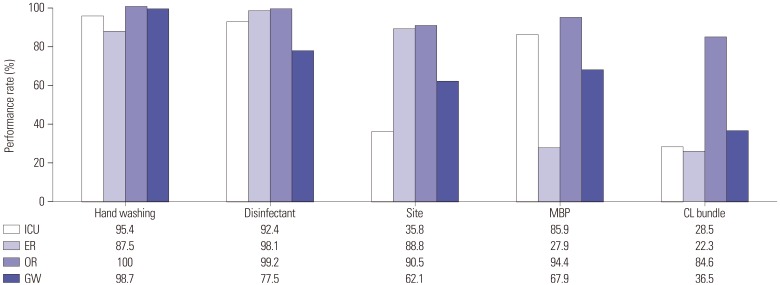
A total of 29 CLABSI episodes (1.73%) were identified, and only 53.7% of the patients completed CL bundles. The performance rates of all components of the CL bundle were 22.3%, 28.5%, 36.5%, and 84.6% for the ER, ICU, GW, and OR, respectively. The highest CLABSI rate was observed in patients of the ICU, for whom all components were not performed perfectly. Conversely, the lowest CLABSI rate was observed for patients of GWs, for whom all components were performed. Among individual components, femoral insertion site [relative risk (RR), 2.26; 95% confidence interval (CI), 1.09-4.68], not using a full body drape (RR, 3.55; 95% CI, 1.44-8.71), and not performing all CL bundle components (RR, 2.79; 95% CI, 1.19-6.54) were significant variables associated with CLABSIs.
This study provides direct evidence that completing all CL bundle components perfectly is essential for preventing CLABSIs. Customized education should be provided, according to specific weaknesses of bundle performance.
本研究旨在评估中心线(CL)集束干预措施的依从性对同一医院不同科室(包括重症监护病房[ICU]和其他科室)中心静脉导管相关血流感染(CLABSI)的影响。
CL集束干预措施的四个组成部分为手卫生、使用最大无菌屏障预防措施、使用洗必泰以及选择合适的静脉穿刺部位。对每个科室(急诊室[ER]、ICU、普通病房[GW]和手术室[OR])测量CL集束干预措施的依从性和CLABSI发生率。在3年期间(2013年8月至2016年7月)共纳入1672例患者。
共识别出29例CLABSI事件(1.73%),仅有53.7%的患者完成了CL集束干预措施。CL集束干预措施各组成部分的执行率在ER、ICU、GW和OR中分别为22.3%、28.5%、36.5%和84.6%。ICU患者的CLABSI发生率最高,其CL集束干预措施的所有组成部分执行情况均不理想。相反,GW患者的CLABSI发生率最低,其CL集束干预措施的所有组成部分均得到执行。在各个组成部分中,股静脉穿刺部位(相对危险度[RR],2.26;95%置信区间[CI],1.09 - 4.68)、未使用全身铺单(RR,3.55;95%CI,1.44 - 8.71)以及未执行CL集束干预措施的所有组成部分(RR,2.79;95%CI,1.19 - 6.54)是与CLABSI相关的显著变量。
本研究提供了直接证据,即完美完成CL集束干预措施的所有组成部分对于预防CLABSI至关重要。应根据集束干预措施执行中的具体薄弱环节提供针对性教育。