Department of Microbiology and Immunology, F. Edward Hébert School of Medicine, Uniformed Services University of the Health Sciences, Bethesda, Maryland, USA.
Emerging Pathogens Institute and Department of Environmental and Global Health, College of Public Health and Health Professions, University of Florida, Gainesville, Florida, USA.
mBio. 2018 Apr 3;9(2):e00204-18. doi: 10.1128/mBio.00204-18.
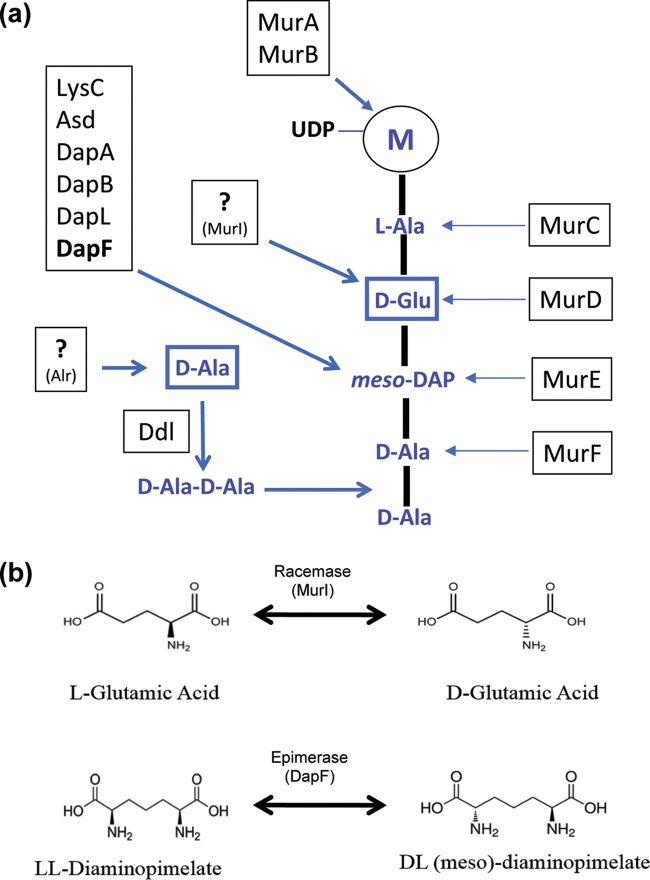
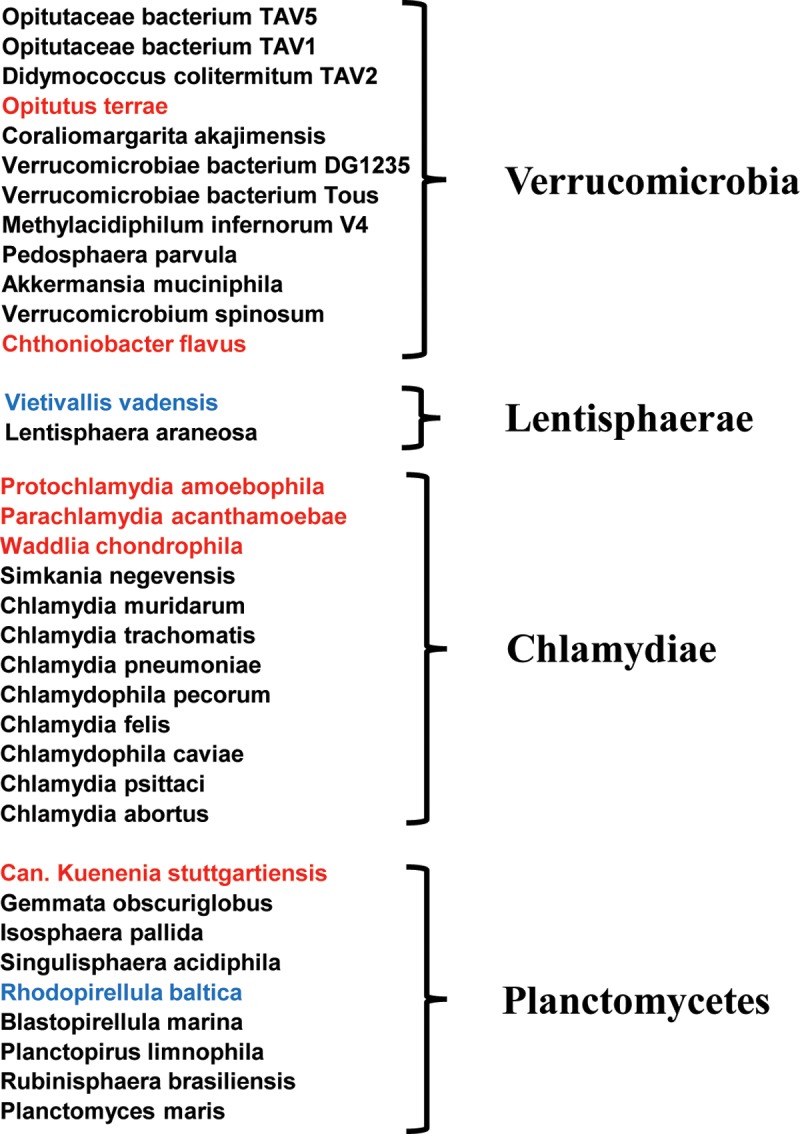
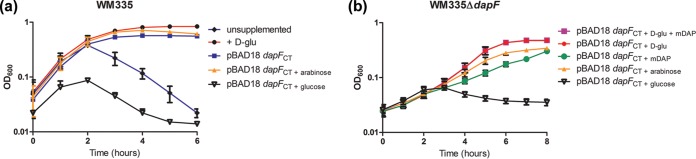
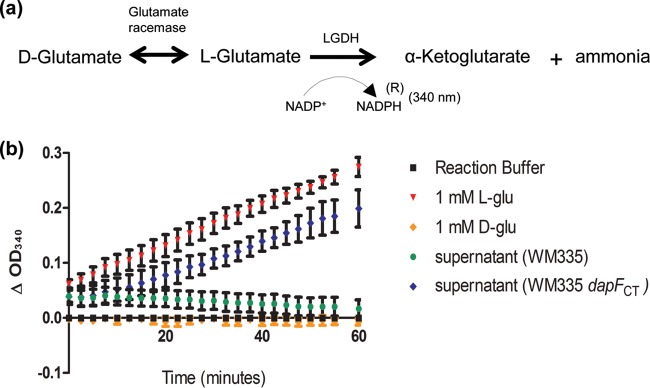
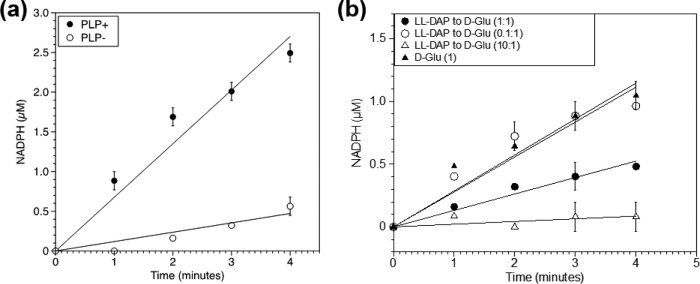
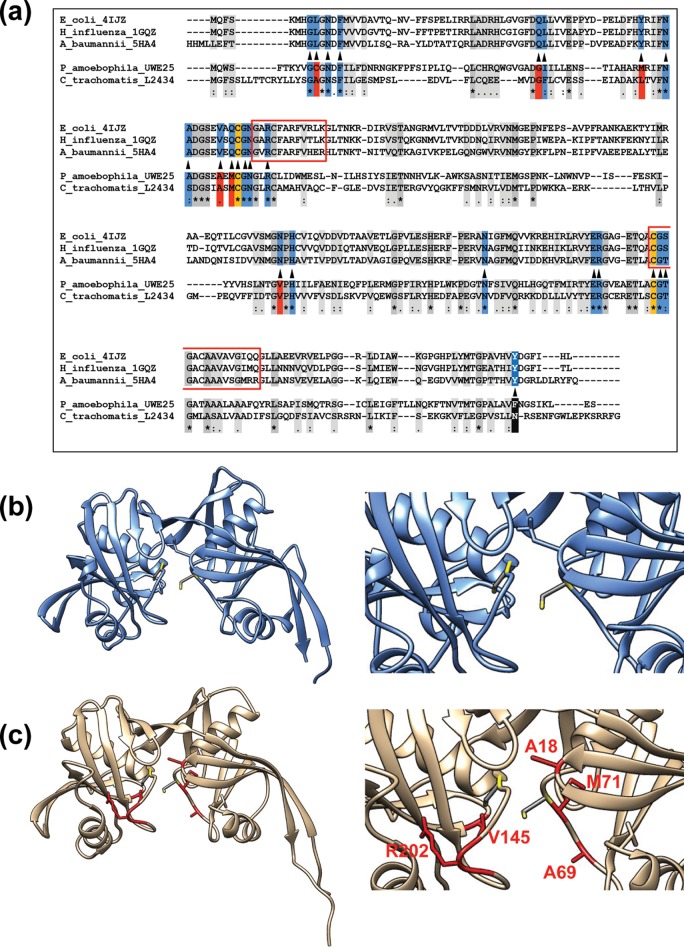
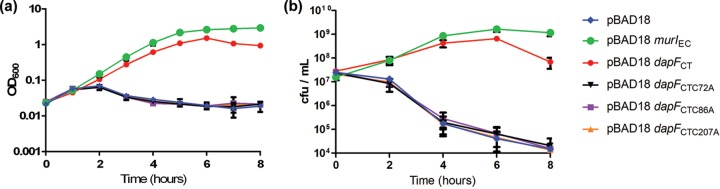
Peptidoglycan is a sugar/amino acid polymer unique to bacteria and essential for division and cell shape maintenance. The d-amino acids that make up its cross-linked stem peptides are not abundant in nature and must be synthesized by bacteria d-Glutamate is present at the second position of the pentapeptide stem and is strictly conserved in all bacterial species. In Gram-negative bacteria, d-glutamate is generated via the racemization of l-glutamate by glutamate racemase (MurI). is the leading cause of infectious blindness and sexually transmitted bacterial infections worldwide. While its genome encodes a majority of the enzymes involved in peptidoglycan synthesis, no homologue has ever been annotated. Recent studies have revealed the presence of peptidoglycan in and confirmed that its pentapeptide includes d-glutamate. In this study, we show that synthesizes d-glutamate by utilizing a novel, bifunctional homologue of diaminopimelate epimerase (DapF). DapF catalyzes the final step in the synthesis of -diaminopimelate, another amino acid unique to peptidoglycan. Genetic complementation of an mutant demonstrated that DapF can generate d-glutamate. Biochemical analysis showed robust activity, but unlike canonical glutamate racemases, activity was dependent on the cofactor pyridoxal phosphate. Genetic complementation, enzymatic characterization, and bioinformatic analyses indicate that chlamydial DapF shares characteristics with other promiscuous/primordial enzymes, presenting a potential mechanism for d-glutamate synthesis not only in but also numerous other genera within the -- superphylum that lack recognized glutamate racemases. Here we describe one of the last remaining "missing" steps in peptidoglycan synthesis in pathogenic species, the synthesis of d-glutamate. We have determined that the diaminopimelate epimerase (DapF) encoded by is capable of carrying out both the epimerization of DAP and the pyridoxal phosphate-dependent racemization of glutamate. Enzyme promiscuity is thought to be the hallmark of early microbial life on this planet, and there is currently an active debate as to whether "moonlighting enzymes" represent primordial evolutionary relics or are a product of more recent reductionist evolutionary pressures. Given the large number of species (as well as members of the -- superphylum) that possess DapF but lack homologues of MurI, it is likely that DapF is a primordial isomerase that functions as both racemase and epimerase in these organisms, suggesting that specialized d-glutamate racemase enzymes never evolved in these microbes.
肽聚糖是一种独特存在于细菌中的糖/氨基酸聚合物,对于细菌的分裂和细胞形状的维持至关重要。构成其交联的短肽的 d-氨基酸在自然界中并不丰富,必须由细菌合成。d-谷氨酸位于五肽短肽的第二个位置,在所有细菌物种中都严格保守。在革兰氏阴性菌中,d-谷氨酸是通过谷氨酸 racemase(MurI)使 l-谷氨酸外消旋化生成的。淋病是全球范围内导致感染性失明和性传播细菌感染的主要原因。尽管其基因组编码了参与肽聚糖合成的大多数酶,但从未注释过任何 同源物。最近的研究表明 中存在肽聚糖,并证实其五肽短肽包含 d-谷氨酸。在这项研究中,我们表明 通过利用二氨基庚二酸差向异构酶(DapF)的新型双功能同源物合成 d-谷氨酸。DapF 催化 -二氨基庚二酸合成的最后一步,这是肽聚糖中另一种独特的氨基酸。对 突变体的遗传互补表明 DapF 可以产生 d-谷氨酸。生化分析显示其具有强大的活性,但与典型的谷氨酸外消旋酶不同,其活性依赖于辅因子吡哆醛磷酸。遗传互补、酶学特性和生物信息学分析表明,衣原体 DapF 与其他混杂/原始酶具有共同特征,为 d-谷氨酸的合成提供了一种潜在的机制,不仅在 中,而且在缺乏公认的谷氨酸外消旋酶的 -- 超门的众多其他属中也存在这种机制。在这里,我们描述了在致病性 物种的肽聚糖合成中最后一个“缺失”步骤之一,即 d-谷氨酸的合成。我们已经确定,由 编码的二氨基庚二酸差向异构酶(DapF)能够进行 DAP 的差向异构化和谷氨酸的依赖吡哆醛磷酸的外消旋化。酶的混杂性被认为是这个星球上早期微生物生命的标志,目前人们正在激烈争论“兼职酶”是原始进化遗迹的代表,还是最近的简化进化压力的产物。鉴于存在大量的 物种(以及 -- 超门的成员)都拥有 DapF,但缺乏 MurI 的同源物,因此 DapF 很可能是一种原始的异构酶,在这些生物体中既作为外消旋酶又作为差向异构酶发挥作用,这表明专门的 d-谷氨酸外消旋酶在这些微生物中从未进化出来。