Wang Ruiming, Liu Keqin, Ye Xiaoyun, Yan Shenqiang
Department of Emergency, Hangzhou Hospital of Traditional Chinese Medicine, Hangzhou, China.
Department of Neurology, Hangzhou First People's Hospital, Hangzhou, China.
Front Psychiatry. 2018 Mar 19;9:94. doi: 10.3389/fpsyt.2018.00094. eCollection 2018.
It remains unclear whether cerebral microbleeds (CMBs) are associated with depression in the general elderly population. We thus performed a meta-analysis to evaluate the relationship between depression and CMBs.
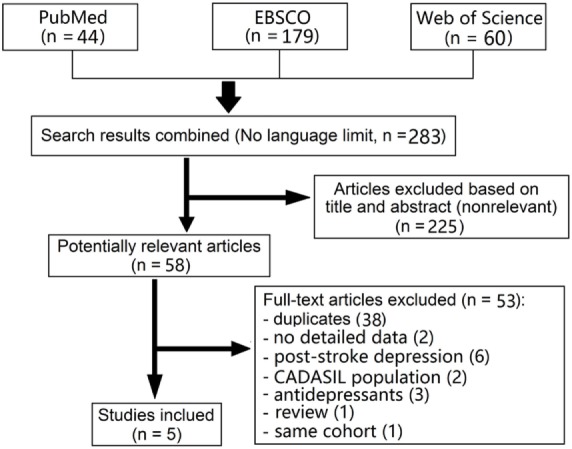
A systematic literature search was conducted in EBSCO, PubMed, and Web of Science for relevant studies that assessed the relationship between depression and the prevalence of CMBs.
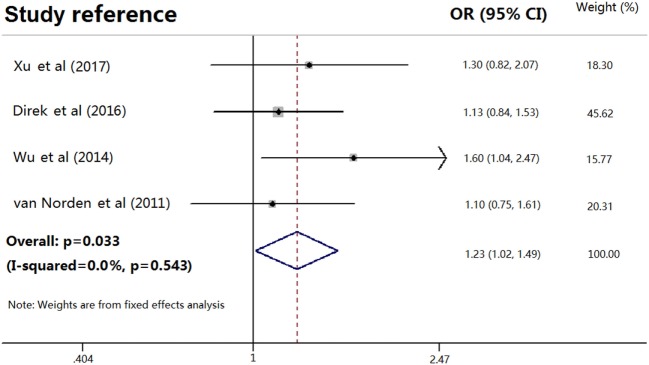
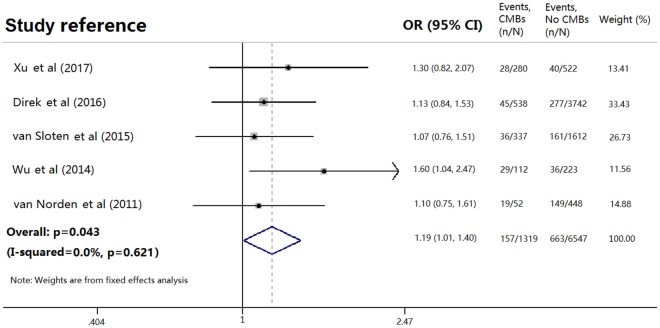
Five eligible studies including 7,328 patients were pooled in meta-analysis. The prevalence of CMBs was 18.0%. The prevalence of depression was 11.1%. The pooled analysis demonstrated odds ratio for CMBs and depression to be 1.187 (95% confidence interval 1.005-1.403; = 0.043) with no evidence of statistical heterogeneity ( = 0.0%, = 0.621).
Our meta-analysis of available published data indicated an increased prevalence of depression in the subjects with pre-existing CMBs. This finding supports the vascular depression hypothesis. Further studies are needed to investigate the role of CMBs in the pathogenesis and progression of depression, which might provide a potential target for the prevention and treatment.
在普通老年人群中,脑微出血(CMBs)是否与抑郁症相关仍不清楚。因此,我们进行了一项荟萃分析以评估抑郁症与脑微出血之间的关系。
在EBSCO、PubMed和Web of Science中进行系统的文献检索,以查找评估抑郁症与脑微出血患病率之间关系的相关研究。
五项符合条件的研究(共7328名患者)被纳入荟萃分析。脑微出血的患病率为18.0%。抑郁症的患病率为11.1%。汇总分析显示,脑微出血与抑郁症的比值比为1.187(95%置信区间为1.005 - 1.403;P = 0.043),且无统计学异质性证据(I² = 0.0%,P = 0.621)。
我们对现有已发表数据的荟萃分析表明,已有脑微出血的受试者中抑郁症患病率增加。这一发现支持血管性抑郁症假说。需要进一步研究来探讨脑微出血在抑郁症发病机制和进展中的作用,这可能为预防和治疗提供一个潜在靶点。