Rebollar Eria A, Gutiérrez-Preciado Ana, Noecker Cecilia, Eng Alexander, Hughey Myra C, Medina Daniel, Walke Jenifer B, Borenstein Elhanan, Jensen Roderick V, Belden Lisa K, Harris Reid N
Department of Biology, James Madison University, Harrisonburg, VA, United States.
Unité d'Ecologie, Systématique et Evolution, Université Paris-Sud, Paris, France.
Front Microbiol. 2018 Mar 20;9:466. doi: 10.3389/fmicb.2018.00466. eCollection 2018.
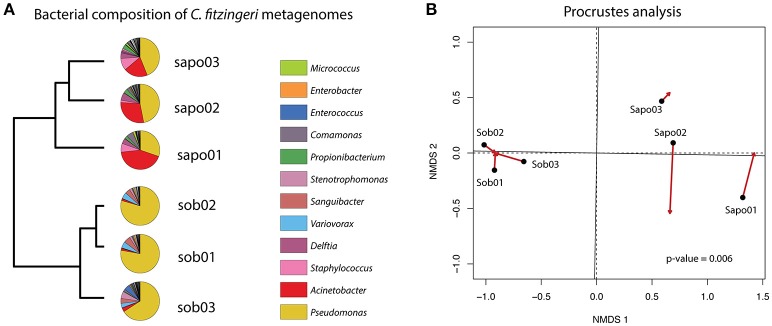
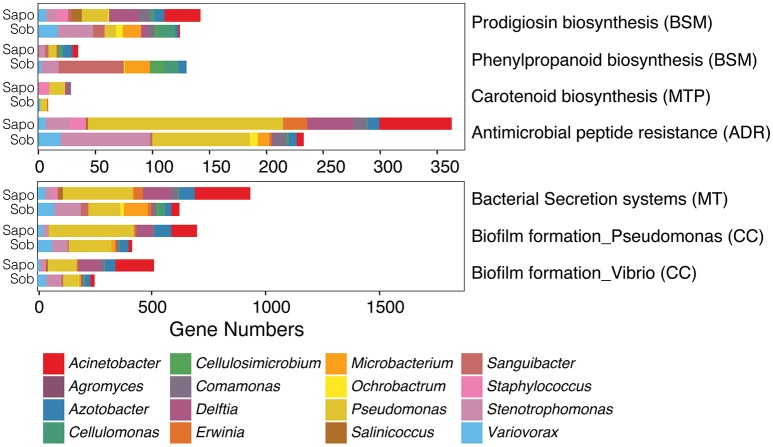
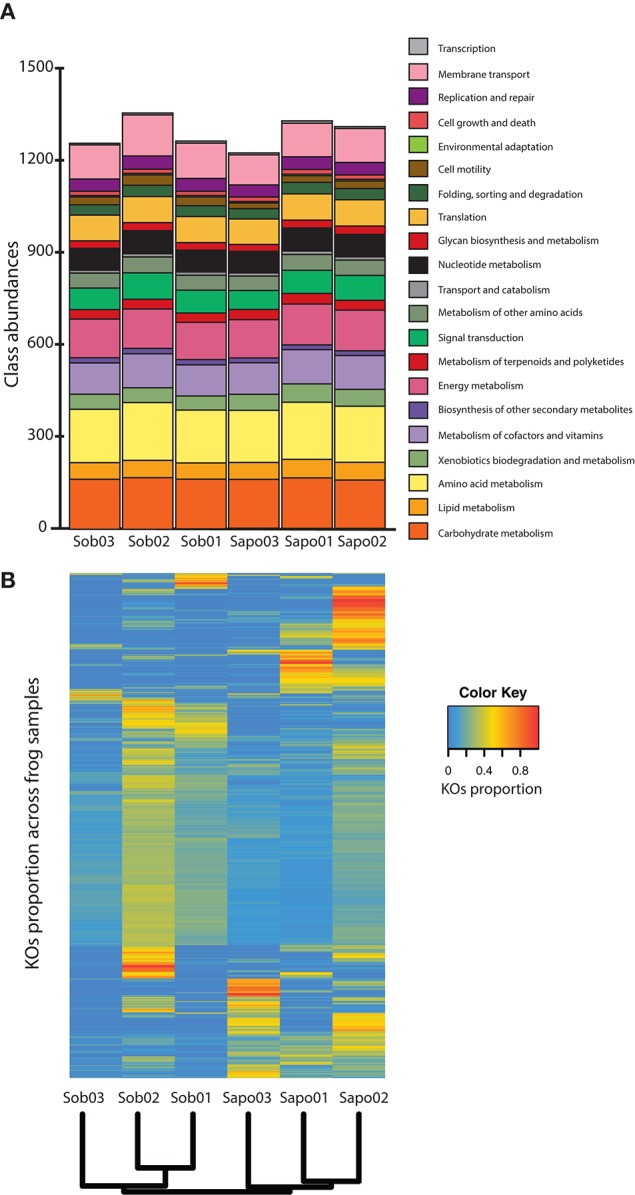
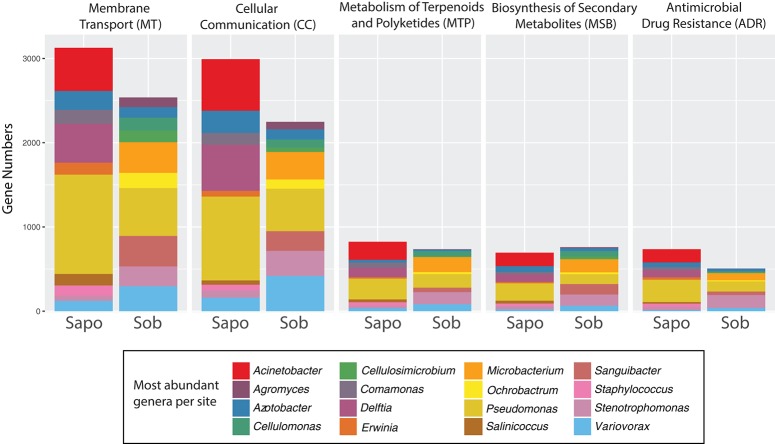
Skin symbiotic bacteria on amphibians can play a role in protecting their host against pathogens. Chytridiomycosis, the disease caused by , Bd, has caused dramatic population declines and extinctions of amphibians worldwide. Anti-Bd bacteria from amphibian skin have been cultured, and skin bacterial communities have been described through 16S rRNA gene amplicon sequencing. Here, we present a shotgun metagenomic analysis of skin bacterial communities from a Neotropical frog, . We sequenced the metagenome of six frogs from two different sites in Panamá: three frogs from Soberanía (Sob), a Bd-endemic site, and three frogs from Serranía del Sapo (Sapo), a Bd-naïve site. We described the taxonomic composition of skin microbiomes and found that was a major component of these communities. We also identified that Sob communities were enriched in Actinobacteria while Sapo communities were enriched in Gammaproteobacteria. We described gene abundances within the main functional classes and found genes enriched either in Sapo or Sob. We then focused our study on five functional classes of genes: biosynthesis of secondary metabolites, metabolism of terpenoids and polyketides, membrane transport, cellular communication and antimicrobial drug resistance. These gene classes are potentially involved in bacterial communication, bacterial-host and bacterial-pathogen interactions among other functions. We found that metagenomes have a wide array of genes that code for secondary metabolites, including antibiotics and bacterial toxins, which may be involved in bacterial communication, but could also have a defensive role against pathogens. Several genes involved in bacterial communication and bacterial-host interactions, such as biofilm formation and bacterial secretion systems were found. We identified specific genes and pathways enriched at the different sites and determined that gene co-occurrence networks differed between sites. Our results suggest that skin microbiomes are composed of distinct bacterial taxa with a wide range of metabolic capabilities involved in bacterial defense and communication. Differences in taxonomic composition and pathway enrichments suggest that skin microbiomes from different sites have unique functional properties. This study strongly supports the need for shotgun metagenomic analyses to describe the functional capacities of skin microbiomes and to tease apart their role in host defense against pathogens.
两栖动物皮肤上的共生细菌可在保护宿主抵御病原体方面发挥作用。由蛙壶菌(Bd)引起的壶菌病已导致全球两栖动物数量急剧下降和灭绝。已培养出两栖动物皮肤中的抗蛙壶菌细菌,并通过16S rRNA基因扩增子测序对皮肤细菌群落进行了描述。在此,我们展示了对一种新热带蛙皮肤细菌群落的鸟枪法宏基因组分析。我们对来自巴拿马两个不同地点的六只青蛙的宏基因组进行了测序:三只来自索韦拉尼亚(Sob),一个蛙壶菌流行地点,三只来自萨波山(Sapo),一个无蛙壶菌地点。我们描述了皮肤微生物群的分类组成,发现[具体细菌名称未给出]是这些群落的主要组成部分。我们还确定索韦拉尼亚群落中放线菌丰富,而萨波山群落中γ-变形菌丰富。我们描述了主要功能类别的基因丰度,发现萨波山或索韦拉尼亚有富集基因。然后我们将研究重点放在五类功能基因上:次级代谢产物的生物合成、萜类和聚酮类的代谢、膜转运、细胞通讯和抗菌药物抗性。这些基因类别可能参与细菌通讯、细菌与宿主以及细菌与病原体的相互作用等其他功能。我们发现[具体细菌名称未给出]宏基因组有大量编码次级代谢产物的基因,包括抗生素和细菌毒素,这些可能参与细菌通讯,但也可能对病原体有防御作用。发现了几个参与细菌通讯和细菌与宿主相互作用的基因,如生物膜形成和细菌分泌系统。我们确定了在不同地点富集的特定基因和途径,并确定不同地点的基因共现网络不同。我们的结果表明,皮肤微生物群由具有广泛代谢能力的不同细菌类群组成,这些代谢能力参与细菌防御和通讯。分类组成和途径富集的差异表明,来自不同地点的皮肤微生物群具有独特的功能特性。这项研究有力地支持了进行鸟枪法宏基因组分析以描述皮肤微生物群的功能能力并阐明它们在宿主抵御病原体中的作用的必要性。