Zhu Kunshou, Deng Yujie, Weng Guoxing, Hu Dan, Huang Cheng, Matsumoto Keitaro, Nagayasu Takeshi, Koji Takehiko, Zheng Xiongwei, Jiang Wenhui, Lin Gen, Cai Yibin, Weng Guibin, Chen Xiaohui
Department of Oncological Surgery, Fujian Cancer Hospital and Fujian Medical University Cancer Hospital, Fuzhou, Fujian 350014, P.R. China.
Department of Chemotherapy, The First Affiliated Hospital of Fujian Medical University, Fuzhou, Fujian 350005, P.R. China.
Oncol Lett. 2018 May;15(5):6179-6188. doi: 10.3892/ol.2018.8100. Epub 2018 Feb 21.
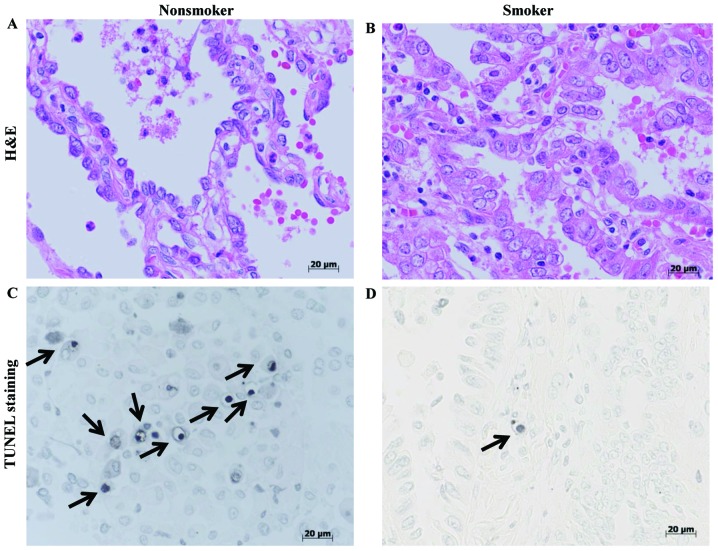
Smoking frequently leads to epigenetic alterations, including DNA methylation and histone modifications. The effect that smoking has on the DNA methylation levels at CCGG sites, the expression of trimethylation of histone H3 at lysine 27 (H3K27me3) and enhancer of zeste homolog 2 (EZH2), and their interactions in patients with non-small cell lung cancer (NSCLC) were analyzed. There were a total of 42 patients with NSCLC, 22 with adenocarcinomas and 20 with squamous cell carcinomas enrolled in the present study. Expression of H3K27me3, EZH2 and proliferating cellular nuclear antigen (PCNA) were immunohistochemically detected. DNA methylation at CCGG sites was evaluated via histoendonuclease-linked detection of DNA methylation sites. The apoptotic index of cancerous tissues obtained from patients of different smoking statuses was evaluated via the terminal deoxynucleotidyl-transferase-mediated dUTP-biotin nick end labeling method. The association with clinicopathological data was calculated relative to different smoking statuses. Compared with the non-smokers, smokers with NSCLC exhibited a significantly lower apoptotic index (P<0.05), and frequently had a lower level of DNA methylation at CCGG sites, lower H3K27me3 expression and a higher EZH2 expression (P<0.05). DNA methylation levels at CCGG sites were negatively correlated to the Brinkman index (P=0.017). Furthermore, there was a parallel association between the H3K27me3 and EZH2 expression levels in the majority of smokers, whereas in the majority of non-smokers, there was a diverging association (P=0.015). There was a diverging association between the PCNA and EZH2 expression levels in the majority of smokers; however, in the majority of non-smokers, there was a parallel association (P=0.048). In addition, the association between the CCGG methylation ratio and immunohistochemical expression of H3K27me3 was a parallel association in the majority of smokers, while in the majority of non-smokers there was a diverging association (P=0.049). Conclusively, patients with NSCLC and different smoking statuses exhibit different epigenetic characteristics. Additionally, DNA methylation levels at the CCGG sites may have the ability to determine associations between the expression levels of H3K27me3, EZH2 and PCNA.
吸烟常常导致表观遗传改变,包括DNA甲基化和组蛋白修饰。分析了吸烟对非小细胞肺癌(NSCLC)患者CCGG位点的DNA甲基化水平、组蛋白H3赖氨酸27三甲基化(H3K27me3)和zeste同源物2增强子(EZH2)的表达及其相互作用的影响。本研究共纳入42例NSCLC患者,其中腺癌22例,鳞状细胞癌20例。采用免疫组织化学法检测H3K27me3、EZH2和增殖细胞核抗原(PCNA)的表达。通过组织核酸酶连接检测DNA甲基化位点来评估CCGG位点的DNA甲基化。采用末端脱氧核苷酸转移酶介导的dUTP-生物素缺口末端标记法评估不同吸烟状态患者癌组织的凋亡指数。计算不同吸烟状态与临床病理数据的相关性。与不吸烟者相比,NSCLC吸烟者的凋亡指数显著降低(P<0.05),且CCGG位点的DNA甲基化水平通常较低,H3K27me3表达较低,EZH2表达较高(P<0.05)。CCGG位点的DNA甲基化水平与布林克曼指数呈负相关(P=0.017)。此外,大多数吸烟者的H3K27me3和EZH2表达水平呈平行关系,而大多数不吸烟者则呈相反关系(P=0.015)。大多数吸烟者的PCNA和EZH2表达水平呈相反关系;然而,大多数不吸烟者则呈平行关系(P=0.048)。此外,大多数吸烟者中CCGG甲基化率与H3K27me3免疫组化表达之间的关系呈平行关系,而大多数不吸烟者则呈相反关系(P=0.049)。总之,不同吸烟状态的NSCLC患者表现出不同的表观遗传特征。此外,CCGG位点的DNA甲基化水平可能能够确定H3K27me3、EZH2和PCNA表达水平之间的关联。