Laboratory of vaccinology/biobanking, CIRCB, Messa, Yaounde, Cameroon.
Department of animal biology and Phisiology, University of Yaounde I, Yaounde, Cameroon.
BMC Infect Dis. 2018 Apr 4;18(1):160. doi: 10.1186/s12879-018-3072-2.
In West and Central Africa areas of endemic Loa loa infections overlap with regions of high prevalence of human immunodeficiency virus type 1 (HIV-1) infections. Because individuals in this region are exposed to filarial parasites from birth, most HIV-1 infected individuals invariably also have a history of filarial parasite infection. Since HIV-1 infection both depletes immune system and maintains it in perpetual inflammation, this can hamper Loa loa filarial parasite mediated immune modulation, leading to enhanced loaisis.
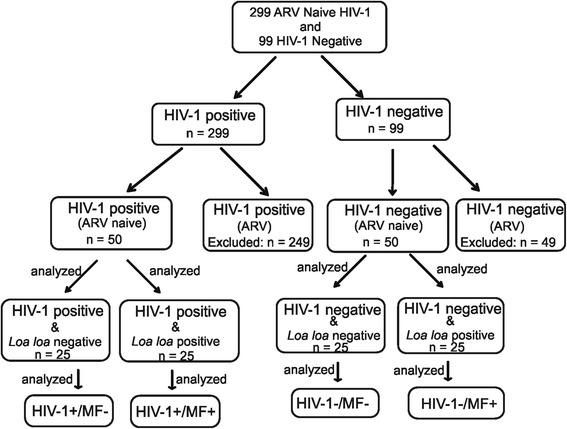
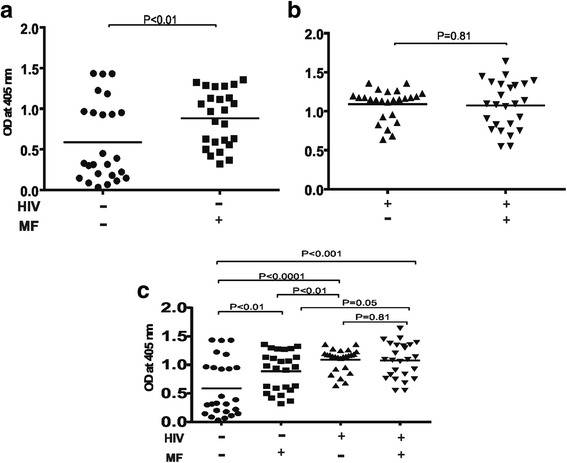
In this study we have assessed in plasma from asymptomatic anti-retroviral (ARV) naïve Loa loa microfilaraemic HIV-1 infected people the filarial antibody responses specific to a filariasis composite antigen consisting of Wbgp29-BmR1-BmM14-WbSXP. The antibody responses specific to the filariasis composite antigen was determined by enzyme linked immunosorbent assay (ELISA) in plasma from ARV naïve Loa loa microfilaraemic HIV-1 infected participants. In addition the filarial antigen specific IgG antibody subclass profiles were also determined for both HIV-1 positive and negative people.
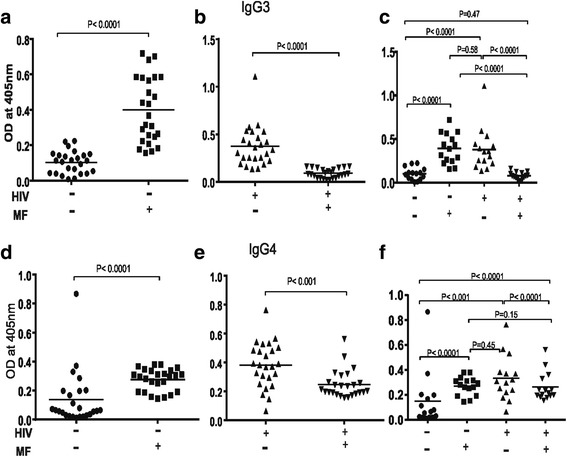
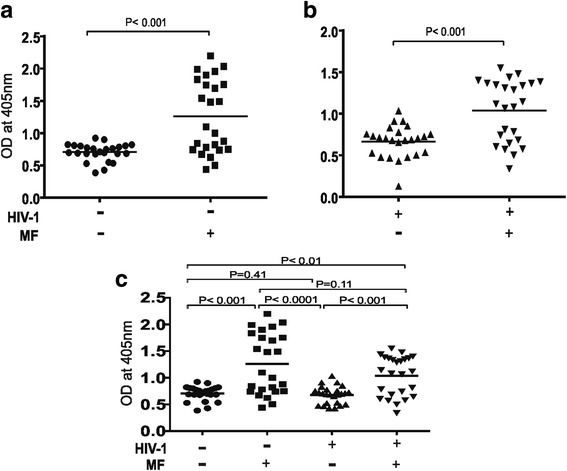
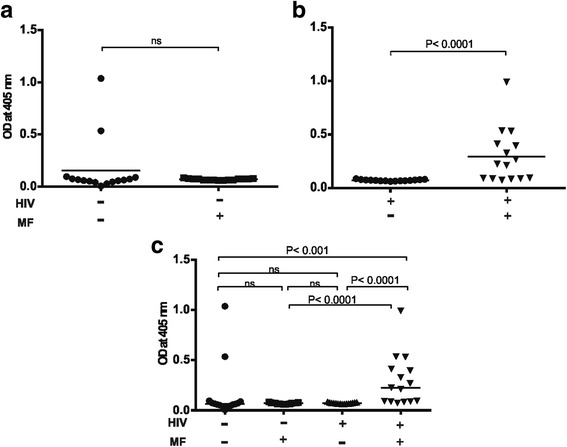
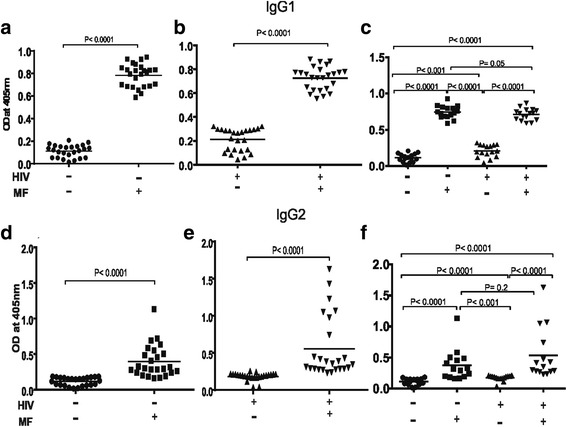
Both Loa loa microfilaraemic HIV-1 positive and negative individuals showed significantly higher plasma levels of IgG1 (P < 0.0001), IgG2 (P < 0.0001) and IgM (P < 0.0001) relative to amicrofilaraemic participants. A significant increase in IgE (P < 0.0001) was observed exclusively in Loa loa microfilaraemic HIV-1 infected people. In contrast there was a significant reduction in the level of IgG4 (p < 0.0001) and IgG3 (P < 0.0001) in Loa loa microfilaraemic HIV-1 infected individuals.
Loa loa microfilaraemia in ARV naïve HIV-1 infected people through differential reduction of plasma levels of filarial antigen specific IgG3, IgG4 and a significant increase in plasma levels of filarial antigen specific IgE could diminish Loa loa mediated immune-regulation. This in effect can result to increase loaisis mediated immunopathology in antiretroviral naive HIV-1 infected people.
在西非和中非地区,旋毛虫病流行地区与人类免疫缺陷病毒 1 型(HIV-1)感染高发地区重叠。由于该地区的人从出生就接触到丝虫寄生虫,大多数 HIV-1 感染者也有丝虫寄生虫感染史。由于 HIV-1 感染既会耗尽免疫系统,又会使其长期处于炎症状态,这可能会阻碍旋毛虫寄生虫介导的免疫调节,导致旋毛虫病加重。
本研究评估了无症状抗逆转录病毒(ARV)初治的旋毛虫微丝蚴血症 HIV-1 感染者血浆中的丝虫抗体反应,这些抗体反应针对由 Wbgp29-BmR1-BmM14-WbSXP 组成的丝虫复合抗原。通过酶联免疫吸附试验(ELISA)检测 ARV 初治的旋毛虫微丝蚴血症 HIV-1 感染者血浆中针对丝虫复合抗原的抗体反应。此外,还确定了 HIV-1 阳性和阴性个体的丝虫抗原特异性 IgG 抗体亚类谱。
旋毛虫微丝蚴血症 HIV-1 阳性和阴性个体的 IgG1(P<0.0001)、IgG2(P<0.0001)和 IgM(P<0.0001)血浆水平均显著高于无微丝蚴血症参与者。仅在旋毛虫微丝蚴血症 HIV-1 感染者中观察到 IgE(P<0.0001)显著增加。相比之下,旋毛虫微丝蚴血症 HIV-1 感染者的 IgG4(p<0.0001)和 IgG3(P<0.0001)水平显著降低。
在 ARV 初治的 HIV-1 感染者中,旋毛虫微丝蚴血症通过降低血浆中旋毛虫抗原特异性 IgG3 和 IgG4 的水平,并显著增加血浆中旋毛虫抗原特异性 IgE 的水平,可能会削弱旋毛虫介导的免疫调节。这实际上会导致抗逆转录病毒治疗初治的 HIV-1 感染者中旋毛虫病介导的免疫病理学增加。