Department of Endocrinology, St Bartholomew's Hospital, West Smithfield, London, EC1A 7BE, UK.
Department of Clinical Genetics, Alder Hey Children's NHS Foundation Trust, E Prescot Rd, Liverpool, L14 5AB, UK.
Orphanet J Rare Dis. 2018 Apr 4;13(1):47. doi: 10.1186/s13023-018-0795-5.
Hajdu-Cheney syndrome (HCS) (#OMIM 102500) is a rare, autosomal dominant condition that presents in early childhood. It is caused by mutations in the terminal exon of NOTCH2, which encodes the transmembrane NOTCH2 receptor. This pathway is involved in the coupled processes of bone formation and resorption. The skeletal features of HCS include acro-osteolysis of the digits and osteoporosis commonly affecting vertebrae and long bones. Fractures are a prominent feature and are associated with significant morbidity. There is no specific treatment, but with both acro-osteolysis and generalized osteoporosis, it is possible that anti-resorptive treatment might be of benefit. However, to date only a few case reports have evaluated the effectiveness of bisphosphonate treatment.
We describe the clinical features, treatment regimens and response to bisphosphonate treatment in 7 newly described patients aged 6-39 with HCS, and pooled the data with that from 8 previously published cases (a total of 17 courses of treatment in 15 individuals).
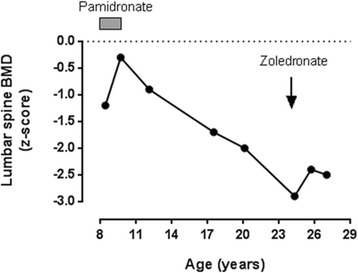
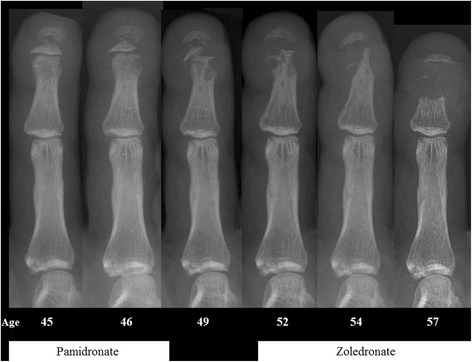
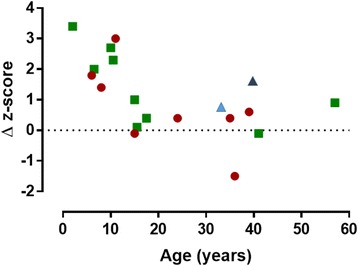
The mean lumbar spine bone mineral density (BMD) z-score before treatment was - 2.9 (SD 1.2). In 14 courses of treatment (82%), there was an increase in BMD with bisphosphonate treatment, but the impact (in terms of change in spinal BMD z-score) appeared to be less with advancing age (p = 0.01). There was no evidence that acro-osteolysis was prevented.
Although individual response is variable and age-related, the data support a role for bisphosphonates in preventing or treating spinal osteoporosis in HCS, but bone loss from the lumbar spine may be rapid after cessation.
Hajdu-Cheney 综合征(HCS)(#OMIM 102500)是一种罕见的常染色体显性遗传疾病,主要发生在儿童早期。它是由 NOTCH2 末端外显子突变引起的,NOTCH2 编码跨膜 NOTCH2 受体。该途径参与骨形成和吸收的偶联过程。HCS 的骨骼特征包括手指的肢端骨质溶解和骨质疏松症,通常影响椎体和长骨。骨折是一个突出的特征,并与显著的发病率相关。目前尚无特定的治疗方法,但对于肢端骨质溶解和全身性骨质疏松症,抗吸收治疗可能有益。然而,迄今为止,只有少数病例报告评估了双膦酸盐治疗的效果。
我们描述了 7 例新诊断的 HCS 患者(年龄 6-39 岁)的临床特征、治疗方案和双膦酸盐治疗反应,并将数据与之前发表的 8 例病例(15 例患者共 17 例疗程)进行了汇总。
治疗前平均腰椎骨密度(BMD)Z 评分中位数为-2.9(标准差 1.2)。在 14 例疗程(82%)中,双膦酸盐治疗后 BMD 增加,但随着年龄的增长,这种影响(以脊柱 BMD Z 评分的变化来衡量)似乎较小(p=0.01)。没有证据表明肢端骨质溶解得到预防。
尽管个体反应存在差异且与年龄相关,但数据支持双膦酸盐在预防或治疗 HCS 脊柱骨质疏松症中的作用,但腰椎骨丢失可能在停药后迅速发生。