Department of Medicine, University of Oklahoma Health Sciences Center and VA Medical Center, Oklahoma City, OK.
Department of Pediatrics, University of Oklahoma Health Sciences Center, Oklahoma City, OK.
J Am Heart Assoc. 2018 Apr 4;7(8):e008351. doi: 10.1161/JAHA.117.008351.
Both the adrenergic and renin-angiotensin systems contribute to orthostatic circulatory homeostasis, which is impaired in postural orthostatic tachycardia syndrome (POTS). Activating autoantibodies to the α1-adrenergic and β1/2-adrenergic receptors have previously been found in sera from patients with POTS. We hypothesized that patients with POTS might also harbor activating autoantibodies to the angiotensin II type 1 receptor (AT1R) independently of antiadrenergic autoimmunity. This study examines a possible pathophysiological role for AT1R autoantibodies in POTS.
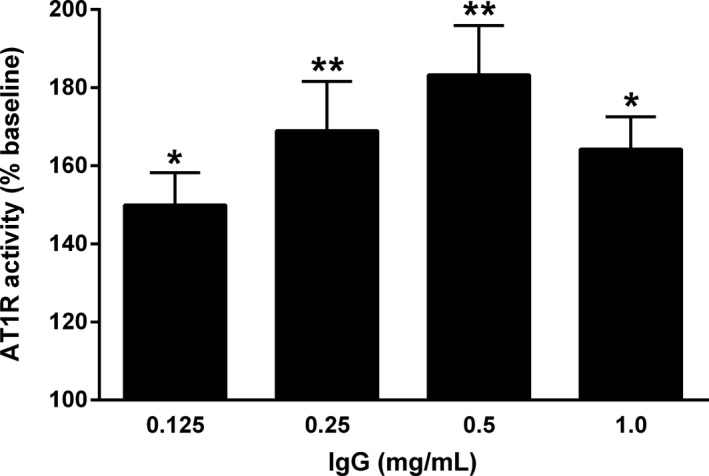
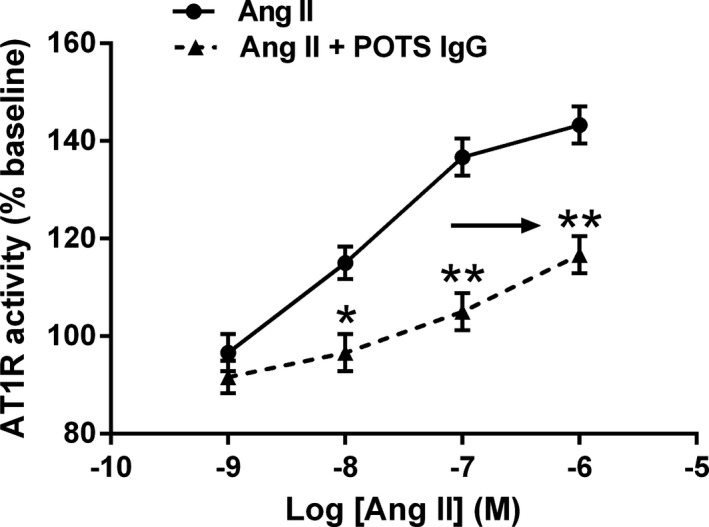
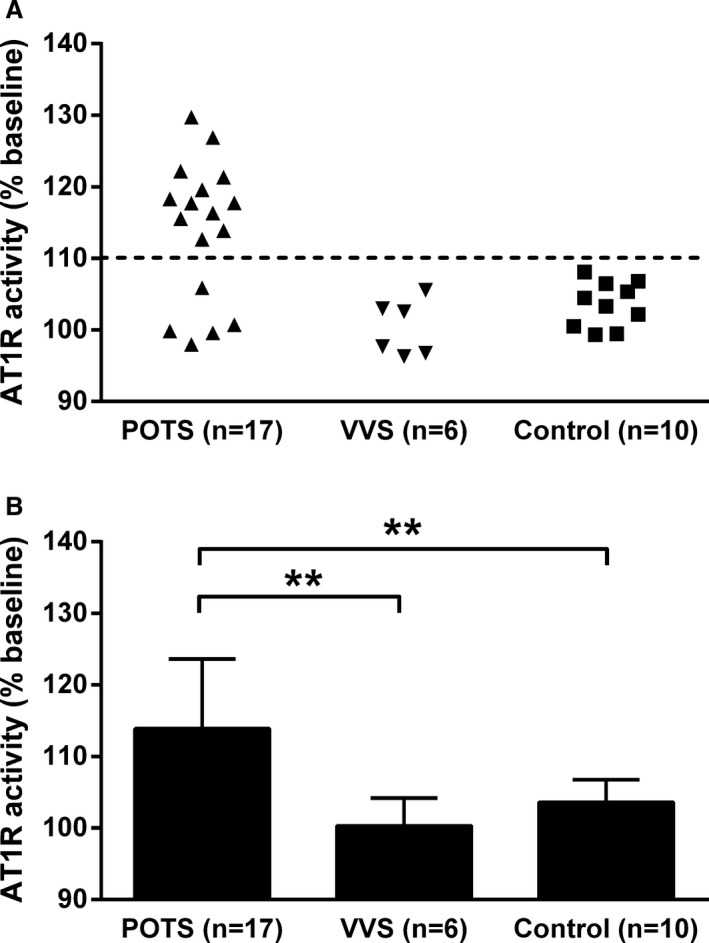
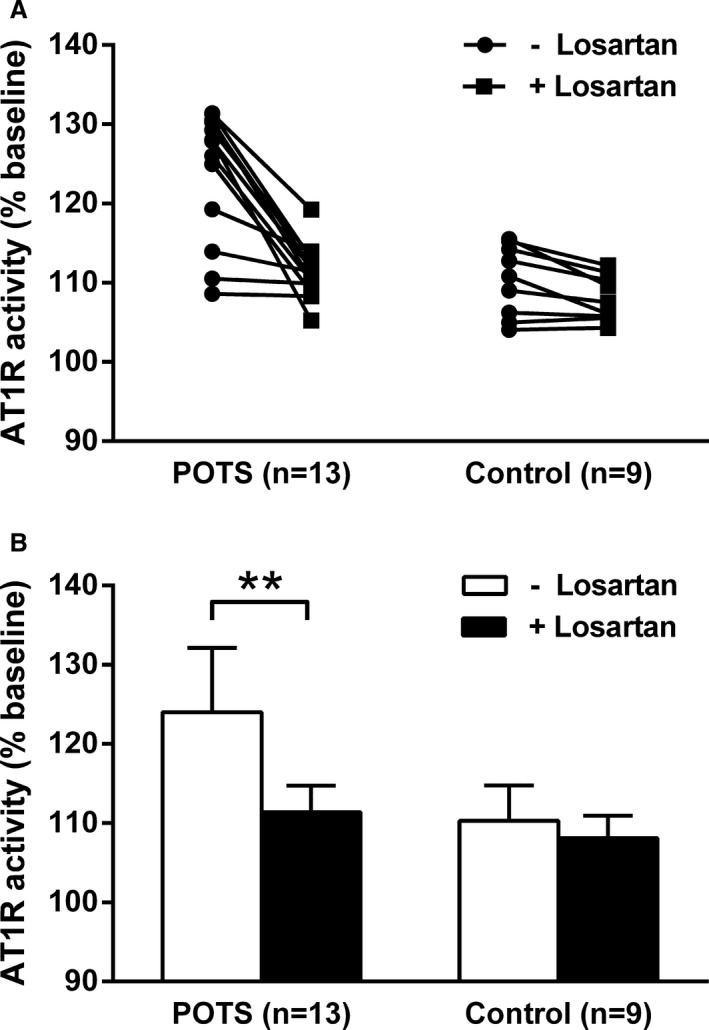
Serum immunoglobulin G from 17 patients with POTS, 6 patients with recurrent vasovagal syncope, and 10 normal controls was analyzed for the ability to activate AT1R and alter AT1R ligand responsiveness in transfected cells in vitro. Of 17 subjects with POTS, 12 demonstrated significant AT1R antibody activity in immunoglobulin G purified from their serum. No significant AT1R antibody activity was found in the subjects with vasovagal syncope or healthy subjects. AT1R activation by POTS immunoglobulin G was specifically blocked by the AT1R blocker losartan. Moreover, POTS immunoglobulin G significantly shifted the angiotensin II dosage response curve to the right, consistent with an inhibitory effect. All subjects with POTS were positive for one or both autoantibodies to the AT1R and α1-adrenergic receptor.
Most patients with POTS harbor AT1R antibody activity. This supports the concept that AT1R autoantibodies and antiadrenergic autoantibodies, acting separately or together, may exert a significant impact on the cardiovascular pathophysiological characteristics in POTS.
去甲肾上腺素能和肾素-血管紧张素系统都有助于直立循环稳态,而体位性心动过速综合征(POTS)患者的这种稳态会受损。先前在 POTS 患者的血清中发现了针对 α1-肾上腺素能和β1/2-肾上腺素能受体的激活自身抗体。我们假设,POTS 患者可能也存在独立于抗肾上腺素能自身免疫的血管紧张素 II 型 1 受体(AT1R)的激活自身抗体。本研究探讨了 AT1R 自身抗体在 POTS 中的可能病理生理作用。
分析了 17 例 POTS 患者、6 例复发性血管迷走性晕厥患者和 10 例正常对照者的血清免疫球蛋白 G,以评估其在体外转染细胞中激活 AT1R 和改变 AT1R 配体反应性的能力。在 17 例 POTS 患者中,有 12 例患者的血清免疫球蛋白 G 中存在显著的 AT1R 抗体活性。在血管迷走性晕厥患者或健康对照者中未发现明显的 AT1R 抗体活性。POTS 免疫球蛋白 G 对 AT1R 的激活可被 AT1R 阻滞剂洛沙坦特异性阻断。此外,POTS 免疫球蛋白 G 显著地将血管紧张素 II 的剂量反应曲线向右移位,表明存在抑制作用。所有 POTS 患者均对 AT1R 和 α1-肾上腺素能受体有一种或两种自身抗体呈阳性。
大多数 POTS 患者存在 AT1R 抗体活性。这支持了 AT1R 自身抗体和抗肾上腺素能自身抗体单独或共同作用可能对 POTS 心血管病理生理特征产生重大影响的概念。