Department of Pediatrics, Washington University School of Medicine in St. Louis, St. Louis, MO.
Department of Oral Immunology and Infectious Diseases, University of Louisville, Louisville, KY.
Blood. 2018 May 24;131(21):2367-2378. doi: 10.1182/blood-2017-09-809004. Epub 2018 Apr 4.
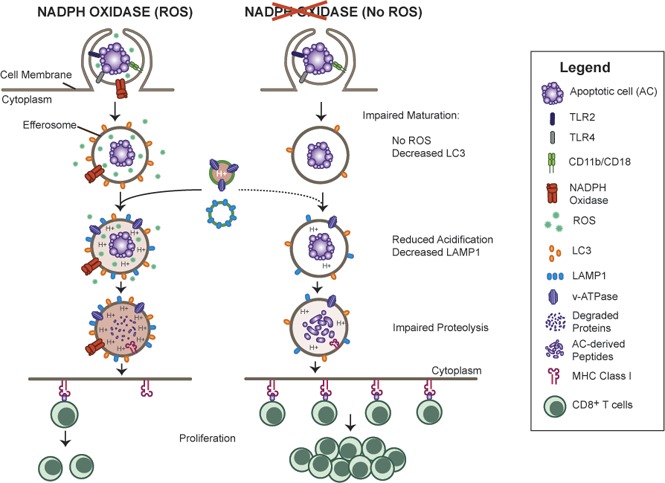
The phagocyte reduced NAD phosphate (NADPH) oxidase generates superoxide, the precursor to reactive oxygen species (ROS) that has both antimicrobial and immunoregulatory functions. Inactivating mutations in NADPH oxidase alleles cause chronic granulomatous disease (CGD), characterized by enhanced susceptibility to life-threatening microbial infections and inflammatory disorders; hypomorphic NADPH oxidase alleles are associated with autoimmunity. Impaired apoptotic cell (AC) clearance is implicated as an important contributing factor in chronic inflammation and autoimmunity, but the role of NADPH oxidase-derived ROS in this process is incompletely understood. Here, we demonstrate that phagocytosis of AC (efferocytosis) potently activated NADPH oxidase in mouse peritoneal exudate macrophages (PEMs). ROS generation was dependent on macrophage CD11b, Toll-like receptor 2 (TLR2), TLR4, and myeloid differentiation primary response 88 (MyD88), and was also regulated by phosphatidylinositol 3-phosphate binding to the p40 oxidase subunit. Maturation of efferosomes containing apoptotic neutrophils was significantly delayed in CGD PEMs, including acidification and acquisition of proteolytic activity, and was associated with slower digestion of apoptotic neutrophil proteins. Treatment of wild-type macrophages with the vacuolar-type H+ ATPase inhibitor bafilomycin also delayed proteolysis within efferosomes, showing that luminal acidification was essential for efficient digestion of efferosome proteins. Finally, cross-presentation of AC-associated antigens by CGD PEMs to CD8 T cells was increased. These studies unravel a key role for the NADPH oxidase in the disposal of ACs by inflammatory macrophages. The oxidants generated promote efferosome maturation and acidification that facilitate the degradation of ingested ACs.
吞噬细胞还原型烟酰胺腺嘌呤二核苷酸磷酸(NADPH)氧化酶产生超氧阴离子,这是活性氧(ROS)的前体,具有抗菌和免疫调节功能。NADPH 氧化酶等位基因的失活突变导致慢性肉芽肿病(CGD),其特征是对危及生命的微生物感染和炎症性疾病的易感性增加;NADPH 氧化酶等位基因的低功能与自身免疫有关。受损的凋亡细胞(AC)清除被认为是慢性炎症和自身免疫的一个重要因素,但 NADPH 氧化酶衍生的 ROS 在这个过程中的作用还不完全清楚。在这里,我们证明了 AC 的吞噬作用(吞噬作用)在小鼠腹膜渗出物巨噬细胞(PEMs)中强烈激活 NADPH 氧化酶。ROS 的产生依赖于巨噬细胞 CD11b、Toll 样受体 2(TLR2)、TLR4 和髓样分化初级反应 88(MyD88),也受结合到 p40 氧化酶亚基的磷脂酰肌醇 3-磷酸的调节。CGD PEMs 中包含凋亡中性粒细胞的吞噬体成熟明显延迟,包括酸化和获得蛋白水解活性,并且与凋亡中性粒细胞蛋白的消化速度较慢有关。用液泡型 H+ATP 酶抑制剂巴弗洛霉素处理野生型巨噬细胞也会延迟吞噬体内的蛋白水解,表明腔内酸化对于吞噬体内蛋白的有效消化是必不可少的。最后,CGD PEMs 对 CD8 T 细胞交叉呈递 AC 相关抗原增加。这些研究揭示了 NADPH 氧化酶在炎症性巨噬细胞清除 AC 中的关键作用。产生的氧化剂促进吞噬体成熟和酸化,从而促进吞噬的 AC 降解。