Martinon Daisy, Dabrowska Joanna
Department of Cellular and Molecular Pharmacology, Chicago Medical School, Rosalind Franklin University of Medicine and Science, North Chicago, IL, United States.
Department of Neuroscience, Chicago Medical School, Rosalind Franklin University of Medicine and Science, North Chicago, IL, United States.
Front Neurosci. 2018 Mar 21;12:183. doi: 10.3389/fnins.2018.00183. eCollection 2018.
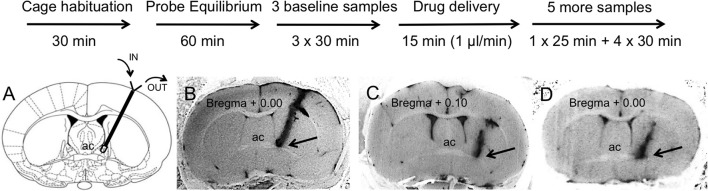
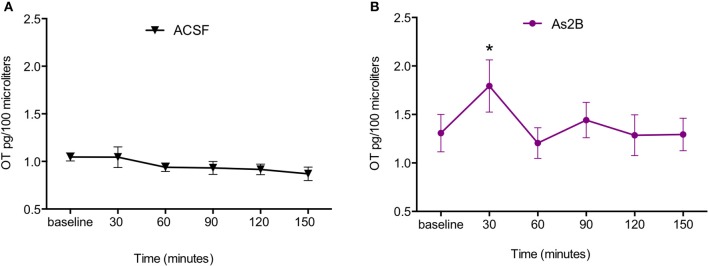
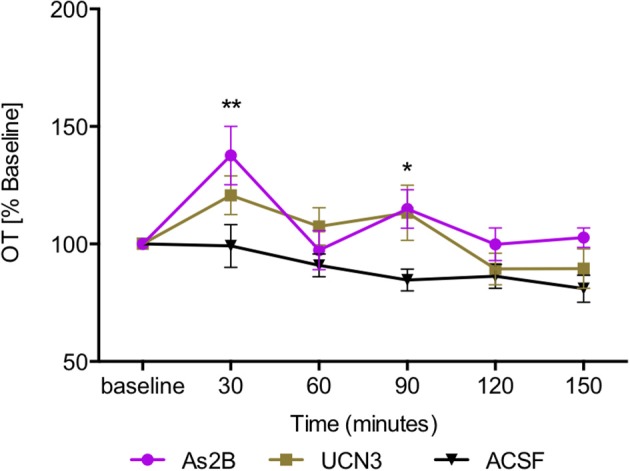
The neuropeptide oxytocin (OT) plays an important role in the regulation of social and anxiety-like behavior. Our previous studies have shown that OT neurons send projections from the hypothalamus to the dorsolateral bed nucleus of the stria terminalis (BNST), a forebrain region critically involved in the modulation of anxiety-like behavior. Importantly, these OT terminals in the BNST express presynaptic corticotropin releasing factor (CRF) receptor type 2 (CRFR2). This suggests that CRFR2 might be involved in the modulation of OT release. To test this hypothesis, we measured OT content in microdialysates collected from the BNST of freely-moving male Sprague-Dawley rats following the administration of a selective CRFR2 agonist (Urocortin 3) or antagonist (Astressin 2B, As2B). To determine if type 1 CRF receptors (CRFR1) are also involved, we used selective CRFR1 antagonist (NBI35965) as well as CRF, a putative ligand of both CRFR1 and CRFR2. All compounds were delivered directly into the BNST via reverse dialysis. OT content in the microdialysates was measured with highly sensitive and selective radioimmunoassay. Blocking CRFR2 with As2B caused an increase in OT content in BNST microdialysates, whereas CRFR2 activation by Urocortin 3 did not have an effect. The As2B-induced increase in OT release was blocked by application of the CRFR1 antagonist demonstrating that the effect was dependent on CRFR1 transmission. Interestingly, CRF alone caused a delayed increase in OT content in BNST microdialysates, which was dependent on CRF2 but not CRF1 receptors. Our results suggest that members of the CRF peptide family modulate OT release in the BNST via a fine-tuned mechanism that involves both CRFR1 and CRFR2. Further exploration of mechanisms by which endogenous OT system is modulated by CRF peptide family is needed to better understand the role of these neuropeptides in the regulation of anxiety and the stress response.
神经肽催产素(OT)在社交和焦虑样行为的调节中起重要作用。我们之前的研究表明,OT神经元从下丘脑发出投射至终纹床核背外侧部(BNST),这是一个在前脑区域中对焦虑样行为调节至关重要的区域。重要的是,BNST中的这些OT终末表达2型促肾上腺皮质激素释放因子(CRF)受体(CRFR2)。这表明CRFR2可能参与OT释放的调节。为了验证这一假设,我们在自由活动的雄性Sprague-Dawley大鼠的BNST中注射选择性CRFR2激动剂(urocortin 3)或拮抗剂(astressin 2B,As2B)后,测量了从BNST收集的微透析液中的OT含量。为了确定1型CRF受体(CRFR1)是否也参与其中,我们使用了选择性CRFR1拮抗剂(NBI35965)以及CRF,CRF是CRFR1和CRFR2的假定配体。所有化合物均通过反向透析直接注入BNST。用高灵敏度和选择性放射免疫分析法测量微透析液中的OT含量。用As2B阻断CRFR2会导致BNST微透析液中OT含量增加,而urocortin 3激活CRFR2则没有作用。CRFR1拮抗剂的应用阻断了As2B诱导的OT释放增加,表明该作用依赖于CRFR1传递。有趣的是,单独使用CRF会导致BNST微透析液中OT含量延迟增加,这依赖于CRF2而非CRF1受体。我们的结果表明,CRF肽家族成员通过一种涉及CRFR1和CRFR2的精细调节机制来调节BNST中的OT释放。需要进一步探索内源性OT系统被CRF肽家族调节的机制,以更好地理解这些神经肽在焦虑调节和应激反应中的作用。