Laurence Paulo G, Mecca Tatiana P, Serpa Alexandre, Martin Romain, Macedo Elizeu C
Social and Cognitive Neuroscience Laboratory and Developmental Disorders Program, Center for Health and Biological Sciences, Mackenzie Presbyterian University, São Paulo, Brazil.
Educational Psychology Post-Graduation Program, Centro Universitário FIEO, Osasco, Brazil.
Front Psychol. 2018 Mar 21;9:380. doi: 10.3389/fpsyg.2018.00380. eCollection 2018.
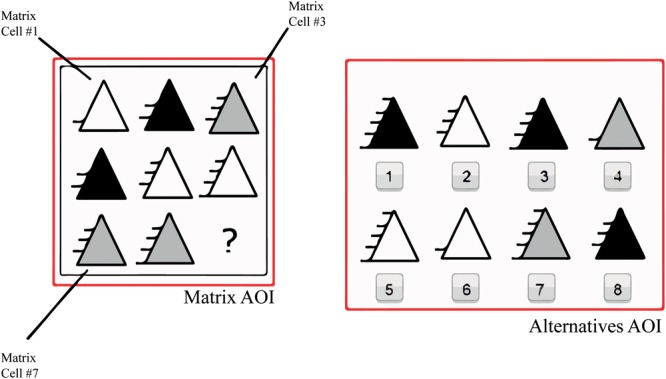
Eye movements help to infer the cognitive strategy that a person uses in fluid intelligence tests. However, intelligence tests demand different relations/rules tokens to be solved, such as rule direction, which is the continuation, variation or overlay of geometric figures in the matrix of the intelligence test. The aim of this study was to understand whether eye movements could predict the outcome of an intelligence test and in the rule item groups. Furthermore, we sought to identify which measure is best for predicting intelligence test scores and to understand if the rule item groups use the same strategy. Accordingly, 34 adults completed a computerized intelligence test with an eye-tracking device. The toggling rate, that is, the number of toggles on each test item equalized by the item latency explained 45% of the variance of the test scores and a significant amount of the rule tokens item groups. The regression analyses also indicated toggling rate as the best measure for predicting the score and that all the rule tokens seem to respect the same strategy. No correlation or difference were found between baseline pupil size and fluid intelligence. was demonstrated to be a good instrument for the purpose of this study. Finally, the implications of these findings for an understanding of cognition are discussed.
眼球运动有助于推断一个人在流体智力测试中所使用的认知策略。然而,智力测试要求解决不同的关系/规则表征,比如规则方向,它是智力测试矩阵中几何图形的延续、变化或叠加。本研究的目的是了解眼球运动是否能够预测智力测试的结果以及在规则项目组中的情况。此外,我们试图确定哪种测量方法最适合预测智力测试分数,并了解规则项目组是否使用相同的策略。因此,34名成年人使用眼动追踪设备完成了一项计算机化智力测试。切换率,即每个测试项目的切换次数通过项目潜伏期进行均衡,解释了测试分数方差的45%以及大量规则表征项目组的方差。回归分析还表明切换率是预测分数的最佳测量方法,并且所有规则表征似乎都遵循相同的策略。在基线瞳孔大小和流体智力之间未发现相关性或差异。 被证明是本研究目的的一种良好工具。最后,讨论了这些发现对理解认知的意义。