Department of Allergology, Rheumatology and Clinical Immunology, Children's Hospital Ljubljana, University Medical Centre Ljubljana, Ljubljana, Slovenia.
Department of Special Laboratory Diagnostics, Children's Hospital Ljubljana, University Medical Centre Ljubljana, Ljubljana, Slovenia.
Front Immunol. 2018 Mar 21;9:500. doi: 10.3389/fimmu.2018.00500. eCollection 2018.
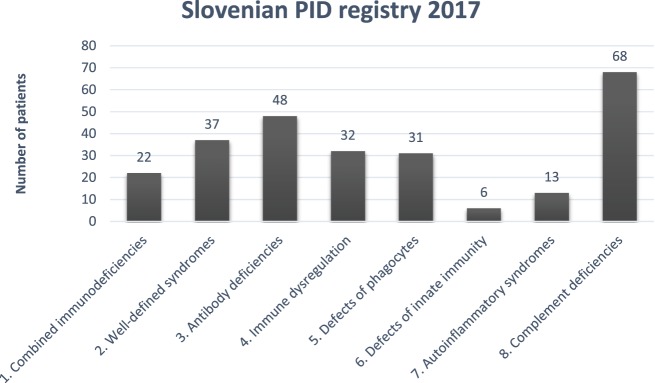
Prevalence of complement deficiencies (CDs) is markedly higher in Slovenian primary immunodeficiency (PID) registry in comparison to other national and international PID registries.
The purposes of our study were to confirm CD and define complete and partial CD in registered patients in Slovenia, to evaluate frequency of clinical manifestations, and to assess the risk for characteristic infections separately for subjects with complete and partial CD.
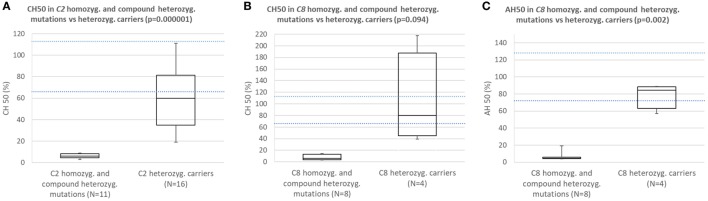
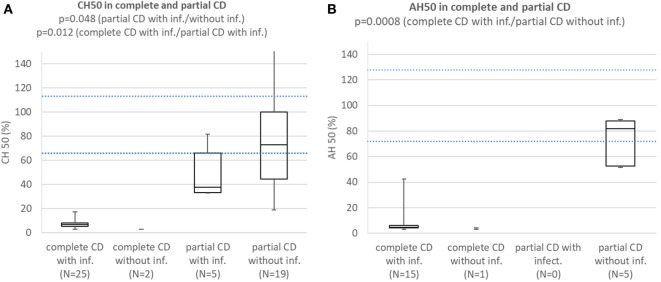
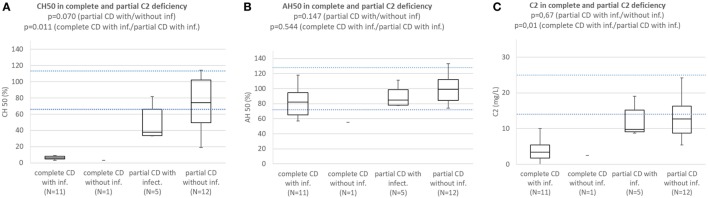
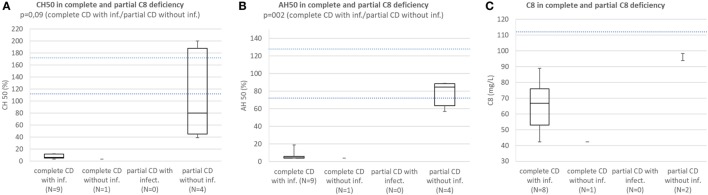
CD was confirmed with genetic analyses in patients with C2 deficiency, C8 deficiency, and hereditary angioedema or with repeated functional complement studies and measurement of complement components in other CD. Results of genetic studies (homozygous subjects vs. heterozygous carriers) and complement functional studies were analyzed to define complete (complement below the level of heterozygous carriers) and partial CD (complement above the level of homozygous patients). Presence of characteristic infections was assessed separately for complete and partial CD.
Genetic analyses confirmed markedly higher prevalence of CD in Slovenian PID registry (26% of all PID) than in other national and international PID registries (0.5-6% of all PID). Complement functional studies and complement component concentrations reliably distinguished between homozygous and heterozygous CD carriers. Subjects with partial CD had higher risk for characteristic infections than previously reported.
Results of our study imply under-recognition of CD worldwide. Complement functional studies and complement component concentrations reliably predicted risk for characteristic infections in patients with complete or partial CD. Vaccination against encapsulated bacteria should be advocated also for subjects with partial CD and not limited to complete CD.
与其他国家和国际原发性免疫缺陷(PID)登记处相比,斯洛文尼亚原发性免疫缺陷登记处补体缺陷(CD)的患病率明显更高。
我们研究的目的是确认 CD,并在斯洛文尼亚登记的患者中定义完全和部分 CD,评估临床表现的频率,并分别评估完全和部分 CD 患者发生特征性感染的风险。
在 C2 缺乏症、C8 缺乏症和遗传性血管性水肿患者中或在其他 CD 中进行反复功能补体研究和补体成分测量的情况下,通过遗传分析确认 CD;对遗传研究(纯合子与杂合子携带者)和补体功能研究的结果进行分析,以定义完全(补体低于杂合子携带者水平)和部分 CD(补体高于纯合子患者水平)。分别评估完全和部分 CD 患者特征性感染的存在。
遗传分析证实,斯洛文尼亚 PID 登记处 CD 的患病率(所有 PID 的 26%)明显高于其他国家和国际 PID 登记处(所有 PID 的 0.5-6%)。补体功能研究和补体成分浓度可靠地区分了纯合子和杂合子 CD 携带者。与先前报道相比,部分 CD 患者发生特征性感染的风险更高。
我们的研究结果表明,全球对 CD 的认识不足。补体功能研究和补体成分浓度可靠地预测了完全或部分 CD 患者发生特征性感染的风险。对于部分 CD 患者,也应提倡接种针对荚膜细菌的疫苗,而不仅仅局限于完全 CD 患者。