Angell Trevor E, Min Le, Wieczorek Tad J, Hodi F Stephen
Division of Endocrinology, Diabetes, and Hypertension, Brigham and Women's Hospital, Boston, MA.
Department of Pathology, Brigham and Women's Hospital, Boston, MA.
Genes Dis. 2018 Mar;5(1):46-48. doi: 10.1016/j.gendis.2017.11.002. Epub 2017 Nov 21.
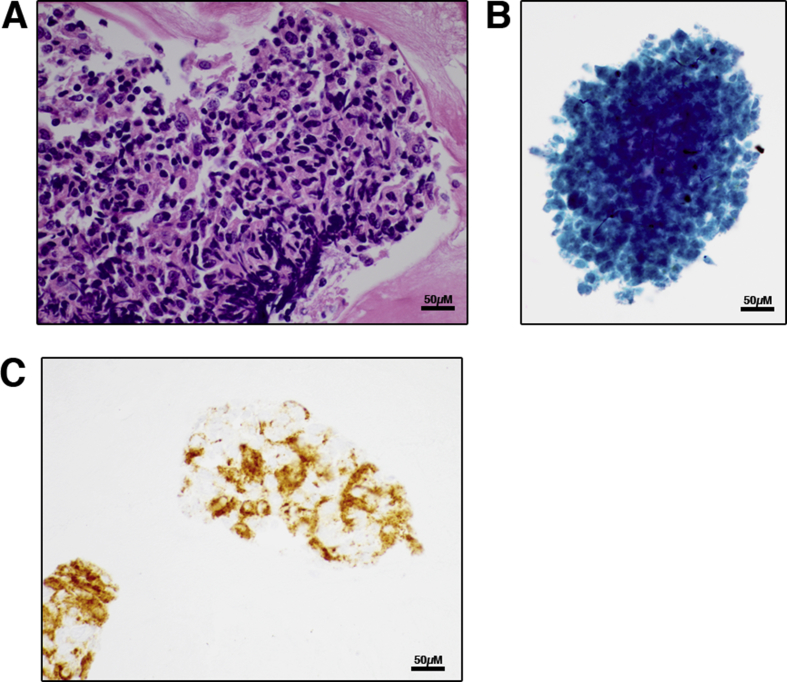
Blockade of immune checkpoint molecules to reverse cancer-induced immune suppression can improve anti-tumor immune responses in cancer patients. Monoclonal antibodies targeting two such molecules, Programmed cell death protein 1 (PD-1) and cytotoxic T-lymphocyte associated protein 4 (CTLA-4) have shown clinical benefit in the treatment of advanced malignancies, including metastatic melanoma. Adverse effects of these immune checkpoint inhibitors include immune-related adverse events (irAE) and the inducing of new autoimmunity, of which one of the most common is autoimmune thyroiditis. Though thyroiditis is increasingly recognized, there are no reports of the pathological findings that occur in immunotherapy-induced thyroiditis. We present a case of immunotherapy-induced thyroiditis demonstrating its unique cytopathologic features. A 51-year-old woman with metastatic melanoma was found to have a suppressed TSH and elevated free thyroxine concentration 14 days after starting treatment with nivolumab (PD-1 antagonist) plus ipilimumab (CTLA-4 antagonist) therapy. A thyroid biopsy was performed based on ultrasound findings and cytopathology revealed unique features including abundant clusters of necrotic cells, lymphocytes and CD163-positive histiocytes. This case reports cytopathologic features found in immune checkpoint inhibitor related thyroiditis. These appear to be unique findings and may help inform future research regarding the pathophysiology and mechanisms of this condition.
阻断免疫检查点分子以逆转癌症诱导的免疫抑制可改善癌症患者的抗肿瘤免疫反应。靶向两种此类分子,即程序性细胞死亡蛋白1(PD-1)和细胞毒性T淋巴细胞相关蛋白4(CTLA-4)的单克隆抗体已在包括转移性黑色素瘤在内的晚期恶性肿瘤治疗中显示出临床益处。这些免疫检查点抑制剂的不良反应包括免疫相关不良事件(irAE)和诱导新的自身免疫,其中最常见的一种是自身免疫性甲状腺炎。尽管甲状腺炎越来越受到认可,但尚无关于免疫治疗诱导的甲状腺炎病理发现的报道。我们报告一例免疫治疗诱导的甲状腺炎病例,展示其独特的细胞病理学特征。一名51岁患有转移性黑色素瘤的女性在开始使用纳武单抗(PD-1拮抗剂)加伊匹单抗(CTLA-4拮抗剂)治疗14天后,促甲状腺激素水平降低,游离甲状腺素浓度升高。根据超声检查结果进行了甲状腺活检,细胞病理学显示出独特特征,包括大量坏死细胞、淋巴细胞和CD163阳性组织细胞簇。本病例报告了免疫检查点抑制剂相关甲状腺炎的细胞病理学特征。这些似乎是独特的发现,可能有助于为今后关于这种疾病的病理生理学和机制的研究提供信息。