Cantillon Marc, Ings Robert, Prakash Arul, Bhat Laxminarayan
Reviva Pharmaceuticals, Inc., 1250 Oakmead Parkway, Suite 210, Sunnyvale, CA, 94085, USA.
Eur J Drug Metab Pharmacokinet. 2018 Oct;43(5):573-585. doi: 10.1007/s13318-018-0472-z.
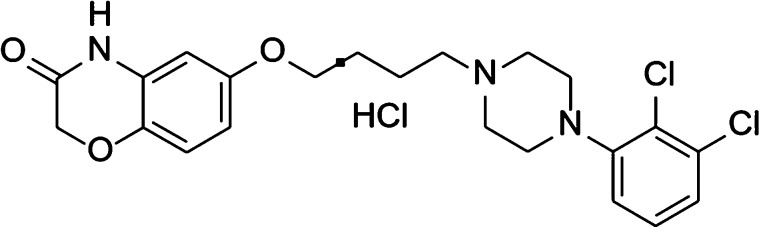
RP5063 is a novel multimodal dopamine (D)-serotonin (5-HT) stabilizer possessing partial agonist activity for D and 5-HT, antagonist activity for 5-HT and moderate affinity for the serotonin transporter. Phase 2 trial data analysis of RP5063 involving patients with schizophrenia and schizoaffective disorder defined: (1) the pharmacokinetic profile; and (2) the pharmacokinetic/pharmacodynamic relationships.
Pharmacokinetic sample data (175 patients on RP5063; 28 doses/patient) were analyzed, utilized one- and two-compartment models, and evaluated the impact of covariates. Pharmacodynamic analysis involved development of an E model.
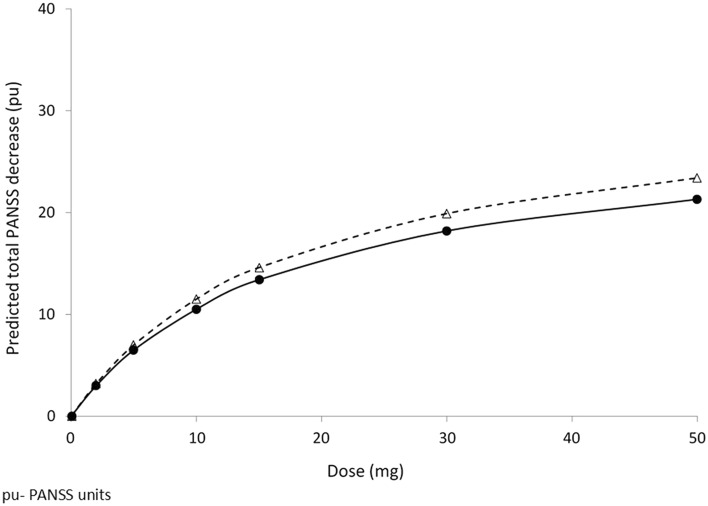
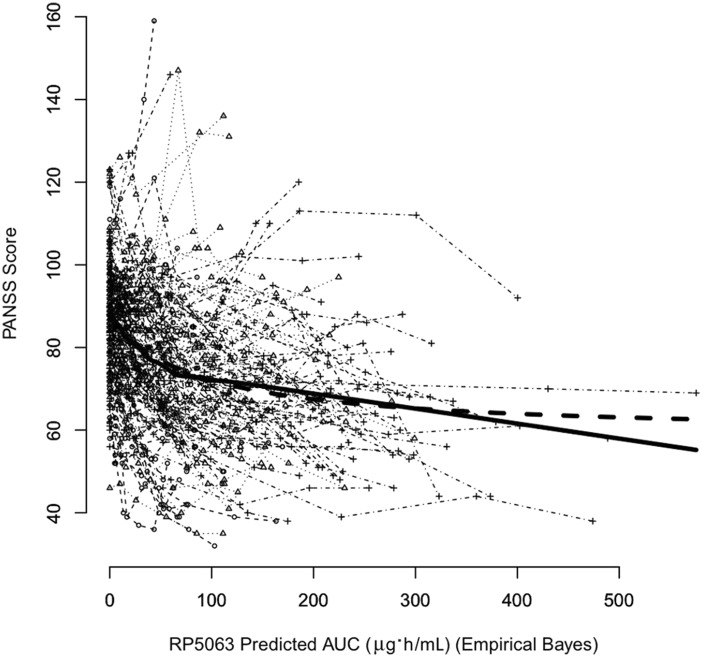
The pharmacokinetic analysis identified a one-compartment model incorporating body mass index influence on volume as the optimum construct, with fixed-effect parameters: (1) oral clearance (Cl/F), 5.11 ± 0.11 L/h; (2) volume of distribution (V/F), 328.00 ± 31.40 L; (3) absorption constant (ka) 0.42 ± 0.17 h; (4) lag time (t lag) of 0.41 ± 0.02 h; and (5) a calculated half-life of 44.5 h. Pharmacokinetics were linear related to dose. An E model for total Positive and Negative Syndrome Scale (PANSS) scores as the response factor against cumulative area under the curve (AUC) provided fixed-effect estimates: (1) E = 87.3 ± 0.71 (PANSS Units; pu); (2) E = - 31.60 ± 4.05 (pu); and (3) AUC = 89.60 ± 30.10 (µg·h/mL). The predicted PANSS improvement reflected a clinical dose range of 5-30 mg.
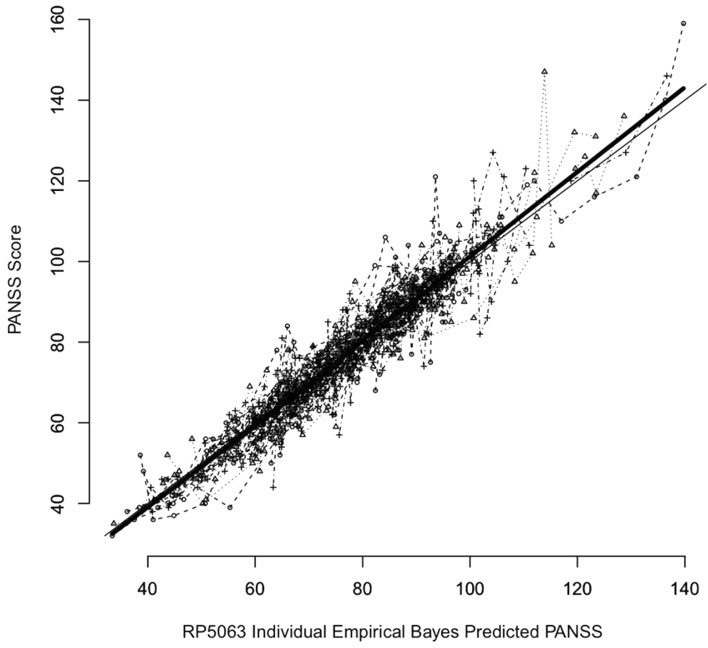
Pharmacokinetics of RP5063 behaved predictably and consistently. Pharmacodynamics were characterized using an E model, reflecting total PANSS score as a function of cumulative AUC, that showed high predictability and low variability when correlated with actual observations.
RP5063是一种新型多模式多巴胺(D)-血清素(5-HT)稳定剂,对D和5-HT具有部分激动剂活性,对5-HT具有拮抗剂活性,对血清素转运体具有中等亲和力。对涉及精神分裂症和分裂情感性障碍患者的RP5063进行的2期试验数据分析确定了:(1)药代动力学特征;(2)药代动力学/药效学关系。
分析药代动力学样本数据(175例服用RP5063的患者;每位患者28剂),采用一室和二室模型,并评估协变量的影响。药效学分析涉及建立E模型。
药代动力学分析确定以体重指数对体积的影响纳入一室模型为最佳构建,固定效应参数为:(1)口服清除率(Cl/F),5.11±0.11L/h;(2)分布容积(V/F),328.00±31.40L;(3)吸收常数(ka)0.42±0.17h;(4)滞后时间(t lag)0.41±0.02h;(5)计算得出的半衰期为44.5小时。药代动力学与剂量呈线性相关。以总阳性和阴性症状量表(PANSS)评分作为反应因子、以曲线下面积(AUC)累计值为自变量的E模型提供了固定效应估计值:(1)E = 87.3±0.71(PANSS单位;pu);(2)E = -31.60±4.05(pu);(3)AUC = 89.60±30.10(µg·h/mL)。预测的PANSS改善反映了5-30mg的临床剂量范围。
RP5063的药代动力学表现出可预测性和一致性。药效学通过E模型进行表征,该模型将总PANSS评分反映为累积AUC的函数,与实际观察结果相关时显示出高预测性和低变异性。