Platon Birgitta, Mannheimer Clas, Andréll Paulin
Department of Anaesthesiology and Intensive Care Medicine, Sahlgrenska University Hospital, Gothenburg, Sweden.
Multidisciplinary Pain Center Kungälv Hospital Kungälv and Institute of Medicine, Sahlgrenska Academy at the University of Gothenburg, Sahlgrenska University Hospital, Gothenburg, Sweden.
Korean J Anesthesiol. 2018 Apr;71(2):149-156. doi: 10.4097/kjae.2018.71.2.149. Epub 2018 Apr 2.
The aim of the study was to compare the pain relieving effect and the time spent in the recovery unit after treatment with high frequency, high-intensity transcutaneous electrical nerve stimulation (TENS) or intravenous (IV) opioids after gynecologic laparoscopic surgery.
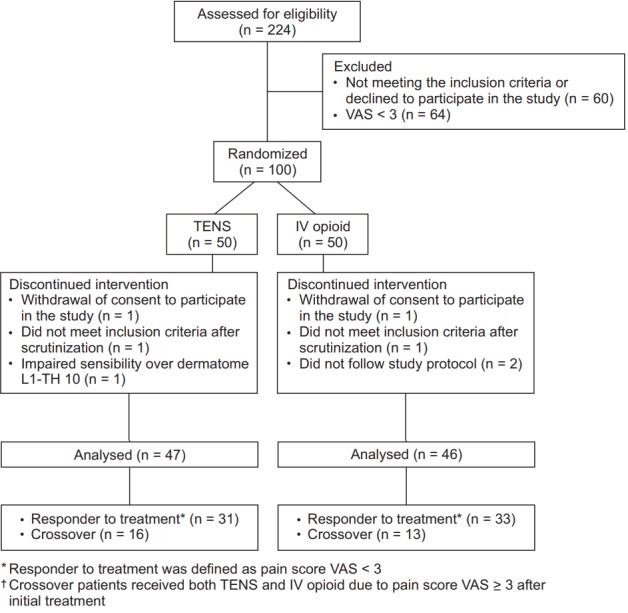
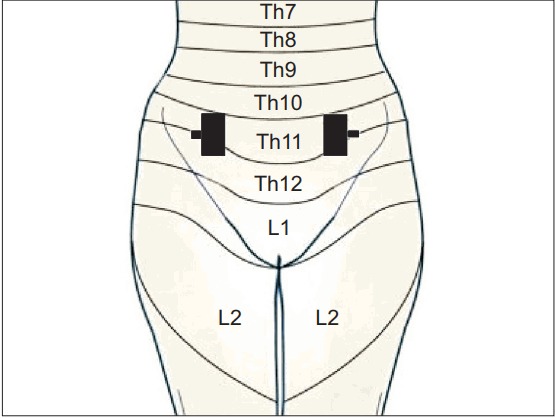
All patients who postoperatively reported visual analogue scale (VAS) pain score ≥ 3 were consecutively included in the study. The TENS treatment was given with a stimulus intensity between 40-60 mA during 1 minute, repeated once if insufficient pain relief. In the opioid group, a maximum dose of 10 mg morphine was given IV. If the patient reported insufficient pain relief (VAS ≥ 3) on the assigned treatment, the patient crossed over to the other treatment group.
Ninety-three women were randomized to TENS (n = 47) or IV opioids (n = 46). Both groups reported significant pain relief at leave from the recovery unit (TENS group: VAS 5.4 to 1.0, P < 0.001; IV opioid group: VAS 5.2 to 1.1, P < 0.001) with no differences between the groups. When only responders, i.e. patients with VAS < 3 after assigned treatment, were compared the TENS responders spent significantly shorter time in the recovery unit (90 vs. 122 minutes, P = 0.008) compared to the responders in the opioid group.
TENS and IV opioids are both effective treatments for pain relief after gynecologic laparoscopic surgery. TENS seems to be preferable for first choice of treatment as the treatment is associated with shorter time spent in recovery unit if the patient responds to the treatment.
本研究旨在比较高频、高强度经皮电刺激神经疗法(TENS)或静脉注射(IV)阿片类药物治疗妇科腹腔镜手术后的止痛效果及在恢复室的停留时间。
所有术后视觉模拟评分(VAS)疼痛评分≥3的患者均连续纳入本研究。TENS治疗时刺激强度为40 - 60 mA,持续1分钟,若止痛效果不佳则重复一次。在阿片类药物组,静脉注射最大剂量为10 mg吗啡。若患者在指定治疗后报告止痛效果不佳(VAS≥3),则转至另一治疗组。
93名女性被随机分为TENS组(n = 47)或静脉注射阿片类药物组(n = 46)。两组在离开恢复室时均报告疼痛明显缓解(TENS组:VAS从5.4降至1.0,P < 0.001;静脉注射阿片类药物组:VAS从5.2降至1.1,P < 0.001),两组之间无差异。当仅比较治疗有效者,即指定治疗后VAS < 3的患者时,与阿片类药物组的有效者相比,TENS组的有效者在恢复室的停留时间明显更短(90分钟对122分钟,P = 0.008)。
TENS和静脉注射阿片类药物均是妇科腹腔镜手术后有效的止痛治疗方法。如果患者对治疗有反应,TENS似乎更适合作为首选治疗方法,因为该治疗与在恢复室的停留时间较短有关。