a Department of Nephrology , The 97th Hospital of PLA Affiliated with Bengbu Medical College , Xuzhou , China.
b Department of Nephrology , Huaihai Hospital Affiliated with Xuzhou Medical University , Xuzhou , China.
Ren Fail. 2018 Nov;40(1):273-279. doi: 10.1080/0886022X.2018.1456460.
TLR4 signaling is known to be involved in podocyte injury. We have previously shown that Salvia przewalskii extract of total phenolic acids (SPE) and its active monomer salvianolic acid B (SalB) and rosmarinic acid (RA) protect podocytes from injury induced by PAN. In the present study, we test whether SPE inhibits TLR4 signaling.
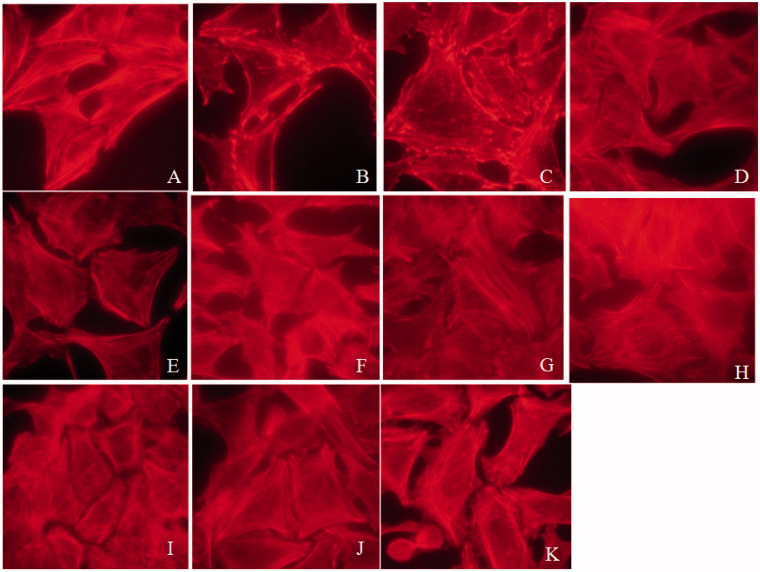
The conditionally immortalized mouse podocytes were treated with SPE, SalB, RA, SalB + RA or tacrolimus for 30 min, followed by PAN (100 μg/mL) for 24 h. The F-actin staining with phalloidin was used to assess cytoskeletal injury in the podocytes. Western blotting and semi-quantitatives RT-PCR were used to assess the changes of the components in the TLR4 signaling pathway.
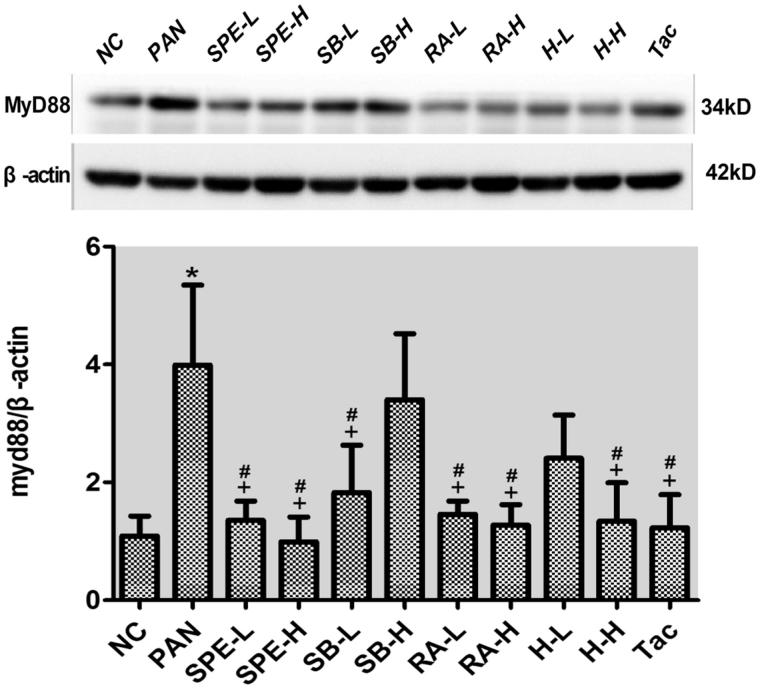
(1) The F-actin stress fibers of podocytes were almost completely disrupted after PAN treatment for 24 h, and the disruption was significantly alleviated by SPE; (2) the PAN-induced elevation of mRNA levels of TLR4, MyD88 and p65 were inhibited except p65 with high-dose SalB; (3) consistently, the protein levels of TLR4, MyD88 and pp65 were significantly elevated by PAN, and SPE, SalB, RA and admixture, respectively, attenuated the elevations of TLR4 and pp65 proteins; (4) SPE and tacrolimus have a similarly strong effect on inhibition of the expression of TLR4 signaling components.
SPE protects podocytes from PAN-induced injury at least partly through inhibiting TLR4 signaling. SPE is as strong as tacrolimus in inhibiting TLR4 signaling in podocytes.
已知 TLR4 信号通路参与足细胞损伤。我们之前的研究表明,总酚酸提取物(SPE)及其活性单体丹参酸 B(SalB)和迷迭香酸(RA)可保护足细胞免受 PAN 诱导的损伤。在本研究中,我们测试 SPE 是否抑制 TLR4 信号通路。
用 SPE、SalB、RA、SalB+RA 或他克莫司处理条件永生化小鼠足细胞 30min,然后用 PAN(100μg/ml)处理 24h。用鬼笔环肽染色检测足细胞骨架损伤。Western blot 和半定量 RT-PCR 用于评估 TLR4 信号通路成分的变化。
(1)PAN 处理 24h 后,足细胞的 F-肌动蛋白应力纤维几乎完全破坏,SPE 明显缓解了这种破坏;(2)除高剂量 SalB 外,PAN 诱导的 TLR4、MyD88 和 p65mRNA 水平升高被抑制;(3)同样,PAN 显著上调 TLR4、MyD88 和 pp65 蛋白水平,而 SPE、SalB、RA 和混合物分别减弱 TLR4 和 pp65 蛋白的升高;(4)SPE 和他克莫司对抑制 TLR4 信号通路成分的表达具有相似的强作用。
SPE 通过抑制 TLR4 信号通路保护足细胞免受 PAN 诱导的损伤。SPE 抑制足细胞 TLR4 信号通路的作用与他克莫司相当。