Jäger Franziska, Kneuper Holger, Palmer Tracy
Division of Molecular Microbiology, School of Life Sciences, University of Dundee, Dundee, UK.
Microbiology (Reading). 2018 May;164(5):816-820. doi: 10.1099/mic.0.000650. Epub 2018 Apr 5.
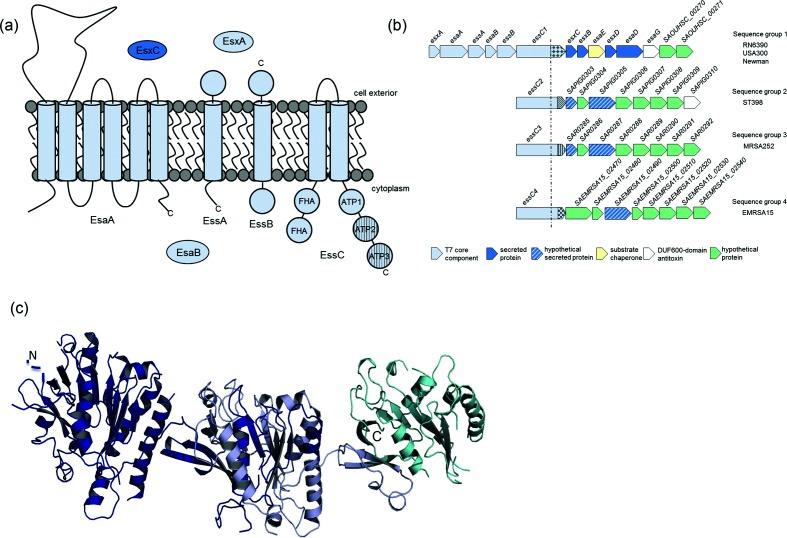
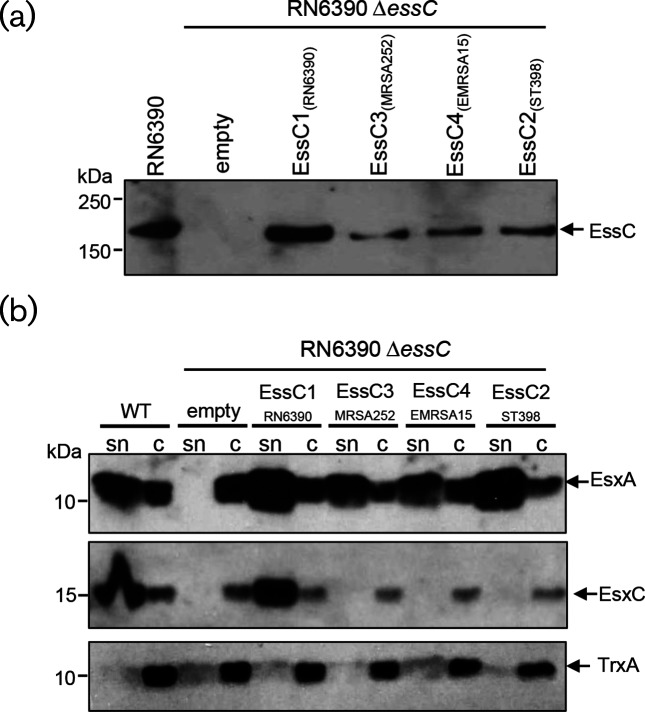
The type VII protein secretion system (T7SS) is found in actinobacteria and firmicutes, and plays important roles in virulence and interbacterial competition. A membrane-bound ATPase protein, EssC in Staphylococcus aureus, lies at the heart of the secretion machinery. The EssC protein from S. aureus strains can be grouped into four variants (EssC1-EssC4) that display sequence variability in the C-terminal region. Here we show that the EssC2, EssC3 and EssC4 variants can be produced in a strain deleted for essC1, and that they are able to mediate secretion of EsxA, an essential component of the secretion apparatus. They are, however, unable to support secretion of the substrate protein EsxC, which is only encoded in essC1-specific strains. This finding indicates that EssC is a specificity determinant for T7 protein secretion. Our results support a model in which the C-terminal domain of EssC interacts with substrate proteins, whereas EsxA interacts elsewhere.
VII型蛋白质分泌系统(T7SS)存在于放线菌和厚壁菌中,在毒力和细菌间竞争中发挥重要作用。金黄色葡萄球菌中的一种膜结合ATP酶蛋白EssC是分泌机制的核心。来自金黄色葡萄球菌菌株的EssC蛋白可分为四个变体(EssC1-EssC4),它们在C端区域表现出序列变异性。在这里,我们表明EssC2、EssC3和EssC4变体可以在缺失essC1的菌株中产生,并且它们能够介导分泌装置的重要组成部分EsxA。然而,它们无法支持底物蛋白EsxC的分泌,EsxC仅在essC1特异性菌株中编码。这一发现表明EssC是T7蛋白分泌的特异性决定因素。我们的结果支持一种模型,其中EssC的C端结构域与底物蛋白相互作用,而EsxA在其他地方相互作用。