Department of Pathology and Molecular Medicine, McMaster University, 1280 Main Street West, Hamilton, ON, L8S 4K1, Canada.
Centre for Innovation, Canadian Blood Services, Hamilton, ON, Canada.
BMC Biotechnol. 2018 Apr 5;18(1):21. doi: 10.1186/s12896-018-0431-4.
Hirudin is a potent thrombin inhibitor but its antithrombotic properties are offset by bleeding side-effects. Because hirudin's N-terminus must engage thrombin's active site for effective inhibition, fusing a cleavable peptide at this site may improve hirudin's risk/benefit ratio as a therapeutic agent. Previously we engineered a plasmin cleavage site (C) between human serum albumin (HSA) and hirudin variant 3 (HV3) in fusion protein HSACHV3. Because coagulation factor XI (FXI) is more involved in thrombosis than hemostasis, we hypothesized that making HV3 activity FXIa-dependent would also improve HV3's potential therapeutic profile. We combined albumin fusion for half-life extension of hirudin with positioning of an FXIa cleavage site N-terminal to HV3, and assessed in vitro and in vivo properties of this novel protein.
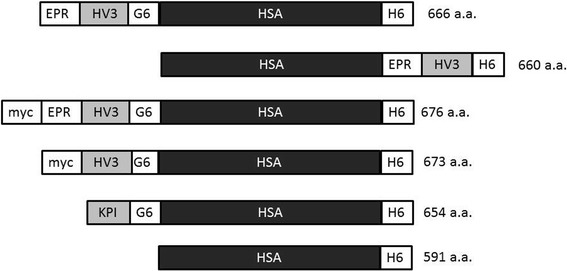
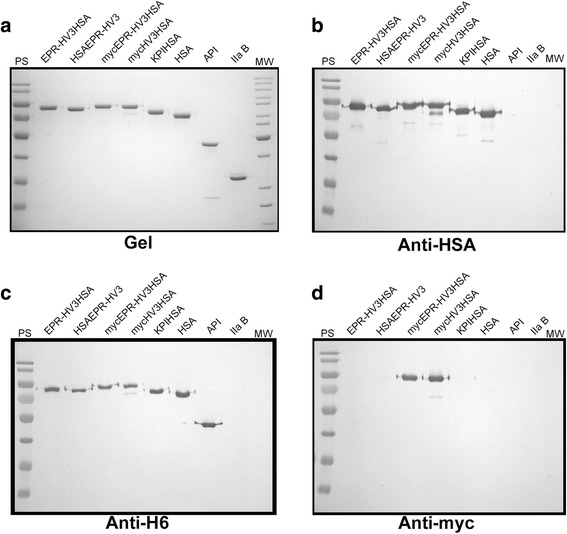
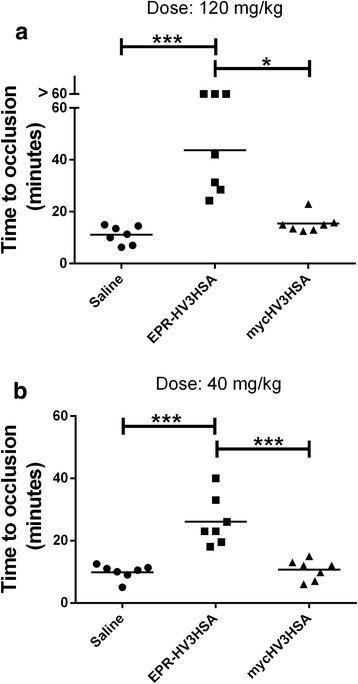
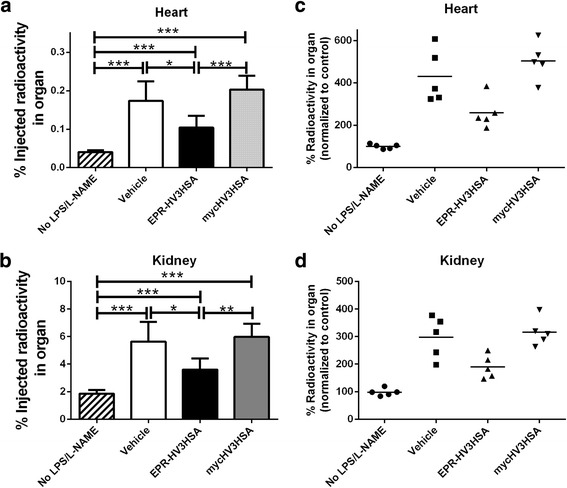
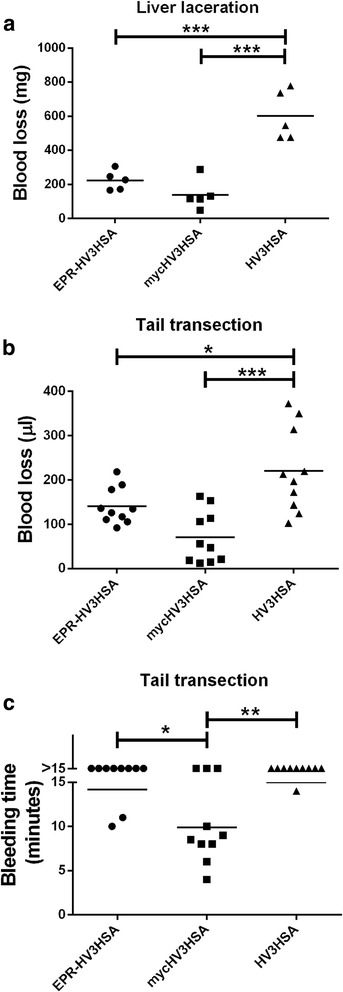
FXIa cleavage site EPR was employed. Fusion protein EPR-HV3HSA but not HSAEPR-HV3 was activated by FXIa in vitro. FVIIa, FXa, FXIIa, or plasmin failed to activate EPR-HV3HSA. FXIa-cleavable EPR-HV3HSA reduced the time to occlusion of ferric chloride-treated murine arteries and reduced fibrin deposition in murine endotoxemia; noncleavable mycHV3HSA was without effect. EPR-HV3HSA elicited less blood loss than constitutively active HV3HSA in murine liver laceration or tail transection but extended bleeding time to the same extent. EPR-HV3HSA was partially activated in citrated human or murine plasma to a greater extent than HSACHV3.
Releasing the N-terminal block to HV3 activity using FXIa was an effective way to limit hirudin's bleeding side-effects, but plasma instability of the exposed EPR blocking peptide rendered it less useful than previously described plasmin-activatable HSACHV3.
水蛭素是一种强效的凝血酶抑制剂,但它的抗血栓形成特性会被出血副作用所抵消。由于水蛭素的 N 端必须与凝血酶的活性位点结合才能有效抑制,因此在该位点融合一个可切割的肽可能会改善水蛭素作为治疗剂的风险/效益比。我们之前在融合蛋白 HSACHV3 中水蛭素变体 3 (HV3) 的 N 端设计了一个纤溶酶裂解位点 (C)。由于凝血因子 XI (FXI) 比止血更参与血栓形成,我们假设使 HV3 活性依赖 FXIa 也会改善 HV3 的潜在治疗谱。我们将半衰期延长的白蛋白融合与 HV3 上 N 端 FXIa 切割位点的定位相结合,评估了这种新型蛋白的体外和体内特性。
使用 FXIa 切割位点 EPR。融合蛋白 EPR-HV3HSA 而不是 HSAEPR-HV3 在体外被 FXIa 激活。FVIIa、FXa、FXIIa 或纤溶酶均不能激活 EPR-HV3HSA。FXIa 可切割的 EPR-HV3HSA 缩短了氯化铁处理的小鼠动脉闭塞时间,并减少了小鼠内毒素血症中的纤维蛋白沉积;不可切割的 mycHV3HSA 则没有效果。EPR-HV3HSA 在小鼠肝裂伤或尾切断中引起的出血量比组成型激活的 HV3HSA 少,但出血时间延长程度相同。与 HSACHV3 相比,EPR-HV3HSA 在人或鼠血浆中被部分激活到更大程度。
使用 FXIa 释放 HV3 活性的 N 端阻断是限制水蛭素出血副作用的有效方法,但暴露的 EPR 阻断肽的血浆不稳定性使其不如以前描述的纤溶酶可激活的 HSACHV3 有用。