School of Life Sciences, BK21 Plus KNU Creative BioResearch Group, College of Natural Sciences, Kyungpook National University, Daegu, 41566, Republic of Korea.
School of Life Sciences, College of Natural Sciences, Kyungpook National University, Daegu, 41566, Republic of Korea.
Exp Mol Med. 2018 Apr 6;50(4):1-10. doi: 10.1038/s12276-017-0015-8.
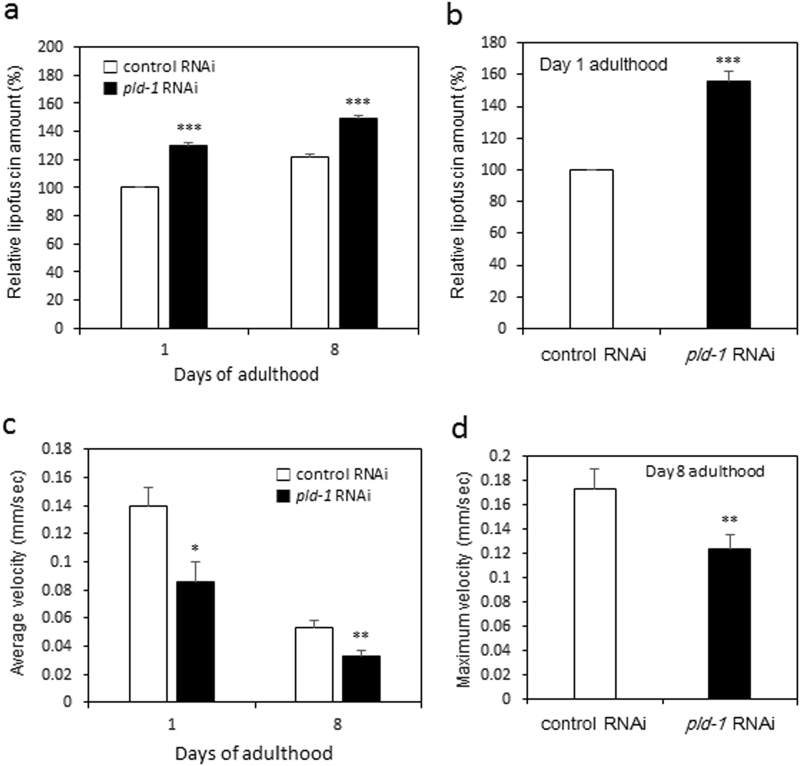
We have previously shown that phospholipase D (PLD) downregulation accelerates cellular senescence, which is widely believed to play an important role in aging, by stimulating reactive oxygen species (ROS) accumulation in human cells. In this study, we examined the role of PLD in aging using the nematode Caenorhabditis elegans. The mRNA level of pld-1 was found to be inversely correlated with aging. RNAi-mediated knockdown of pld-1 expression in nematodes enhanced ROS and lipofuscin accumulation and decreased lifespan, motility, and resistance to stress compared to that in nematodes treated with control RNAi. Pld-1 knockdown repressed the long lifespan of age-1 and akt-1 mutants but did not further reduce the short lifespan of daf-16 mutants, suggesting that PLD functions between AKT-1 and DAF-16. The ROS scavenger N-acetyl-L-cysteine, a PLD effector phosphatidic acid and a possible CK2 activator spermidine attenuated the lifespan shortening and age-related biomarkers triggered by pld-1 knockdown. Pld-1 RNAi downregulated the expression of DAF-16 target genes such as sod-3, dod-11, and mtl-1 in nematodes. In human cells, furthermore, PLD2 downregulation decreased the transcription of FoxO3a target genes (Cu/ZnSOD, MnSOD, catalase, thioredoxin-2, and peroxiredoxin-5), whereas ectopic PLD2 expression elevated the mRNA levels of these antioxidant genes. Taken together, these results indicated that PLD downregulation shortens longevity and induces age-related biomarkers through ROS accumulation by inhibiting the DAF-16/FoxO3a pathway in nematodes.
我们之前已经表明,通过刺激人细胞中活性氧(ROS)的积累,磷脂酶 D(PLD)下调加速了细胞衰老,而细胞衰老是广泛认为在衰老中起着重要作用的。在这项研究中,我们使用秀丽隐杆线虫检查了 PLD 在衰老中的作用。发现 pld-1 的 mRNA 水平与衰老呈负相关。与用对照 RNAi 处理的线虫相比,线虫中 pld-1 表达的 RNAi 介导的敲低增强了 ROS 和脂褐素的积累,降低了寿命、运动能力和对压力的抵抗力。Pld-1 敲低抑制了 age-1 和 akt-1 突变体的长寿命,但没有进一步降低 daf-16 突变体的短寿命,表明 PLD 在线粒体 AKT-1 和 DAF-16 之间起作用。ROS 清除剂 N-乙酰-L-半胱氨酸、PLD 效应物磷脂酸和可能的 CK2 激活剂亚精胺减弱了 pld-1 敲低引发的寿命缩短和与年龄相关的生物标志物。Pld-1 RNAi 下调了线虫中 DAF-16 靶基因 sod-3、dod-11 和 mtl-1 的表达。此外,在人类细胞中,PLD2 下调降低了 FoxO3a 靶基因(Cu/ZnSOD、MnSOD、过氧化氢酶、硫氧还蛋白-2 和过氧化物酶-5)的转录,而外源性 PLD2 表达则升高了这些抗氧化基因的 mRNA 水平。综上所述,这些结果表明,PLD 下调通过抑制线虫中的 DAF-16/FoxO3a 途径来加速长寿并诱导与年龄相关的生物标志物,这是通过 ROS 积累实现的。