Department of Psychiatry, University of California, San Diego School of Medicine, La Jolla, California.
Alcohol Clin Exp Res. 2018 May;42(5):822-835. doi: 10.1111/acer.13628. Epub 2018 Apr 5.
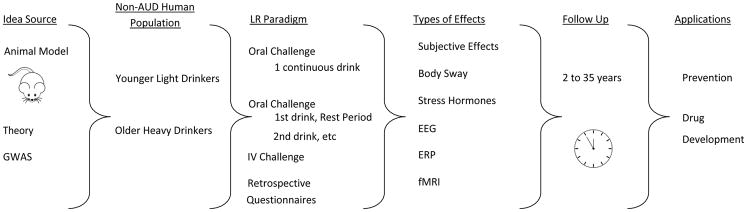
Attributes of alcohol sensitivity are present before alcohol use disorders (AUDs) develop, they predict those adverse alcohol outcomes, are familial in nature, and many are heritable. Whether measured by alcohol challenges or retrospective reports of numbers of drinks required for effects, alcohol sensitivity reflects multiple phenotypes, including low levels of alcohol response and alcohol-related stimulation. Identification of genes that contribute to alcohol sensitivity could help identify individuals carrying risks for AUDs through their alcohol responses for whom early intervention might mitigate their vulnerability. Such genes could also improve understanding of biological underpinnings of AUDs, which could lead to new treatment approaches. However, the existing literature points to a wide range of genetic mechanisms that might contribute to alcohol responses, and few such genetic findings have been widely replicated. This critical review describes the potential impact of the diverse methods used to study sensitivity on the diversity of genetic findings that have been reported, places the genetic variants mentioned in the literature into broader categories rather than isolated results, and offers suggestions regarding how to advance the field by interpreting findings in light of the methods used to select research subjects and to measure alcohol sensitivity. To date, the most promising results have been for GABA, glutamate, opioid, dopamine, serotonin, and cholinergic system genes. The more gene variants that can be identified as contributors to sensitivity the better future gene screening platforms or polygenic scores are likely to be.
酒精敏感性的特征在酒精使用障碍 (AUD) 出现之前就已经存在,它们可以预测这些不良的酒精后果,具有家族性,并且很多是可以遗传的。无论是通过酒精挑战还是对产生影响所需的饮酒量的回顾性报告来衡量,酒精敏感性都反映了多种表型,包括酒精反应水平低和与酒精相关的刺激。确定导致酒精敏感性的基因可以帮助识别通过酒精反应携带 AUD 风险的个体,早期干预可能减轻他们的脆弱性。这些基因还可以提高对 AUD 生物学基础的理解,从而可能带来新的治疗方法。然而,现有文献表明,有广泛的遗传机制可能会影响酒精反应,而且很少有此类遗传发现得到广泛复制。这篇批判性评论描述了研究敏感性所使用的不同方法对已报道的遗传发现多样性的潜在影响,将文献中提到的遗传变异归入更广泛的类别,而不是孤立的结果,并就如何通过根据选择研究对象和测量酒精敏感性的方法来解释研究结果来推进该领域提出了建议。迄今为止,最有希望的结果是针对 GABA、谷氨酸、阿片、多巴胺、血清素和胆碱能系统基因。可以确定的导致敏感性的基因变异越多,未来的基因筛选平台或多基因评分就越好。