GlaxoSmithKline, Stevenage, Hertfordshire, UK.
GlaxoSmithKline, Brentford, Middlesex, UK.
Orphanet J Rare Dis. 2018 Apr 6;13(1):49. doi: 10.1186/s13023-018-0791-9.
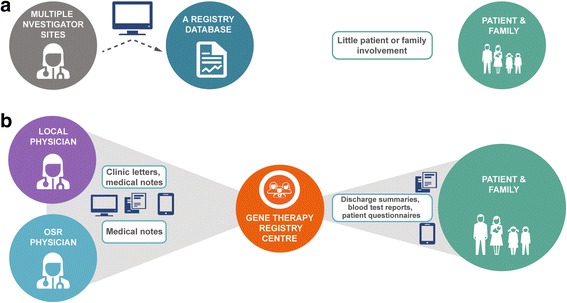
Strimvelis (autologous CD34+ cells transduced to express adenosine deaminase [ADA]) is the first ex vivo stem cell gene therapy approved by the European Medicines Agency (EMA), indicated as a single treatment for patients with ADA-severe combined immunodeficiency (ADA-SCID) who lack a suitable matched related bone marrow donor. Existing primary immunodeficiency registries are tailored to transplantation outcomes and do not capture the breadth of safety and efficacy endpoints required by the EMA for the long-term monitoring of gene therapies. Furthermore, for extended monitoring of Strimvelis, the young age of children treated, small patient numbers, and broad geographic distribution of patients all increase the risk of loss to follow-up before sufficient data have been collected. Establishing individual investigator sites would be impractical and uneconomical owing to the small number of patients from each location receiving Strimvelis.
An observational registry has been established to monitor the safety and effectiveness of Strimvelis in up to 50 patients over a minimum of 15 years. To address the potential challenges highlighted above, data will be collected by a single investigator site at Ospedale San Raffaele (OSR), Milan, Italy, and entered into the registry via a central electronic platform. Patients/families and the patient's local physician will also be able to submit healthcare information directly to the registry using a uniquely designed electronic platform. Data entry will be monitored by a Gene Therapy Registry Centre (funded by GlaxoSmithKline) who will ensure that necessary information is collected and flows between OSR, the patient/family and the patient's local healthcare provider.
The Strimvelis registry sets a precedent for the safety monitoring of future gene therapies. A unique, patient-focused design has been implemented to address the challenges of long-term follow-up of patients treated with gene therapy for a rare disease. Strategies to ensure data completeness and patient retention in the registry will help fulfil pharmacovigilance requirements. Collaboration with partners is being sought to expand from a treatment registry into a disease registry. Using practical and cost-efficient approaches, the Strimvelis registry is hoped to encourage further innovation in registry design within orphan drug development.
Strimvelis(经基因修饰表达腺苷脱氨酶的自体 CD34+细胞)是首个获得欧洲药品管理局(EMA)批准的体外干细胞基因治疗药物,适用于缺乏合适配型相关供体骨髓的 ADA-严重联合免疫缺陷(ADA-SCID)患者的单药治疗。现有的原发性免疫缺陷登记处是为移植结果量身定制的,无法捕获 EMA 长期监测基因治疗所需的广泛安全性和疗效终点。此外,对于 Strimvelis 的扩展监测,由于接受治疗的儿童年龄较小、患者数量较少且患者分布广泛,在收集到足够的数据之前,患者失访的风险增加。由于从每个地点接受 Strimvelis 的患者数量较少,因此建立单独的研究者站点在实践上和经济上都是不切实际的。
已经建立了一个观察性登记处,以监测 Strimvelis 在多达 50 名患者中的安全性和有效性,至少持续 15 年。为了解决上述潜在挑战,将由意大利米兰 Ospedale San Raffaele(OSR)的单一研究者站点收集数据,并通过中央电子平台输入登记处。患者/家属和患者的当地医生也可以使用专门设计的电子平台直接向登记处提交医疗保健信息。基因治疗登记处中心(由葛兰素史克资助)将监测数据录入情况,确保收集到必要的信息并在 OSR、患者/家属和患者的当地医疗保健提供者之间流动。
Strimvelis 登记处为未来基因治疗的安全性监测树立了典范。为了应对长期随访接受基因治疗的罕见病患者的挑战,实施了独特的、以患者为中心的设计。为了确保登记处数据的完整性和患者的保留率,已经制定了相关策略来满足药物警戒要求。正在寻求与合作伙伴合作,将登记处从治疗登记处扩展为疾病登记处。Strimvelis 登记处希望通过采用实用且具有成本效益的方法,鼓励在孤儿药开发中进一步创新登记处设计。