Fortius Clinic, 17 Fitzhardinge St, London, W1H 6EQ, UK.
The Biomechanics Group, Department of Mechanical Engineering, Imperial College London, London, UK.
Knee Surg Sports Traumatol Arthrosc. 2020 Jan;28(1):320-325. doi: 10.1007/s00167-018-4936-0. Epub 2018 Apr 7.
To assess whether early rehabilitation could be safe after flexor digitorum longus (FDL) tendon transfer, the current biomechanical study aimed to measure tendon displacement under cyclic loading and load to failure, comparing a traditional tendon-to-tendon (TT) repair with interference screw fixation (ISF).
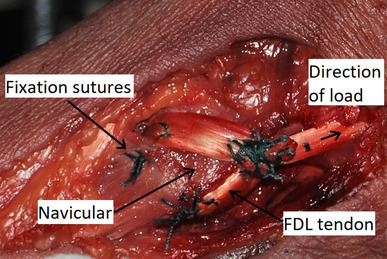
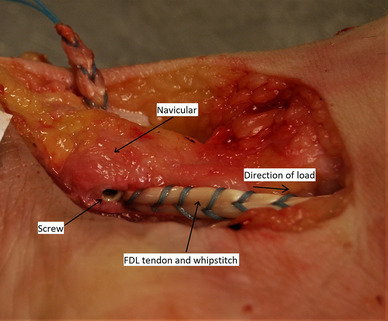
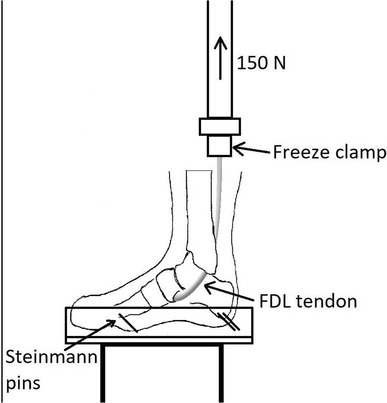
24 fresh-frozen cadaveric below knee specimens underwent FDL tendon transfer. In 12 specimens a TT repair was performed via a navicular bone tunnel. In a further 12 specimens ISF was performed. Using a materials testing machine, the FDL tendon was cycled 1000 times to 150 N and tendon displacement at the insertion site measured. A final load to failure test was then performed. Statistical analysis was performed using two-way ANOVA and an independent t test, with a significance level of p < 0.05.
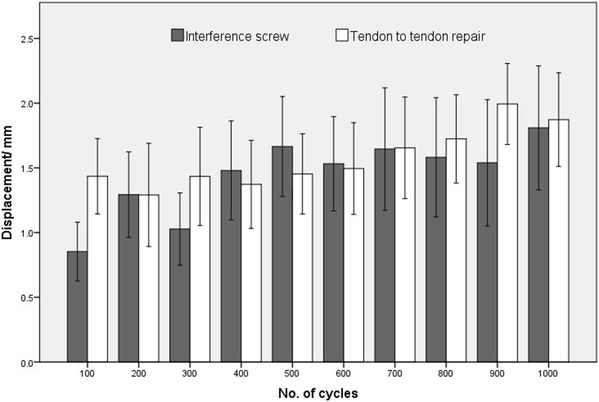
No significant difference in tendon displacement occurred after cyclic loading, with mean tendon displacements of 1.9 ± 1.2 mm (mean ± SD) in the TT group and 1.8 ± 1.5 mm in the ISF group (n.s.). Two early failures occurred in the ISF group, none in the TT group. Mean load to failure was significantly greater following TT repair (459 ± 96 N), compared with ISF (327 ± 76 N), p = 0.002.
Minimal tendon displacement of less than 2 mm occurred during cyclic testing in both groups. The two premature failures and significantly reduced load to failure observed in the ISF group, however, indicate that the traditional TT technique is more robust. Regarding clinical relevance, this study suggests that early active range of motion and protected weight bearing may be safe following FDL tendon transfer for stage 2 tibialis posterior tendon dysfunction.
为了评估在屈趾长肌腱(FDL)肌腱转移后早期康复是否安全,本生物力学研究旨在测量循环加载和失效载荷下的肌腱移位,比较传统的肌腱到肌腱(TT)修复与干扰螺钉固定(ISF)。
24 个新鲜冷冻的膝下标本进行 FDL 肌腱转移。在 12 个标本中,通过舟骨隧道进行 TT 修复。在另外 12 个标本中进行 ISF。使用材料试验机,将 FDL 肌腱循环加载 1000 次至 150N,并测量插入部位的肌腱移位。然后进行最终的失效载荷试验。使用双向方差分析和独立 t 检验进行统计学分析,显著性水平为 p<0.05。
在循环加载后,肌腱位移没有明显差异,TT 组的平均肌腱位移为 1.9±1.2mm,ISF 组为 1.8±1.5mm(无统计学意义)。ISF 组有 2 个早期失效,TT 组无失效。TT 修复的失效载荷平均值明显大于 ISF(459±96N 比 327±76N,p=0.002)。
在两组的循环测试中,肌腱位移都小于 2mm。然而,ISF 组的两个早期失效和明显降低的失效载荷表明,传统的 TT 技术更具稳健性。就临床相关性而言,本研究表明,对于 2 期胫骨后肌腱功能障碍的 FDL 肌腱转移后,早期主动活动范围和保护负重可能是安全的。