Hong On-Yu, Youn Hyun Jo, Jang Hye-Yeon, Jung Sung Hoo, Noh Eun-Mi, Chae Hee Suk, Jeong Young-Ju, Kim Won, Kim Cheorl-Ho, Kim Jong-Suk
Department of Biochemistry, Institute for Medical Sciences, Chonbuk National University Medical School, Jeonju, Korea.
Department of Surgery, Research Institute of Clinical Medicine, Chonbuk National University Hospital, Chonbuk National University and Biomedical Research Institute, Jeonju, Korea.
J Breast Cancer. 2018 Mar;21(1):28-36. doi: 10.4048/jbc.2018.21.1.28. Epub 2018 Mar 23.
Peroxisome proliferator-activated receptor γ (PPARγ) is involved in the pathology of numerous diseases including atherosclerosis, diabetes, obesity, and cancer. Matrix metalloproteinases (MMPs) play a significant role in tissue remodeling related to various processes such as morphogenesis, angiogenesis, tissue repair, invasion, and metastasis. We investigated the effects of PPARγ on MMP expression and invasion in breast cancer cells.
MCF-7 cells were cultured and then cell viability was monitored in an MTT assay. Western blotting, gelatin zymography, real-time polymerase chain reaction, and luciferase assays were performed to investigate the effect of the synthetic PPARγ ligand troglitazone on MMP expression. Transcription factor DNA binding was analyzed by electrophoretic mobility shift assay. A Matrigel invasion assay was used to assess the effects of troglitazone on MCF-7 cells.
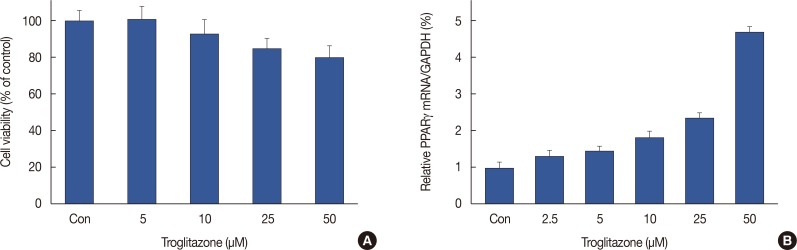
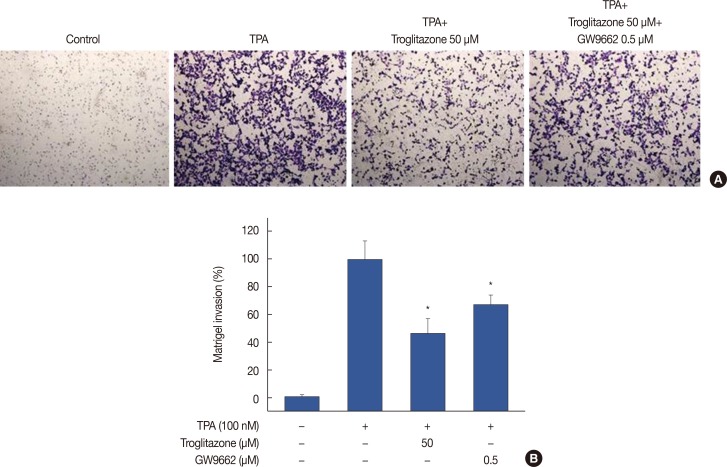
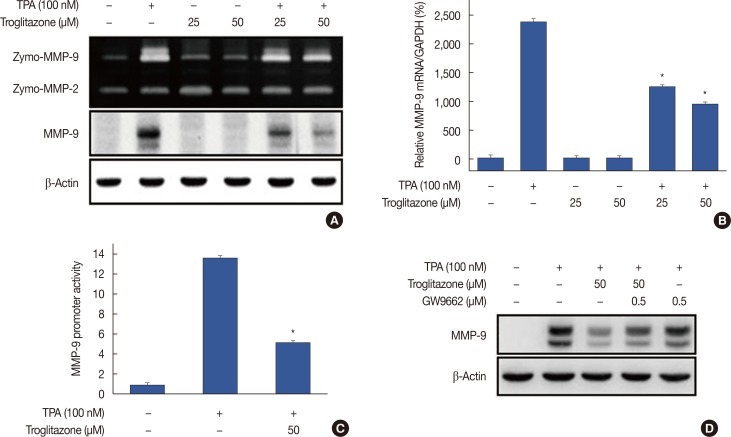
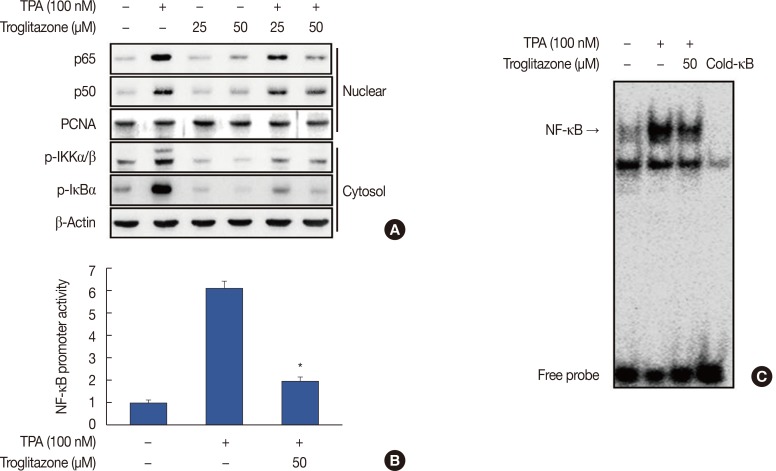
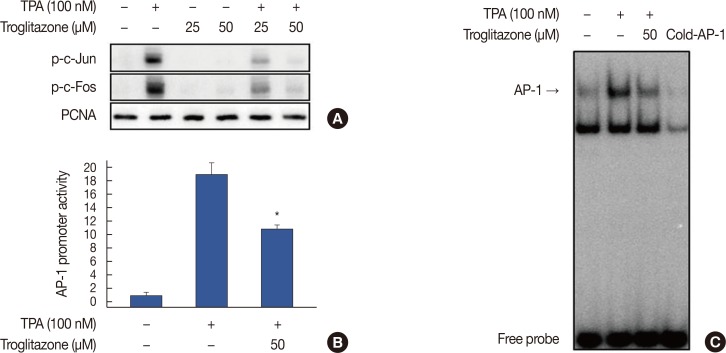
Troglitazone did not affect MCF-7 cell viability. 12--tetradecanoylphorbol-13-acetate (TPA) induced MMP-9 expression and invasion in MCF-7 cell. However, these effects were decreased by troglitazone. TPA increased nuclear factor κB and activator protein-1 DNA binding, while troglitazone inhibited these effects. The selective PPARγ antagonist GW9662 reversed MMP-9 inhibition by troglitazone in TPA-treated MCF-7 cells.
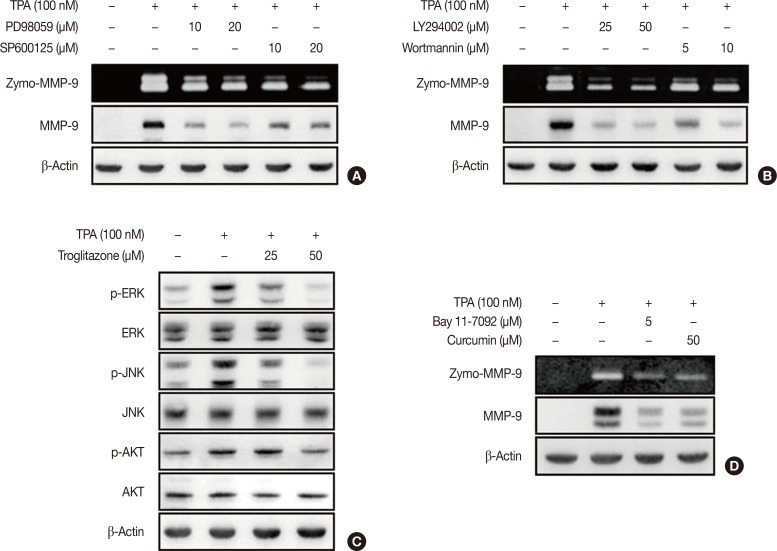
Troglitazone inhibited nuclear factor κB and activator protein-1-mediated MMP-9 expression and invasion of MCF-7 cells through a PPARγ-dependent mechanism.
过氧化物酶体增殖物激活受体γ(PPARγ)参与包括动脉粥样硬化、糖尿病、肥胖症和癌症在内的多种疾病的病理过程。基质金属蛋白酶(MMPs)在与形态发生、血管生成、组织修复、侵袭和转移等各种过程相关的组织重塑中起重要作用。我们研究了PPARγ对乳腺癌细胞中MMP表达和侵袭的影响。
培养MCF-7细胞,然后通过MTT法监测细胞活力。进行蛋白质免疫印迹、明胶酶谱分析、实时聚合酶链反应和荧光素酶测定,以研究合成的PPARγ配体曲格列酮对MMP表达的影响。通过电泳迁移率变动分析来分析转录因子DNA结合情况。使用基质胶侵袭试验评估曲格列酮对MCF-7细胞的影响。
曲格列酮不影响MCF-7细胞活力。12-十四酰佛波醇-13-乙酸酯(TPA)诱导MCF-7细胞中MMP-9的表达和侵袭。然而,曲格列酮可降低这些作用。TPA增加核因子κB和激活蛋白-1的DNA结合,而曲格列酮抑制这些作用。选择性PPARγ拮抗剂GW9662可逆转曲格列酮对TPA处理的MCF-7细胞中MMP-9的抑制作用。
曲格列酮通过PPARγ依赖性机制抑制核因子κB和激活蛋白-1介导的MCF-7细胞中MMP-9的表达和侵袭。