Sulaiman Nabil, Mahmoud Ibrahim, Hussein Amal, Elbadawi Salah, Abusnana Salah, Zimmet Paul, Shaw Jonathan
College of Medicine, University of Sharjah, Sharjah, United Arab Emirates.
Dubai Health Authority, Dubai, United Arab Emirates.
BMJ Open Diabetes Res Care. 2018 Mar 29;6(1):e000489. doi: 10.1136/bmjdrc-2017-000489. eCollection 2018.
The objective of this study was to develop a simple non-invasive risk score, specific to the United Arab Emirates (UAE) citizens, to identify individuals at increased risk of having undiagnosed type 2 diabetes mellitus.
A retrospective analysis of the UAE National Diabetes and Lifestyle data was conducted. The data included demographic and anthropometric measurements, and fasting blood glucose. Univariate analyses were used to identify the risk factors for diabetes. The risk score was developed for UAE citizens using a stepwise forward regression model.
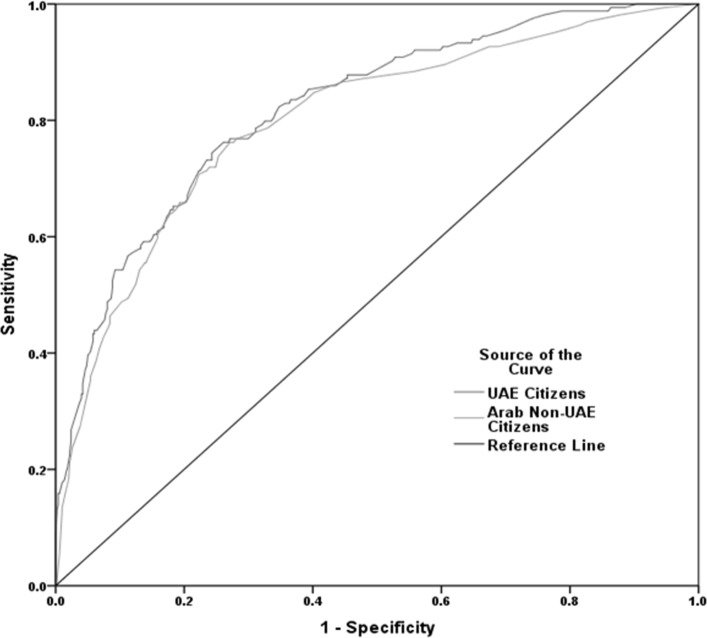
A total of 872 UAE citizens were studied. The overall prevalence of diabetes in the UAE adult citizens in the Northern Emirates was 25.1%. The significant risk factors identified for diabetes were age (≥35 years), a family history of diabetes mellitus, hypertension, body mass index ≥30.0 and waist-to-hip ratio ≥0.90 for males and ≥0.85 for females. The performance of the model was moderate in terms of sensitivity (75.4%, 95% CI 68.3 to 81.7) and specificity (70%, 95% CI 65.8 to 73.9). The area under the receiver-operator characteristic curve was 0.82 (95% CI 0.78 to 0.86).
A simple, non-invasive risk score model was developed to help to identify those at high risk of having diabetes among UAE citizens. This score could contribute to the efficient and less expensive earlier detection of diabetes in this high-risk population.
本研究的目的是开发一种针对阿拉伯联合酋长国(阿联酋)公民的简单非侵入性风险评分,以识别未确诊的2型糖尿病风险增加的个体。
对阿联酋国家糖尿病与生活方式数据进行回顾性分析。数据包括人口统计学和人体测量学指标以及空腹血糖。采用单因素分析来确定糖尿病的风险因素。使用逐步向前回归模型为阿联酋公民制定风险评分。
共研究了872名阿联酋公民。阿联酋北部成年公民中糖尿病的总体患病率为25.1%。确定的糖尿病显著风险因素为年龄(≥35岁)、糖尿病家族史、高血压、体重指数≥30.0以及男性腰臀比≥0.90、女性腰臀比≥0.85。该模型在敏感性(75.4%,95%CI 68.3至81.7)和特异性(70%,95%CI 65.8至73.9)方面表现中等。受试者工作特征曲线下面积为0.82(95%CI 0.78至0.86)。
开发了一种简单的非侵入性风险评分模型,以帮助识别阿联酋公民中患糖尿病的高风险人群。该评分有助于在这一高风险人群中高效且低成本地早期检测糖尿病。